Have you ever watched a puddle disappear on a hot afternoon, or noticed someone suddenly fade out of a group text without a trace? The word evaporation carries a distinct scientific definition, but its presence in our everyday vocabulary has expanded significantly.
People search for this term for two main reasons. Some are looking for a clear, straightforward explanation of physical science for school or work, while others encounter it used figuratively in pop culture, online dating, and digital conversations.
Understanding how a single word moves from chemistry labs into modern group chats removes confusion. It helps you navigate both academic studies and nuanced social interactions with complete confidence.
Evaporation Mean – Quick Meaning
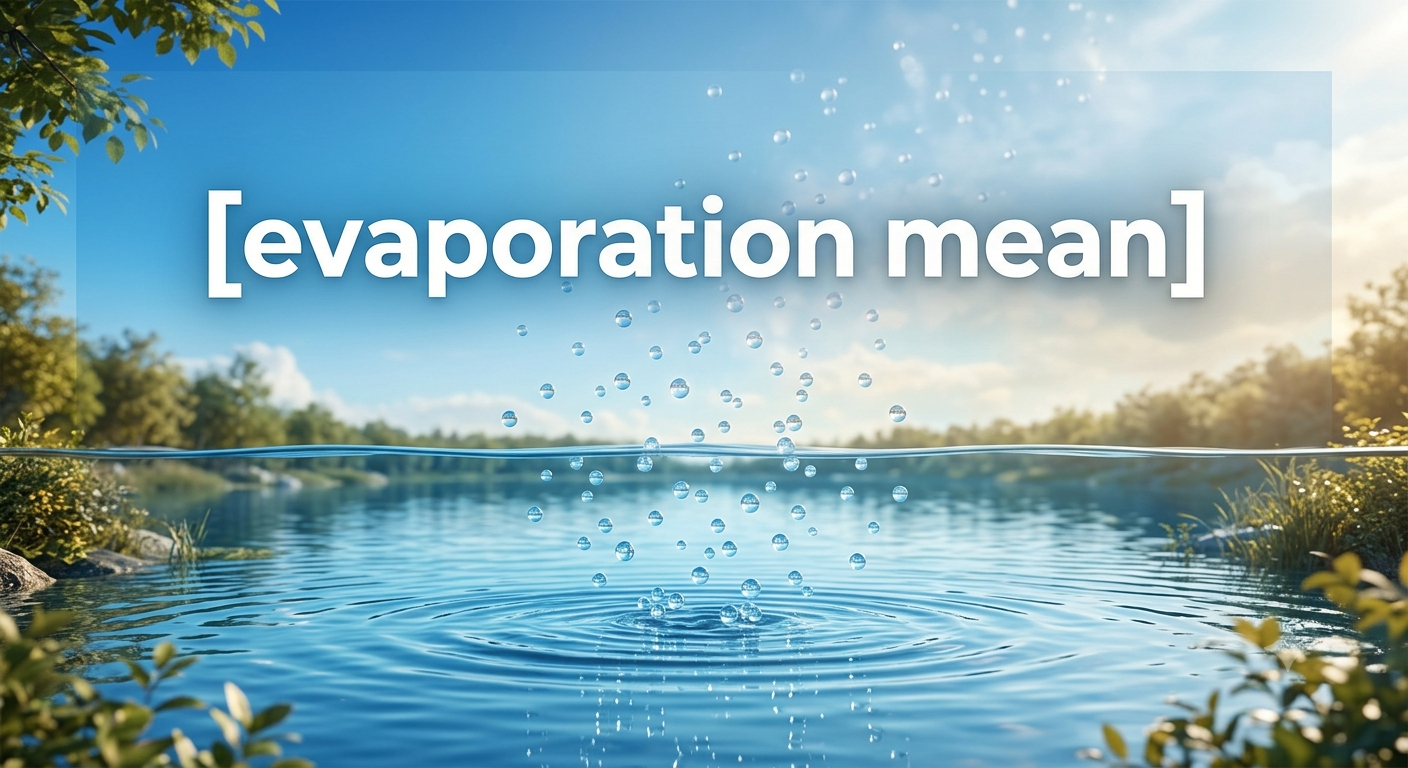
At its fundamental level, evaporation is the process where a liquid changes into a gas or vapor below its boiling point. It occurs constantly around us, driving weather patterns and natural cooling systems.
In figurative speech, it describes something vanishing quickly, quietly, or completely—whether that involves funds, enthusiasm, or a person’s presence in a social setting.
Core Definitions
- Scientific Definition: The phase transition of liquid molecules escaping into a gaseous state from an open surface.
- Metaphorical Meaning: A sudden, silent disappearance or fading away of an abstract concept, feeling, or presence.
- Social Slang Meaning: Quietly leaving a situation, event, or digital thread without making a formal announcement.
“The morning dew underwent rapid evaporation as soon as the sun crested the ridge.”
“After the unexpected project delay, our team’s initial excitement experienced a total evaporation.”
“I looked around the noisy party at midnight and realized my roommate had pulled a total evaporation.”
Origin & Background
Where It Came From
The word traces back to the Latin term evaporare, constructed from e- (meaning “out of”) and vapor (meaning “steam” or “steam thread”). It entered Late Middle English during the 15th century, initially appearing in medical and alchemy texts to describe rising vapors.
Cultural Influence
Over centuries, writers and poets borrowed the term from physical science to describe fleeting human experiences. Romantic literature frequently referenced the “evaporation of hope” or “evaporating youth,” anchoring the word’s figurative potential long before the internet age.
Social Media Impact
Digital communication accelerated this linguistic shift. Modern messaging platforms value brevity and vivid imagery. Describing a sudden departure or loss of interest as “evaporating” offers a distinct, visual alternative to older idioms like “ghosting” or “vanishing into thin air.”
How Meaning Evolved
What started as a strict term for thermodynamics transformed into a versatile metaphor. Today, it spans multiple domains—from environmental science and culinary techniques to social dynamics and financial commentary.
Real-Life Conversations
WhatsApp Group Chat
Person A: Is Marcus still coming to dinner tonight? He promised he’d bring the board games.
Person B: Honestly, his replies just underwent complete evaporation around 5 PM. I wouldn’t count on him.
Instagram DMs
Person A: That new sneaker drop sold out in literally three seconds flat!
Person B: Tell me about it. My paycheck experienced full evaporation the second I hit checkout.
TikTok Comments
Person A: Why did everyone stop doing that viral dance trend from last week?
Person B: Internet trends have a two-day lifespan now. Total evaporation of hype!
Text Message Thread
Person A: How did your awkward meeting with the landlord go?
Person B: The moment I brought up the official lease agreement, all his tough talk seemed to evaporate.
Emotional & Psychological Meaning
Expressing Loss and Transition
Using this term figuratively captures a specific emotional reality: quiet dissipation. Unlike a sudden crash or dramatic break, evaporation implies a gentle, steady disappearance that leaves an empty space behind.
Why People Choose This Word
Language users select this metaphor when they want to convey lightness mixed with finality. It suggests that a feeling or presence did not fight or shatter—it simply ceased to exist in a visible form.
Modern Digital Disconnection
In contemporary digital life, connections often fade without loud arguments. The word reflects our modern anxiety around silent disengagement, where attention spans shrink and online interactions quietly dissolve.
A Practical Scenario
Consider attending a crowded professional networking mixer. You are conversing with an acquaintance, turn around for five seconds to grab a glass of water, and return to find them gone. They did not cause a scene or bid farewell. Their presence simply vanished. Describing that moment as “evaporation” captures both the subtle confusion and the frictionless nature of modern social exits.
Usage in Different Contexts
Social Media & Digital Platforms
On platforms like X, TikTok, or Instagram, users apply the concept to fleeting trends, brief internet fame, or disappearing posts. Stories that self-delete after 24 hours mirror the physical process directly.
Personal Relationships
In casual dating or friendships, the term describes a partner who slowly reduces texting frequency until communication stops entirely. It feels softer than active rejection, yet carries the same end result.
Work and Professional Environments
Corporate discussions use the term to describe intangible assets, disappearing budgets, or fading motivation. A manager might note the “evaporation of quarterly profit margins” or address “evaporating team morale” during difficult transitions.
Casual vs. Serious Tone
- Casual: “My motivation for the gym completely evaporated the moment it started raining.”
- Serious: “Without immediate intervention, public trust in the institution risks total evaporation.”
When NOT to Use It
High-Stakes Legal or Medical Settings
Avoid using the figurative sense in legal documents or medical consultations unless referencing physical liquids. Precision is vital in these fields; metaphoric language creates ambiguity regarding responsibility or physical symptoms.
Contexts Requiring Empathy
When addressing serious human loss or severe crisis, describing someone’s support or presence as having “evaporated” can sound cold or indifferent. Direct, empathetic language serves better during moments of grief.
Misinterpretation Risks
Using the term in cross-cultural professional settings can cause confusion. Non-native speakers might interpret the word literally, assuming a physical liquid reaction rather than a figurative loss of progress or money.
Common Misunderstandings
Boiling vs. Evaporation
Many people confuse evaporation with boiling. Boiling occurs throughout an entire liquid volume at a specific temperature (the boiling point). Evaporation happens only at the exposed surface and occurs at any temperature above freezing.
Tone Confusion in Texts
When applied to people in text messaging, the word can be misunderstood. Some view it as a harmless observation of busyness, while others interpret it as a direct accusation of passive-aggressive ghosting.
Physical Reality vs. Metaphor
A common misconception is that when liquid evaporates, it vanishes from existence. In reality, matter is conserved—it simply changes form into an invisible gas. Similarly, when social energy “evaporates,” it has usually just redirected elsewhere.
Comparison Table
| Term / Slang | Primary Meaning | Tone / Context | Key Difference |
| Evaporation | Phase change from liquid to gas; subtle vanishing | Academic, Figurative, Casual | Focuses on a natural, gradual disappearing process |
| Ghosting | Abruptly ending all communication without explanation | Casual, Dating, Social Media | Implies deliberate personal avoidance |
| Dissipation | Scattering or breaking up until gone | Formal, Scientific, Literary | Emphasizes spreading out across a wider area |
| Vaporizing | Turning into vapor instantly; total destruction | Technical, Casual, Sci-Fi | Implies rapid, forceful, or violent disappearance |
| Irish Exit | Leaving a party quietly without saying goodbye | Social, Casual | Refers strictly to physical departure from events |
Key Insight
While terms like “ghosting” point fingers at intentional avoidance, “evaporation” describes the gradual, natural fading of presence, energy, or matter without necessarily assigning blame.
Variations & Types
1. Thermal Evaporation
The standard physical process driven by thermal energy, where surface heat accelerates molecular movement.
2. Social Evaporation
The quiet act of slipping away from a gathering or group chat without formal farewells.
3. Financial Evaporation
The sudden, alarming decrease of capital, savings, or investment value during market drops.
4. Emotional Evaporation
The steady loss of enthusiasm, affection, or anger over a prolonged period.
5. Flash Evaporation
A rapid industrial process where saturated liquid undergoes a sudden pressure drop, turning instantly to vapor.
6. Digital Evaporation
The loss of data, ephemeral content, or online presence due to platform wipes or expiring posts.
7. Creative Evaporation
The frustrating moment an inspiring idea or train of thought disappears before you can write it down.
8. Sweat Evaporation
The physiological cooling mechanism where body heat converts perspiration into vapor to regulate temperature.
How to Respond When Someone Uses It
Casual Replies
- “Poof! Gone like smoke.”
- “That hype really didn’t last long at all.”
- “Classic move—here one minute, gone the next!”
Funny Replies
- “Did they leave a trail of water vapor behind, or just silence?”
- “My bank account does that exact same magic trick every Friday.”
- “Science in action! Nature is truly healing.”
Mature Replies
- “It is unfortunate that interest faded, but we can redirect our focus elsewhere.”
- “I noticed the shift in engagement as well. Let’s address it directly.”
- “Sometimes projects lose momentum naturally; we just need a new strategy.”
Respectful Replies
- “I understand that priorities change. Thank you for letting me know.”
- “No worries at all, I appreciate you keeping me updated.”
- “It happens! Let’s touch base whenever your schedule clears up.”
Regional & Cultural Usage
Western Culture
In North America and Europe, both scientific and metaphorical uses are widespread. Using the term to describe fading enthusiasm, disappearing funds, or quiet social exits is common in corporate culture and casual conversation alike.
Asian Culture
In Asian contexts, direct scientific translation dominates. When used metaphorically in English communication across business hubs like Singapore or Tokyo, it typically carries a neutral, analytical tone rather than casual social slang.
Middle Eastern Culture
Educational systems emphasize the scientific definition heavily due to climate focus, water conservation, and desalination industries. Figurative use occurs mainly among younger, bilingual demographics on digital platforms.
Global Internet Usage
Online communities treat the concept universally. Memes depicting characters dissolving into dust frequently use captions referencing evaporation to express awkwardness or sudden embarrassment.
Generational Differences
- Gen Z: Uses the concept alongside terms like “fading out” or “melting,” often applying it to short-lived internet trends and quick social exits.
- Millennials: Frequently apply the term to corporate burnouts, disappearing free time, or budget shifts.
- Gen X & Boomers: Prefer the strict scientific definition or classic literary metaphors regarding the passage of time.
Is It Safe for Kids?
Yes, the term is entirely safe for children of all ages.
From an educational standpoint, it is a foundational science concept taught in early elementary school curriculum during water cycle units. It carries no inappropriate connotations or harmful slang meanings. Parents and educators can comfortably encourage kids to use it in both scientific and everyday contexts.
Frequently Asked Questions
What is the simple definition of evaporation?
It is the process where a liquid turns into a gas or vapor, usually occurring at the surface as temperatures rise.
How does evaporation differ from condensation?
Evaporation transforms liquid into vapor, while condensation is the exact opposite process—turning vapor back into liquid.
Can a person “evaporate” in slang?
Yes, figuratively speaking. It means quietly slipping away from a social event or abruptly stopping replies in a conversation.
Why is evaporation considered a cooling process?
When molecules escape as vapor, they take heat energy with them, lowering the temperature of the remaining liquid surface.
What factors speed up evaporation?
Higher temperatures, increased surface area, lower humidity levels, and stronger airflow all accelerate the rate of evaporation significantly.
Is evaporation the same thing as drying?
Drying is the result, while evaporation is the physical process that removes moisture to achieve that dry state.
Conclusion
Understanding the full scope of what evaporation means bridges the gap between core physical science and dynamic human communication. Whether you are observing water transform within the natural environment or watching a tense situation lose its charge, the concept provides a clear lens for interpreting changes around us.
Words evolve alongside our daily experiences. Embracing both the precise technical definitions and their creative figurative uses enriches your vocabulary, allowing you to articulate physical phenomena and subtle social moments with clarity.