Demystifying Modern Slang: Why Everyone Is Asking What Opps Means
Language shifts faster today than at any point in human history. Digital culture moves at lightning speed, turning hyper-local street terms into global internet vernacular overnight. If you have spent five minutes scrolling through TikTok comments, reading Instagram captions, or overhearing a conversation between teenagers, you have likely encountered the term “opps.”
It shows up everywhere from viral rap lyrics and gaming chats to casual text threads between friends. Yet, despite its prevalence, its exact meaning often feels slippery to those outside specific social circles.
People search for this term because the gap between literal dictionary English and online street dialect grows wider every day. Missing the context of a word like “opps” leads to awkward social moments or complete misunderstandings.
This guide bridges that gap completely. By breaking down its origins, psychological weight, cross-cultural shifts, and proper social boundaries, you will gain full clarity on how modern slang operates in real life.
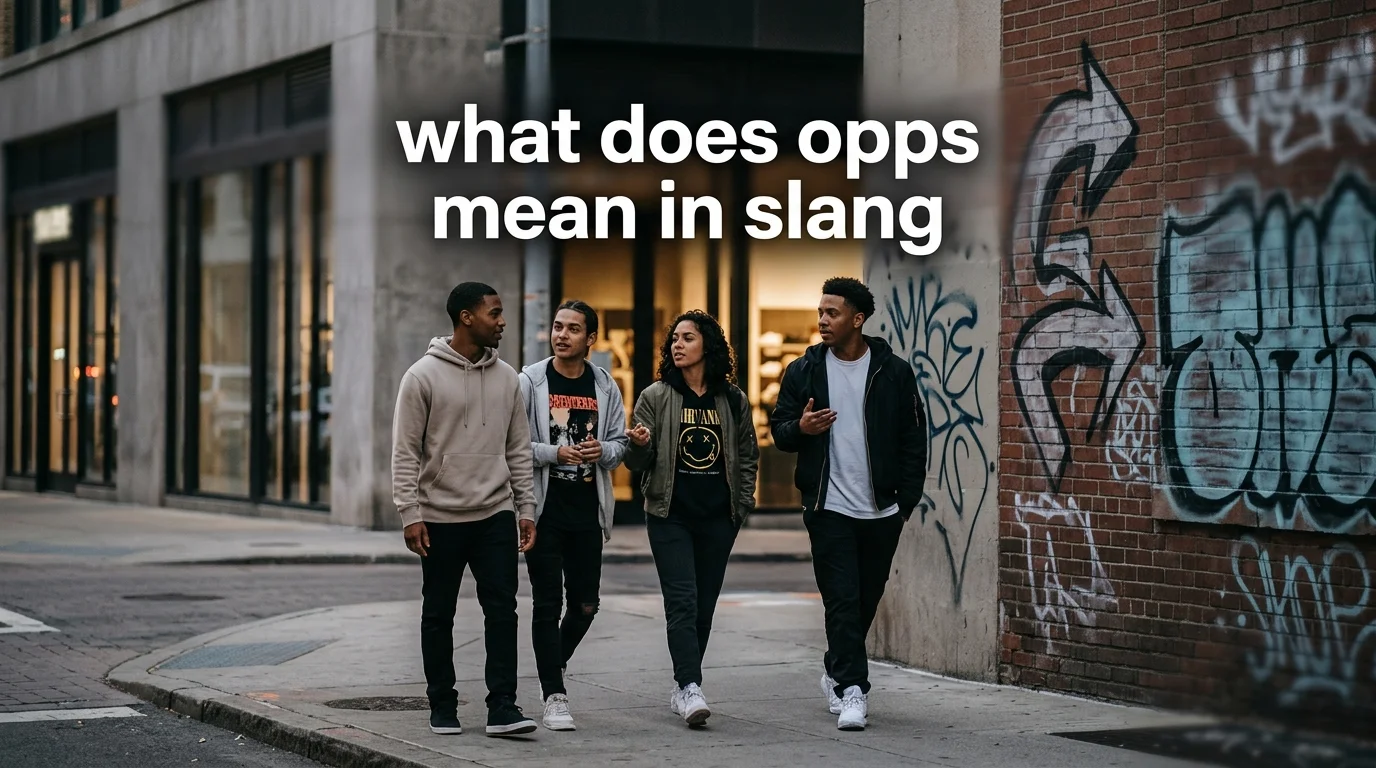
What Does Opps Mean in Slang? A Quick Breakdown
At its core, opps is a slang shorthand word that stands for opposition, opponents, or enemies. It refers to individuals, rival groups, or competing forces that stand against someone.
Understanding the term requires looking at its primary applications across everyday speech:
- Primary Definition: Rivals, enemies, or people working against your interests.
- Singular Form: “Opp” (referring to one specific enemy or rival).
- Plural Form: “Opps” (referring to a collective group of rivals).
- Typological Note: It is distinct from the exclamation “oops” (an accidental mistake), despite sharing similar spelling.
“I can’t share my location on my story; the opps are always watching.”
“Why are you talking to him? He hangs out with the opps.”
“Keep your circle small so no opps can infiltrate your group.”
Origin and Background: From Chicago Streets to Global Social Feeds
The Hip-Hop Roots of Chicago Drill
The term originated within urban street culture, gaining heavy traction through the Chicago drill music scene during the early 2010s. Rappers used “opp” as shorthand for opposition—specifically referring to rival gangs or hostile street competitors.
In its original environment, the word carried serious weight. It wasn’t a playful insult; it designated genuine threat, deep-seated rivalry, and street territorialism.
The Social Media Pipeline
As drill music expanded into a global subgenre, the vocabulary moved right along with it. Platforms like Twitter, Vine, and later TikTok stripped the word of its hyper-specific regional confines.
Digital algorithms pushed the terminology into mainstream youth culture. Young internet users adopted the cadence and vocabulary of rap artists to signal cultural awareness, humor, and digital savvy.
How the Meaning Evolved Over Time
Through mainstream adoption, the word underwent significant semantic dilution. While it still means “enemy,” the intensity of that hostility shifted dramatically in everyday usage.
Today, the word spans a spectrum ranging from serious street conflicts to playful banter about mild annoyances, rival sports teams, or overly strict parents.
Real-Life Conversations: How “Opps” Looks in the Wild
Scenario 1: WhatsApp Group Chat
Person A: Are we still meeting up at the coffee shop downtown?
Person B: Nah, change of plans. My ex-boyfriend works there now.
Person A: Ah, got it. Can’t be hanging out around the opps!
Scenario 2: Instagram DM
Person A: Why did you block Sarah on your main account?
Person B: She’s been taking screenshot of my stories and sending them to people I don’t talk to anymore.
Person A: Yeah, she definitely sounds like an opp. Good call.
Scenario 3: TikTok Comment Section
Person A: My cat literally stares at the blank wall for hours like he’s planning an attack.
Person B: He’s checking the perimeter for any opps outside.
Scenario 4: Text Messages Between Gamers
Person A: Ready to jump into the lobby for this match?
Person B: Give me two minutes. Let me set up my loadout so we can destroy these opps.
The Emotional and Psychological Meaning Behind the Word
What Emotion the Slang Expresses
Using the word taps into an ancient human instinct: tribalism and the clear division between an “in-group” and an “out-group.” It defines boundaries between who is safe and who poses a threat.
Even when used lightly, it carries a psychological edge of hyper-vigilance. It expresses defensive solidarity among friends against external negativity or rivalry.
Why People Reach for It in Modern Speech
Modern digital life often feels hyper-competitive and performative. Using punchy, dramatic language gives everyday micro-conflicts a larger-than-life narrative feel.
Instead of saying someone is “a person I dislike,” calling them an “opp” frames the dynamic with cinematic flair. It makes social interactions feel structured, memorable, and culturally current.
A Real-World Perspective on Digital Boundaries
Working alongside high school and college students reveals how naturally this language functions as social armor. One student once explained her social media habits to me with striking clarity: “I keep my private Instagram strictly for close friends because anyone else could be an opp trying to start drama.”
That brief interaction highlighted the true value of the word today. It serves as modern emotional shorthand for self-protection, boundary setting, and identity management in a hyper-connected world.
Usage in Different Contexts: Matching Tone to Environment
Social Media Feeds and Digital Spaces
On platforms like TikTok, X, and Instagram, the term leans heavily comedic or melodramatic. Users label minor inconveniences—like alarm clocks, slow Wi-Fi, or diet plans—as their ultimate “opps.”
Friends and Personal Relationships
Within personal circles, it signals strong group loyalty. Calling someone an “opp” in a friendly group dynamic usually means calling out minor disloyalty, like choosing a rival sports team or teasing a friend.
Professional and Workplace Environments
This slang does not belong in professional settings. Using street-derived rivalry terms in corporate emails, meetings, or performance reviews creates immediate discomfort and signals a lack of professional awareness.
Navigating the Casual vs. Serious Spectrum
Context determines everything with this term. The table below outlines how the word shifts across different social environments:
| Environment | Tone / Intent | Example Usage | Social Risk Level |
|---|---|---|---|
| Gaming Lobby | Competitive, playful | “Clear out the opps on the B site!” | Very Low |
| Close Friends | Teasing, lighthearted | “You’re eating at my ex’s favorite spot? Opp behavior.” | Low |
| Social Media Caption | Dramatic, ironic | “Monday morning is my biggest opp.” | Very Low |
| Street/Urban Setting | Serious, hostile | “Watch out, those guys are opps.” | High |
| Corporate Office | Out of place, unprofessional | “Our competitor is our main opp.” | Extreme |
When NOT to Use It: Cultural Sensitivity and Social Awareness
Inappropriate Professional and Formal Contexts
Avoid using this term in formal settings, academic papers, or interactions with superiors. It disrupts professional boundaries and can make you sound out of touch with situational awareness.
Understanding Cultural Sensitivity and Appropriation
The term emerged from marginalized urban communities where street rivalries carry genuine life-or-death consequences. Blithely adopting serious street dialect without understanding its roots can come across as insensitive or performative.
Preventing Unnecessary Social Escalation
Calling someone an “opp” to their face in an unfamiliar or tense environment can escalate conflict quickly. If the listener interprets the term through its original, serious definition, a light joke can transform into an active confrontation.
Common Misunderstandings: Avoiding Easy Mistakes
Confusing “Opps” with “Oops”
The most common mistake made by non-native speakers or older generations is confusing the slang word with the standard English interjection “oops.”
- Oops: An expression used when making a minor mistake (e.g., “Oops, I spilled my water”).
- Opps: A plural noun referring to enemies or competitors (e.g., “Avoid the opps”).
Missing Ironic and Comedic Nuance
Outsiders often assume the term always implies dangerous street violence. In reality, modern youth culture uses it self-referentially and humorously at least half the time.
Literal vs. Figurative Interpretation
Failing to read the room leads to misinterpretation. If someone calls their alarm clock an “opp,” they are being figurative. If someone warns you about a hostile group down the block, the term is literal.
Comparative Analysis: How “Opps” Measures Up
Comparing “Opps” to Similar and Opposite Expressions
| Term | Category | Meaning | Key Difference from “Opps” |
|---|---|---|---|
| Opps | Enemy / Rival | Opposition or adversary | Focuses on active external rivalry |
| Haters | Jealous Critics | People who criticize your success | Focuses on envy rather than active opposition |
| Frenemy | False Friend | Someone who acts friendly but harbors ill intent | Combines friendship with underlying hostility |
| Bros / Circle | Opposite Meaning | Trusted inner group of friends | Represents complete loyalty instead of rivalry |
| Main Character | Related Concept | Someone who views themselves as the protagonist | Frames others as antagonists or “opps” |
Key Insight
Slang words like “haters” describe passive negativity, whereas “opps” implies active, structural opposition. Understanding this distinction helps you decode the specific dynamic someone is describing.
Variations and Types of “Opps”: A Complete Field Guide
1. Main Opp
- Meaning: The primary adversary or biggest rival in your life.
- Explanation: Used to describe the single person or entity causing you the most stress or conflict.
2. Micro-Opp
- Meaning: A minor, low-stakes annoyance.
- Explanation: Playful slang for small daily frustrations, like bad weather or a stubborn zipper.
3. Closet Opp
- Meaning: A hidden enemy pretending to be a friend.
- Explanation: Refers to someone inside your social circle who secretly works against you.
4. Accidental Opp
- Meaning: A friend who temporarily acts against your interests by mistake.
- Explanation: Used when a close buddy accidentally ruins your plan or reveals a secret.
5. Corporate Opp
- Meaning: A rival company, tough boss, or difficult client.
- Explanation: A humorous, informal way younger workers refer to professional obstacles.
6. Inner Opp
- Meaning: Your own self-sabotaging tendencies.
- Explanation: Used introspectively when your own bad habits hold you back from success.
7. Past Opp
- Meaning: A former rival with whom you made peace.
- Explanation: Refers to someone you used to conflict with but now tolerate or respect.
8. Opp Behavior
- Meaning: Actions that resemble betrayal or hostility.
- Explanation: Used to call out shady, disloyal, or unsupportive conduct in real time.
How to Respond When Someone Uses the Term
Casual Replies
- “Fair enough, keep them at a distance.”
- “No way, is it really like that between you two?”
- “You’re letting them rent free space in your head!”
Funny Replies
- “Is the opp in the room with us right now?”
- “My main opp is my own snooze button.”
- “Stay strong, warrior. Battle through it.”
Mature Replies
- “Life is too short to worry about rivalries.”
- “I prefer to focus on my own path rather than stress over opponents.”
- “It might be worth talking things out to clear the air.”
Respectful Replies
- “I hear you. Protect your peace above everything.”
- “That sounds like a stressful dynamic to deal with.”
- “I’m in your corner, no matter what.”
Regional and Cultural Usage Differences
Western Internet and Youth Culture
In North America, the UK, and Australia, the term has saturated mainstream youth speech. It frequently appears in memes, gaming streams, and everyday casual chatter with light, exaggerated meaning.
Asian Digital Communities
Across Asian online spaces—especially among English-speaking gaming subcultures in South and Southeast Asia—the term is used almost exclusively in competitive gaming or hip-hop enthusiast spaces.
Middle Eastern Youth Contexts
In regional urban hubs like Dubai or Riyadh, international school students and young expats use the term as part of globalized, internet-driven English slang.
Generational Divide: Gen Z vs. Millennials vs. Gen X
[Gen X] -------------> [Millennials] -------------> [Gen Z / Gen Alpha]
Confuses with "Oops"    Understands via Hip-Hop      Uses natively as everyday
or assumes typo.        music; uses sparingly.       internet vernacular.
Is It Safe for Kids to Use? A Guide for Parents
The word itself is not an explicit profanity or inherently vulgar term. However, parents should understand its dual nature depending on the child’s age and social environment.
In most cases, young teens use it harmlessly to describe video game rivals, annoying chores, or strict teachers. It acts as simple digital hyperbole.
The only concern arises if a child uses the term within high-tension, real-world social environments where gang imagery or genuine bullying is present. Context and underlying intent always dictate whether the usage is healthy or concerning.
Frequently Asked Questions
Is “opps” short for police?
Historically, some regions used “opps” to refer to “officers” or police intervention. However, in modern slang, it almost universally stands for “opposition” or personal enemies.
Is calling someone an “opp” an insult?
Yes, calling someone an “opp” frames them as an enemy or adversary. Depending on the delivery, it ranges from a serious accusation of hostility to a lighthearted, playful jab.
Does “opp” mean the same thing as “haters”?
Not quite. A “hater” is someone who envies your progress or criticizes you from afar. An “opp” is an active rival whose presence directly conflicts with your group or interests.
Why do rappers constantly talk about opps?
Hip-hop artists, particularly within street-drill subgenres, write about real-world street dynamics, territorial rivalries, and self-preservation where real opposition exists.
Can “opps” be used as a singular noun?
Yes. While “opps” is plural, the singular form is simply “opp.” For example: “He is my biggest opp.”
Master Modern Slang with Confidence
Language is dynamic, living, and constantly shifting. Understanding terms like “opps” gives you a clear window into how digital media shapes human connection, group identity, and modern communication.
Whether you plan to incorporate it into your own casual conversations or simply want to understand what your kids, colleagues, or social feeds are talking about, knowing the context makes all the difference.
Recognizing the boundary between street origins and digital hyperbole lets you navigate modern conversations with ease, cultural awareness, and absolute confidence.