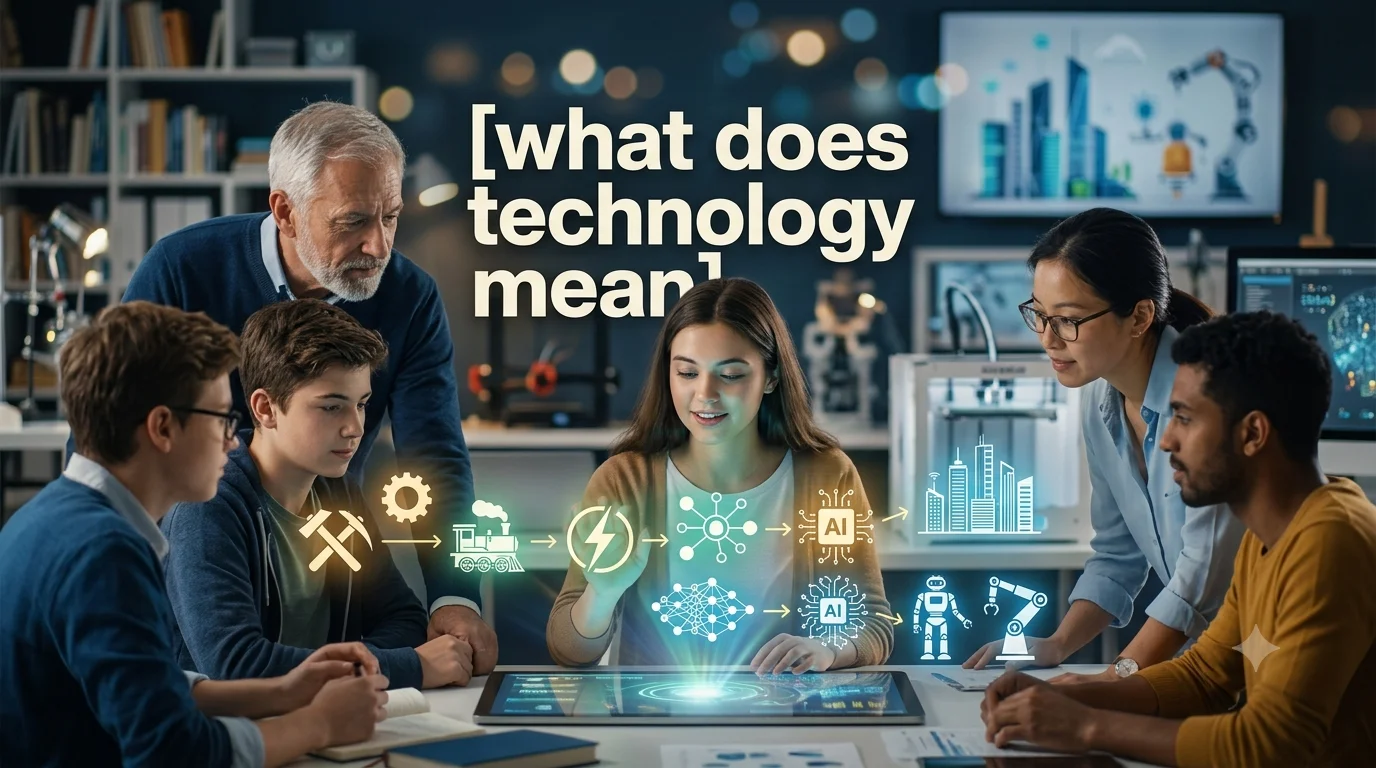
If you ask ten different people to define technology, you will likely get ten wildly different answers. A teenager might hold up their smartphone, a surgeon might point to a robotic arm, and a historian might mention the invention of the wheel.
Most people search for the true meaning of technology because the term has evolved far beyond its traditional definition. We live in an era where digital tools dictate how we communicate, work, and love.
Understanding the deeper scope of technology clears up a massive misconception: technology is not just metal, screens, and microchips. It is a fundamental human drive to solve problems and adapt to our environment.
What Does Technology Mean? Stripping Away the Jargon
At its core, technology is the practical application of knowledge to accomplish specific tasks, solve human problems, or extend our natural abilities.
It is the practical bridge between scientific discovery and daily life. It encompasses everything from the physical machinery in a factory to the invisible software algorithms curating your daily social media feed.
Knowledge + Craft = Problem-Solving Tool (Technology)
“Technology is best when it brings people together.” — Matt Mullenweg
“Any sufficiently advanced technology is indistinguishable from magic.” — Arthur C. Clarke
“Technology is just a tool. In terms of getting the kids working together and motivating them, the teacher is the most important.” — Bill Gates
The Core Pillars of Technology
- Knowledge Application: Transforming theoretical ideas into tangible, working solutions.
- Problem Solving: Reducing human effort, saving time, or bypassing physical limitations.
- Systemic Processes: Methods, routines, and techniques used to produce goods or services efficiently.
Origin & Background: How the Word Evolved
The term originates from two Greek words: techne, meaning art, skill, or craft, and logos, meaning study, discourse, or reason. Ancient Greeks viewed technologia as the systematic study of a practical craft or manual skill.
For centuries, technology simply meant the techniques used in trades like carpentry, metallurgy, or weaving. The Industrial Revolution shifted the focus toward mechanical machinery, engines, and mass manufacturing.
[Greek Techne + Logos] ➔ [Industrial Machinery] ➔ [Digital Code & AI]
The 20th century brought the digital revolution, forever altering the word’s cultural weight. Today, social media platforms and online culture have popularized a narrower view of technology, equating it almost exclusively with digital devices and internet connectivity.
Real-Life Conversations: How We Talk About Technology Today
Scenario 1: Texting About Digital Fatigue
- Maya: Are you coming to dinner tonight?
- Sam: I need a break from my phone. My screen time was eight hours today.
- Maya: I get it. Technology is completely stealing our peaceful evenings lately!
Scenario 2: Instagram DM Between Co-workers
- Leo: Hey, did you try that new project management app?
- Elena: Yes! It saved me two hours of manual scheduling.
- Leo: Crazy how a little bit of smart software changes the whole workflow.
Scenario 3: TikTok Comment Section on Old Crafts
- User_99: Is a hand-woven basket considered tech?
- CraftMaster: Technically, yes! Ancient weaving techniques were the cutting-edge craft systems of their day.
Scenario 4: WhatsApp Family Group
- Dad: Can someone fix the smart TV? It keeps disconnecting.
- Sophia: Dad, did you try turning it off and on again?
- Dad: Modern tech is great until it loses Wi-Fi!
Emotional & Psychological Meaning: Why Technology Feels So Personal
Beyond hardware, technology carries profound psychological weight. It evokes feelings of empowerment, connection, and sheer awe. Simultaneously, it triggers anxiety, burnout, and isolation.
We use technological solutions to seek security, comfort, and control over our unpredictable world. A smartphone is no longer just a communication tool; it acts as a digital security blanket containing our memories, relationships, and identity.
I remember helping my grandmother learn how to video call her sister across the Atlantic. As tears streamed down her face, I realized technology is not about circuits. It is about human presence transcending physical distance.
Usage in Different Contexts
Social Media & Digital Spaces
On platforms like TikTok, X, and Instagram, the word usually refers to modern consumer gadgets, artificial intelligence, software apps, and digital algorithms.
Friends & Personal Relationships
In casual conversations, people use the term to highlight convenience or complain about screen addiction and social disconnect.
Work & Professional Settings
In business environments, it signifies efficiency, automation, infrastructure, data security, and enterprise software systems.
Casual vs. Serious Tone
Saying “I love tech” in a casual conversation usually means you enjoy buying new smartphones. In a academic context, it refers to complex sociotechnical systems reshaping human behavior.
When NOT to Use the Term
Inappropriate Contexts
Avoid reducing deeply emotional, human-driven experiences solely to technological terms. Describing human relationships purely as “networking systems” strips away genuine empathy.
❌ Bad Context:  "Our marriage just needs a software update."
✅ Good Context: "We need to improve how we communicate with each other."
Misrepresenting Simple Concepts
Do not confuse basic scientific principles with technological application. Science is the understanding of how things work; technology is the tool built using that understanding.
Sensitivity in Low-Resource Areas
Using tech-heavy jargon when communicating in regions with limited access to electricity or internet can create alienating social barriers.
Common Misunderstandings
- Equating it Only with Electronics: Many people forget that a pencil, a spoon, and a door hinge are all brilliant forms of physical innovation.
- Confusing Tech with Science: Science discovers natural truths; technological development applies those truths to create practical items.
- Assuming Progress is Always Positive: New innovations often bring unintended ethical, psychological, and environmental side effects.
Comparing Technology to Related Terms
| Term | Core Meaning | Primary Focus | Human Impact |
| Technology | Practical application of knowledge | Problem-solving tools & processes | Directly alters daily living & work |
| Science | Systematic study of the natural world | Discovering truth & physical laws | Expands human understanding |
| Innovation | Introducing new ideas or methods | Novelty & improvement | Drives economic & social change |
| Engineering | Designing & building structures/systems | Practical creation & math | Provides physical infrastructure |
| Automation | Operating systems without human intervention | Reducing manual labor | Boosts speed & operational scale |
Key Insight
Science seeks understanding, engineering designs the plan, and technology is the resulting functional system that changes how humans interact with their environment.
10 Variations and Types of Technology
1. Information Technology (IT)
Systems used for storing, retrieving, transmitting, and manipulating digital data across computers.
2. Biotechnology
The use of living organisms or biological systems to develop medical treatments, foods, and agricultural products.
3. Medical Technology
Tools, equipment, and pharmaceuticals designed to diagnose, monitor, and treat human illnesses effectively.
4. Educational Technology (EdTech)
Hardware and software platforms dedicated to enhancing learning, virtual teaching, and classroom instruction.
5. Clean / Green Technology
Environmental innovations engineered to protect natural resources, reduce carbon emissions, and generate renewable energy.
6. Construction Technology
Advanced machinery, tools, and material science techniques used to erect modern buildings and infrastructure.
7. Artificial Intelligence (AI)
Computer systems engineered to perform complex cognitive tasks traditionally requiring human intelligence.
8. Mechanical Technology
The application of physical engineering principles to design machines, gears, engines, and mechanical tools.
9. Assistive Technology
Devices and software designed specifically to aid individuals with disabilities in performing daily tasks.
10. Financial Technology (FinTech)
Digital innovations that automate, streamline, and secure personal and commercial financial services.
How to Respond When Someone Uses the Term
Casual Responses
- “It really is crazy how fast things are changing these days!”
- “Honestly, I couldn’t survive a single day without my GPS.”
Funny Responses
- “My favorite piece of tech is still the button that turns off my alarm.”
- “I love modern tech until my printer decides to have a personal crisis.”
Mature Responses
- “It offers amazing convenience, but setting personal boundaries with screen time is crucial.”
- “The key is making sure our tools serve human needs rather than dictating them.”
Respectful Responses
- “That is an insightful perspective on how digital systems shape modern society.”
- “I appreciate how much easier these modern innovations have made our daily work.”
Regional & Cultural Differences in Perception
Western Culture     ➔ Individual Convenience & Consumer Efficiency
Asian Culture       ➔ Systemic Integration & High-Tech Infrastructure
Middle East         ➔ Economic Diversification & Smart City Growth
Generational Shift  ➔ Gen Z (Digital Natives) vs. Baby Boomers (Adapters)
Western Culture
Prioritizes individual convenience, personal productivity, consumer software, and entertainment ecosystems.
Asian Culture
Focuses heavily on integrated public infrastructure, robotics, smart cities, and high-speed transit networks.
Middle Eastern Culture
Emphasizes rapid digital transformation, smart government services, and sustainable energy technological investments.
Generational Differences
Gen Z views digital platforms as a natural extension of their social identity. Boomers and older generations often view technological tools as separate instruments used for specific tasks.
Is It Safe for Kids?
Understanding technology as a concept is completely safe and essential for children. Educating kids on how human tools evolve builds healthy critical thinking skills.
Safety concerns arise when children interact with online technological platforms without guidance. Parents should introduce digital environments with clear boundary rules, screen limits, and age-appropriate privacy controls.
Frequently Asked Questions
What is the simplest definition of technology?
It is the practical application of knowledge to build tools, solve daily problems, and make life easier for human beings.
Is a simple pencil considered a form of technology?
Yes. A pencil is a human-invented tool designed to solve the problem of recording information using physical materials.
What is the difference between science and technology?
Science explores and explains natural phenomena. Technology uses scientific knowledge to create useful tools, products, and processes.
Why is technology so important in modern life?
It streamlines work, connects people across the globe, improves medical care, and drives economic development.
What are the main types of modern technology?
Major categories include Information Technology (IT), Biotechnology, Medical, Educational, Clean Energy, and Artificial Intelligence.
Can technology have negative effects on society?
Yes. Excessive reliance on digital tools can lead to social isolation, privacy risks, physical inactivity, and mental burnout.
Final Thoughts on Navigating Our Tech-Driven World
Understanding what technology truly means empowers you to use it with purpose. It is not a distant, intimidating force owned by massive corporations. It is simply human ingenuity put into action.
When you strip away the flashy marketing, every tool should serve one ultimate goal: improving human lives. Step back, set boundaries with your screens when necessary, and use modern tools to build a balanced life.