Have you ever caught yourself tallying up the dinner bill in your head, splitting a ride-share fare among friends, or calculating how many hours of sleep you will get if you stay up for just one more episode?
If so, you were actively engaging in arithmetic.
While the word sounds like a dusty, formal textbook topic from your school days, arithmetic is actually the invisible thread holding our daily routines together.
Understanding what arithmetic means goes beyond passing a third-grade exam. It unlocks how we manage our time, handle our finances, and navigate modern life with clarity and confidence.
What Does Arithmetic Mean? Unpacking the Basics
At its core, arithmetic is the most fundamental branch of mathematics.
It deals directly with numbers and the basic operations used to calculate them.
When people ask what arithmetic means, they are usually looking for the bridge between abstract numbers and real-world application.
Arithmetic gives us the tools to measure, divide, gather, and compare physical quantities.
       ┌──────────────────────────────────────────────┐
       │                 ARITHMETIC                   │
       │    The study of numbers & basic operations   │
       └──────────────────────┬───────────────────────┘
                              │
         ┌────────────┬───────┴────────┬────────────┐
         ▼            ▼                ▼            ▼
   ┌───────────┐ ┌───────────┐  ┌───────────┐ ┌───────────┐
   │ Addition  │ │Subtraction│  │Multiplication│ Division│
   │    (+)    │ │    (-)    │  │    (×)    │ │    (÷)    │
   └───────────┘ └───────────┘  └───────────┘ └───────────┘
The Core Definition
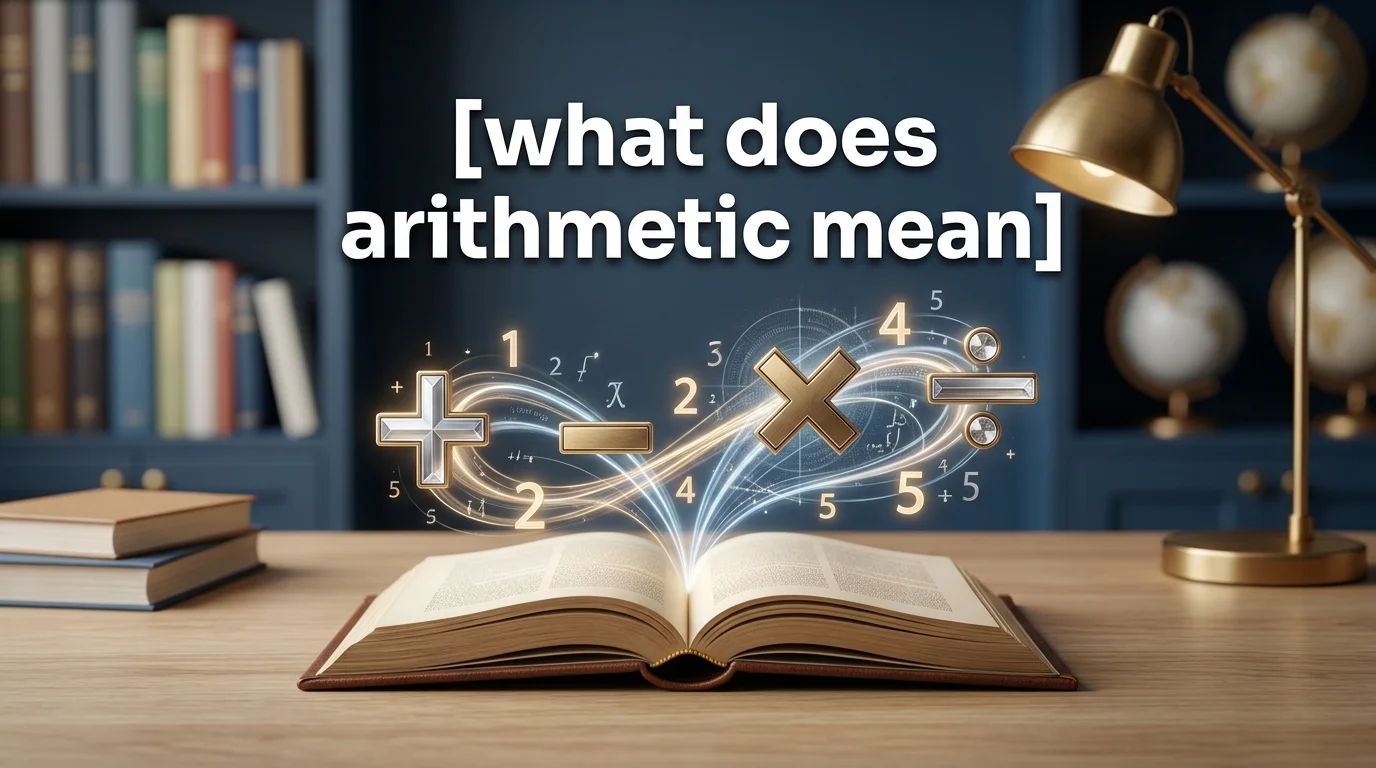
Arithmetic is the practical art of manipulating numbers using four primary fundamental operations:
- Addition (+): Combining two or more quantities to find a total sum.
- Subtraction (-): Taking one quantity away from another to determine the difference.
- Multiplication (×): Adding a specific number to itself a set number of times.
- Division (÷): Splitting a total quantity into equal, smaller groups or shares.
Real-World Quoted Examples
“I need to check the arithmetic on this restaurant check; it looks like they charged us for two desserts instead of one.”
“Her simple daily arithmetic proved that saving five dollars a day on gourmet coffee adds up to over eighteen hundred dollars a year.”
“The business plan failed not because the idea was bad, but because the basic arithmetic behind the inventory costs did not add up.”
Origin & Background: How Numbers Met Human Thought
The story of arithmetic is as old as human civilization itself.
Long before structured schools or written textbooks existed, our ancient ancestors needed ways to track their livestock, trade goods, and measure seasons.
Where It Came From
The word “arithmetic” originates from the ancient Greek word arithmetike, which combines arithmos (meaning “number”) and techne (meaning “art” or “craft”).
To the ancient Greeks, arithmetic was literally “the art of numbers.”
Early civilizations like the Babylonians and Egyptians created basic counting systems using clay tokens and tallies.
Later, Indian mathematicians revolutionized the world by inventing the concept of zero and the decimal place-value system.
Persian scholar Al-Khwarizmi helped translate and expand these numeric systems, spreading modern arithmetic across Europe and reshaping global trade forever.
Ancient Tallies ──► Greek "Arithmos" ──► Indian Zero & Decimals ──► Modern Global Trade
 (Clay Tokens)       ("Art of Numbers")     (Place-Value System)       (Digital Economy)
Cultural Influence and Evolution
Throughout history, mastering arithmetic was considered a rare skill reserved for merchants, astronomers, and rulers.
As public education expanded over the past two centuries, basic arithmetic became a universal human right and standard foundational skill.
In today’s digital era, computer code, financial markets, and algorithms run entirely on rapid arithmetic computations occurring in microseconds behind our screens.
Real-Life Conversations: Arithmetic in Action
We use arithmetic concepts daily, even when we do not explicitly use technical math terminology.
Here is how arithmetic plays out in real, everyday messaging across different platforms.
Scenario 1: WhatsApp Group Chat
Alex: Hey guys, total Airbnb cost came out to $600 for the weekend.
Sam: Perfect! There are four of us, so that’s simple division. $150 each?
Alex: Yep, exactly. Send it over via Venmo when you can!
Scenario 2: Instagram DMs
Maya: That vintage leather jacket you posted is gorgeous! How much did it end up costing with shipping?
Elena: It was $80 base price, plus $10 shipping, minus a $15 discount coupon I found online.
Maya: Nice! So $75 total? That basic addition and subtraction saved you!
Scenario 3: TikTok Comment Section
User_1: How does this creator make 50 videos a week while holding down a full-time job?
User_2: Do the arithmetic! She records 7 videos a day on weekends, which only takes 2 hours a day if each takes 15 minutes.
User_1: Wow, breaking down the time math makes it look so manageable.
Scenario 4: Text Message Exchange
Dad: Don’t forget to check your bank account before buying those concert tickets.
Chris: I did! I had $200, spent $50 on groceries, and earned $100 tutoring yesterday.
Dad: Good arithmetic! You’ve got $250 left, plenty for the ticket.
Emotional & Psychological Meaning: The Mindset of Math
Beyond numbers on a page, arithmetic carries significant psychological weight.
How we feel about arithmetic often mirrors how we handle stress, clarity, and control in our lives.
┌─────────────────────────────────────────────────────────────┐
│                   PSYCHOLOGY OF NUMBERS                     │
├──────────────────────────────┬──────────────────────────────┤
│  High "Math Anxiety"         │  Strong Arithmetic Literacy  │
├──────────────────────────────┼──────────────────────────────┤
│  • Feelings of helplessness  │  • Grounded sense of control │
│  • Avoiding bank accounts    │  • Objective problem-solving │
│  • Overspending due to stress│  • Reduced financial anxiety │
└──────────────────────────────┴──────────────────────────────┘
What Emotion It Expresses
- Clarity and Relief: Arithmetic brings definitive order to chaotic situations. When a stressful situation is reduced to cold numbers, confusion vanishes.
- Control: Knowing your exact financial or time balances provides an immediate sense of personal agency.
- Frustration: For those who struggled with math in school, simple arithmetic can trigger momentary anxiety or self-doubt.
Why People Rely on Arithmetic Thinking
Human brains naturally seek patterns.
Arithmetic provides a concrete framework that transforms subjective worries into objective facts.
It strips away emotional fluff, leaving behind clear realities you can plan around.
Personal Perspective: Finding Calm in Numbers
I remember sitting at my kitchen table years ago, overwhelmed by mounting bills and changing career paths. My mind was spinning with worst-case scenarios.
I finally opened a blank notebook and wrote down my exact income alongside my essential expenses. I did basic subtraction.
Seeing the real balance on paper immediately stopped my panic. The situation wasn’t as dire as my anxiety had painted it. Simple arithmetic gave me back my peace of mind.
Usage in Different Contexts
The context in which you use arithmetic changes how the word is interpreted.
Social Media & Pop Culture
On platforms like TikTok, X, or Reddit, people often say “do the math” or “check the arithmetic” as slang.
In this context, it means “think logically about this situation” or “look at the obvious facts.”
Friends & Personal Relationships
In personal relationships, “emotional arithmetic” refers to weighing the effort you invest in a relationship against the care and support you receive back.
Work & Professional Settings
In corporate settings, “arithmetic” refers directly to financial balance sheets, profit margins, inventory levels, and budget allocations.
Colleagues often talk about “the basic arithmetic of a project,” meaning whether its revenue outweighs its costs.
Casual vs. Serious Tone
| Context | Example Phrase | Underlying Meaning |
|---|---|---|
| Casual | “The math isn’t mathing.” | Something feels confusing or inconsistent. |
| Serious | “Let’s review the quarterly arithmetic.” | An exact, rigorous financial assessment. |
When NOT to Use It: Context & Nuance
While arithmetic is universal, using the term incorrectly or in sensitive moments can cause miscommunication.
Avoid Over-Simplifying Complex Human Problems
Do not try to solve deeply emotional or human situations using simple arithmetic logic.
Telling a grieving or stressed friend that their situation “adds up logically” can sound cold, clinical, and insensitive.
Do Not Confuse Arithmetic with Higher Mathematics
Avoid using “arithmetic” when referring to advanced mathematical fields like calculus, trigonometry, or abstract algebra.
Calling advanced statistical modeling “simple arithmetic” minimizes the complexity of the work and sounds unprofessional in academic or technical settings.
Common Misunderstandings
Despite being a everyday term, people frequently confuse arithmetic with other mathematical concepts.
Myth 1: “Arithmetic and Mathematics Are the Exact Same Thing”
Arithmetic is a subset of mathematics.
Mathematics is a vast umbrella containing geometry, statistics, calculus, and algebra.
Arithmetic is simply the foundational counting and calculating core of that larger mathematical universe.
┌─────────────────────────────────────────────────────────────┐
│                        MATHEMATICS                          │
│ ┌──────────────┐  ┌──────────────┐  ┌─────────────────────┐ │
│ │  ARITHMETIC  │  │   Algebra    │  │ Geometry & Calculus │ │
│ │ (+, -, ×, ÷) │  │  (Variables) │  │  (Shapes & Change)  │ │
│ └──────────────┘  └──────────────┘  └─────────────────────┘ │
└─────────────────────────────────────────────────────────────┘
Myth 2: “Calculators Make Learning Arithmetic Useless”
Calculators execute operations, but they do not teach numeric intuition.
Without understanding fundamental arithmetic, you cannot tell if you entered a wrong digit into your calculator or if an automated receipt charged you incorrectly.
Myth 3: “Literal vs. Figurative Usage”
Literally, arithmetic means computing numbers.
Figuratively, people say “political arithmetic” or “the arithmetic of life” to describe calculating risks, balancing priorities, or weighing choices.
Comparison Table: Related Terms and Concepts
To clarify how arithmetic differs from related words, consider this comparison chart:
| Term | Core Definition | Focus Area | Example |
|---|---|---|---|
| Arithmetic | Basic manipulation of known numbers | Addition, Subtraction, Multiplication, Division | 15+25=40 |
| Algebra | Solving equations with unknown variables | Formulas and unknown values (x,y) | 2x+5=15 |
| Mathematics | The broad science of numbers, shapes, and patterns | All quantitative disciplines combined | “She studied higher mathematics.” |
| Numeracy | The practical ability to use numbers in daily life | Real-world confidence and financial literacy | Reading a budget effectively. |
| Computation | Executing step-by-step mathematical procedures | Algorithms and machine processing | A computer rendering 3D graphics. |
Key Insight
While math explores theoretical concepts and algebra solves for unknown variables, arithmetic remains the purely practical tool focused on computing real, known numbers directly.
Variations and Types of Arithmetic Operations
Arithmetic takes several forms depending on the numbers and context involved.
1. Basic Arithmetic
The standard manipulation of whole numbers using addition, subtraction, multiplication, and division.
2. Mental Arithmetic
Performing calculations entirely within your head without using paper, pens, or digital devices.
3. Modular Arithmetic
A system of arithmetic for integers where numbers “wrap around” after reaching a certain value, much like the 12-hour cycle on a clock.
4. Floating-Point Arithmetic
The specific way computers handle arithmetic calculations involving extremely long decimal numbers.
5. Binary Arithmetic
The base-2 arithmetic system (using only zeros and ones) that powers every computer processor on Earth.
6. Decimal Arithmetic
Everyday arithmetic based on units of ten, which forms the core of our global currency and measurement systems.
7. Fractional Arithmetic
Performing calculations directly on parts of a whole, such as adding or multiplying fractions.
8. Vector Arithmetic
Advanced arithmetic applied to quantities that have both magnitude and direction, used heavily in physics and video game design.
How to Respond When Someone Uses It
When someone brings up “the arithmetic” in conversation, your response depends on the tone of the discussion.
Casual Replies
- “Fair enough, the numbers don’t lie!”
- “Let me double-check that math real quick.”
Funny Replies
- “My brain’s arithmetic processor went offline around 3 PM today.”
- “I was told there would be no math today!”
Mature / Analytical Replies
- “When you break down the numbers like that, the choice becomes very clear.”
- “Let’s review the underlying arithmetic to make sure our assumptions are solid.”
Respectful Replies
- “I appreciate you walking me through those calculations so clearly.”
- “That makes sense. Thank you for clarifying the totals.”
Regional & Cultural Usage
The concept of arithmetic is universal, but cultural approaches to learning and applying it vary globally.
       ┌────────────────────────────────────────────────────────┐
       │                GLOBAL PERSPECTIVES                     │
       └───────────────────────────┬────────────────────────────┘
                                   │
         ┌─────────────────────────┴─────────────────────────┐
         ▼                                                   ▼
┌─────────────────────────────────┐                 ┌─────────────────────────────────┐
│     WESTERN / ANGLOSPHERE       │                 │     EAST ASIAN & MIDDLE EAST    │
│  Focus on digital tools,        │                 │  Early mental math training,    │
│  calculators, and practical     │                 │  abacus methods, and high       │
│  financial application.         │                 │  speed oral computation.        │
└─────────────────────────────────┘                 └─────────────────────────────────┘
Western Culture
In North America and Europe, the term “arithmetic” is often associated with early elementary school education (traditionally called part of the “Three Rs”: Reading, wRiting, and aRithmetic).
In daily adult speech, Westerners more frequently use the casual word “math.”
Asian Culture
In many Asian countries, mental arithmetic (Anzan) is taught early using physical tools like the abacus (Soroban).
This builds extraordinary mental calculation speed and deep numeric intuition from an early age.
Middle Eastern Culture
The Middle East holds a historic legacy as the cradle of modern numerical systems.
Today, strong foundational arithmetic remains a point of academic pride across educational systems in the region.
Generational Differences
- Gen Z: Rarely uses the word “arithmetic” conversationally. Prefers internet slang like “the math isn’t mathing” or “girl math / boy math.”
- Millennials: Uses “math” casually, but recognizes “arithmetic” in financial, business, or educational contexts.
- Boomers & Gen X: Comfortably uses “arithmetic” to describe basic daily calculations, budgeting, and bookkeeping.
Is It Safe for Kids?
Yes, arithmetic is completely safe, highly beneficial, and essential for child development.
Introducing children to basic arithmetic early builds logical reasoning, problem-solving confidence, and spatial awareness.
It equips kids to understand time, manage allowances, and navigate modern technology safely and intelligently.
Frequently Asked Questions
What are the 4 basic rules of arithmetic?
The four basic rules of arithmetic are addition, subtraction, multiplication, and division. These fundamental operations serve as the building blocks for all higher-level mathematics.
What is the difference between math and arithmetic?
Arithmetic is a specific branch of math that deals strictly with calculating numbers. Mathematics is the larger subject that includes arithmetic alongside geometry, algebra, calculus, and statistics.
What is mental arithmetic?
Mental arithmetic is the ability to perform mathematical calculations inside your mind without relying on paper, pencil, calculators, or mobile devices.
Why is arithmetic important in daily life?
Arithmetic is essential for managing personal budgets, calculating tips, tracking time, cooking recipes, measuring items, and making informed financial decisions.
Is arithmetic hard to learn?
Arithmetic is simple to learn when taught step-by-step using practical visual examples. With regular real-world practice, anyone can master basic arithmetic skills.
What does “the math isn’t mathing” mean?
“The math isn’t mathing” is modern internet slang used when a situation, set of numbers, or explanation does not make logical sense or fails to add up correctly.
Conclusion
Arithmetic is far more than a set of rules learned in elementary school classrooms.
It is a dynamic human tool that empowers us to make sense of our daily lives.
By taking control of basic numbers, you gain clarity in your finances, efficiency in your time management, and confidence in your decisions.
Next time you split a bill or track your monthly goals, embrace the moment. You are using the ancient, beautiful art of arithmetic to clear away confusion and build a more structured life.