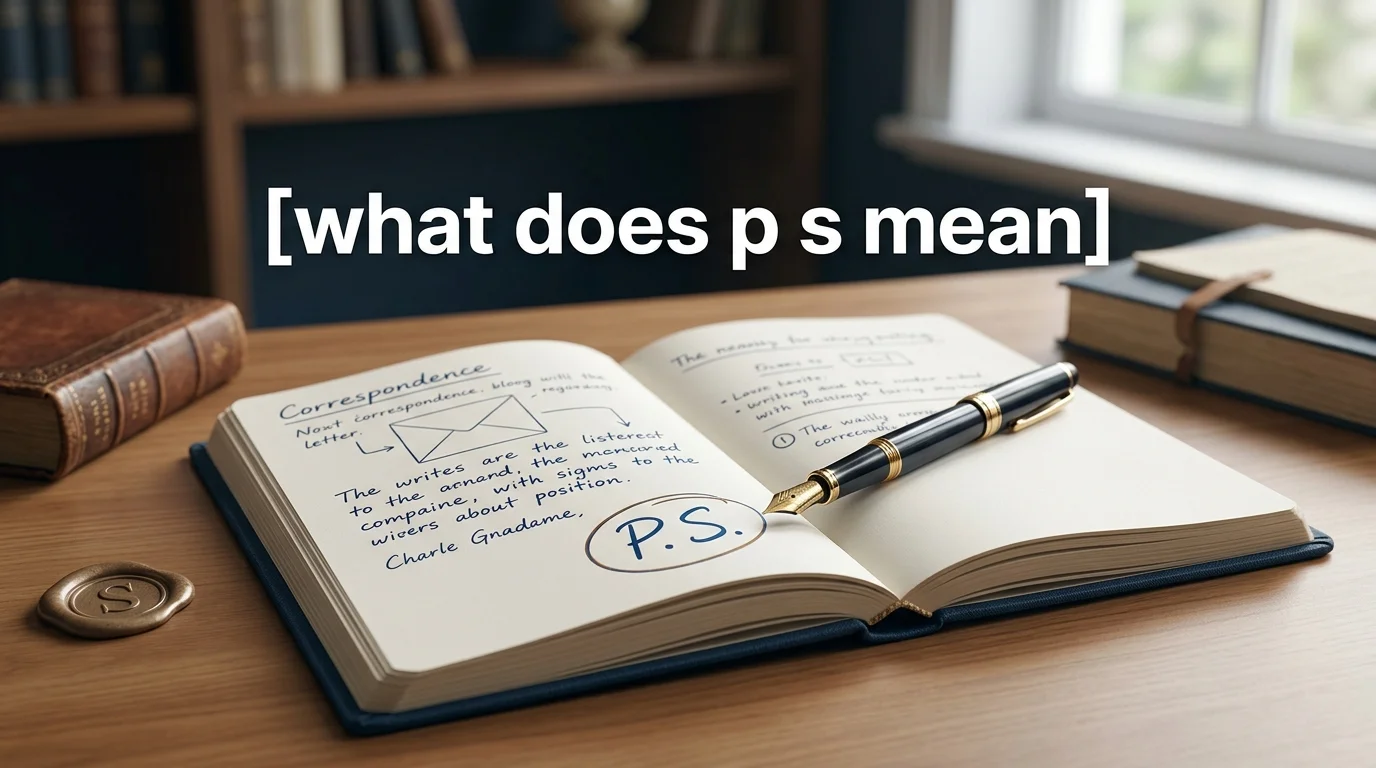
Have you ever finished reading an email or a handwritten letter, only to find two small letters sitting quietly at the very bottom?
You see it everywhere. It pops up in intimate love letters, promotional marketing blasts, and quick text messages from friends.
Understanding what this timeless abbreviation stands for clears up confusion instantly. It helps you navigate both traditional writing and fast-paced digital chats with total confidence.
What Does P.S. Mean? Understanding the Basics
The abbreviation P.S. stands for Postscript.
It originates from the Latin term postscriptum, which literally translates to “written after.”
People search for this term because modern communication moves fast. We often jump between formal emails and casual texts, making us wonder if old rules still apply.
Understanding P.S. solves the common confusion about adding last-minute thoughts without rewriting an entire message.
What Does P.S. Mean? Quick Meaning & Examples
At its core, a postscript is an afterthought added after a main message and signature are already completed.
[Main Body of Message]
Sincerely,
[Your Name]

P.S. [Your additional thought or bonus note]
Quick Definition Breakdown
- Primary Function: Adds extra thoughts, urgent reminders, or personal notes after the sign-off.
- Latin Root: Derived from post (after) + scriptum (written).
- Modern Purpose: Serves as an attention-grabbing tool in digital marketing and casual texts.
Here are a few quick examples showing how it looks in daily life:
“Thanks for sending over the project files today. I will review them first thing tomorrow morning. Best regards, Sarah.
P.S. Don’t forget to bring the physical blueprints to the meeting!”
“Can’t wait to catch up this weekend! It feels like it has been forever.
P.S. I finally watched that movie you recommended, and you were totally right.”
“Happy Birthday! Hope your day is filled with joy, cake, and relaxation.
P.S. Check your front porch; your present was just delivered.”
Origin & Background: From Quill Pens to Touchscreens
Where It Came From
Before digital keyboards made editing effortless, people wrote letters using ink pens, quills, or manual typewriters.
If a writer forgot to mention something important, they could not simply click, backspace, and insert a new paragraph. Re-writing a multi-page letter by hand was tedious and wasted expensive paper.
The solution was simple and brilliant. Writers added “P.S.” below their signature to include crucial details without ruining the original document.
Cultural Influence and Evolution
As printing presses and modern postal systems grew worldwide, P.S. became a universal writing standard.
Literature, love notes, and military dispatches all relied on postscripts to deliver dramatic reveals or intimate thoughts.
Social Media and Digital Impact
You might think backspacing made P.S. obsolete. Surprisingly, digital communication made it stronger.
In modern texting and emailing, backspacing is easy, yet people deliberately choose to use P.S. for emphasis rather than necessity.
Real-Life Conversations: How People Use P.S. Today
Scenario 1: WhatsApp Chat Between Friends
Alex: Hey, are we still meeting at the coffee shop around 4 PM?
Jordan: Yes! I’m leaving my apartment in about twenty minutes.
Jordan: P.S. bring that camera you bought, I want to see it!
Alex: Haha will do, see you soon!
Scenario 2: Instagram DMs
Maya: I just saw your travel story, those mountain views look incredible!
Liam: Thanks! It was such an intense hike, but totally worth the view.
Liam: P.S. if you ever go there, wear double socks… my feet are destroyed 😂
Maya: Ouch! Thanks for the warning!
Scenario 3: TikTok Comment Section
User_123: This recipe literally saved my dinner party last night, everyone loved the sauce!
Creator: That makes me so happy to hear! Thank you for trying it out.
Creator: P.S. try adding a splash of lemon juice next time, it completely elevates the flavor.
Scenario 4: Text Message Between Family Members
Mom: Don’t forget to grab milk on your way home today.
Sam: Got it, leaving work now.
Mom: Great, drive safe!
Mom: P.S. your brother is coming over for dinner too, so grab a bigger container!
Emotional & Psychological Meaning
What Emotion It Expresses
A postscript carries a distinct psychological weight. It creates a feeling of intimacy, exclusivity, or sudden inspiration.
When someone adds a P.S., it often signals:
- Warmth: A desire to leave the reader with a sweet or personal note.
- Urgency: Highlighting something critical that shouldn’t be missed.
- Playfulness: Sharing a lighthearted joke or secondary thought.
Why People Continue to Use It
Eye-tracking studies on digital reading habits show a fascinating pattern. Readers almost always scan down to read the P.S. before reading the main body text.
It acts like a bright neon sign in written text.
+-------------------------------------------------------+
|  Email Subject: Monthly Newsletter                    |
|                                                       |
|  [Long Paragraph 1 - Scanned briefly]                 |
|  [Long Paragraph 2 - Frequently skipped]              |
|                                                       |
|  Best,                                                |
|  The Marketing Team                                   |
|                                                       |
|  >> P.S. Click here to get 50% off today only! <<     |  <-- Highest Visual Focus
+-------------------------------------------------------+
Modern Psychological Impact
I remember receiving a formal project proposal from a client years ago. The email was strictly professional, filled with terms, timelines, and budgets.
At the bottom sat a small note: “P.S. Good luck with your marathon this Sunday!”
That tiny postscript completely changed the tone of our business relationship. It broke through corporate formality and built human connection instantly.
Usage in Different Contexts
Social Media & Text Messages
In casual digital messaging, punctuation rules soften. You might see it typed as “ps”, “p.s.”, or “PS”.
It usually introduces a playful side note, an omitted detail, or a quick joke.
Friends & Romantic Relationships
In personal relationships, a P.S. often carries deep emotional value.
It lets you end a message on an intimate or affectionate note. For example: “P.S. I missed you today.”
Work & Professional Settings
When used in corporate emails, P.S. serves a tactical purpose.
It highlights upcoming deadlines, reinforces call-to-action buttons, or adds a courteous personal touch.
+------------------+------------------------------------------------------+
| Context          | Tone & Function                                      |
+------------------+------------------------------------------------------+
| Professional     | Strategic, urgent, highlights calls to action        |
| Casual / Friends | Relaxed, funny, adds skipped details                 |
| Romantic         | Sweet, affectionate, leaves a lasting impression     |
| Marketing        | High-converting, creates FOMO, highlights bonuses    |
+------------------+------------------------------------------------------+
When NOT to Use It
Formal Legal or Official Documents
Avoid using P.S. in legal contracts, formal court filings, or official academic papers.
Adding an afterthought in legal settings implies sloppy preparation or incomplete drafting.
Bad News Delivery
Never deliver sensitive or painful news in a postscript.
Bad Example:
“Thanks for attending the meeting today.
P.S. By the way, your position has been eliminated.”
Placing serious news in a P.S. feels dismissive, disrespectful, and inappropriate.
Cultural Sensitivity and Misunderstandings
In some high-context professional cultures, placing critical requests in a P.S. might seem disorganized.
Ensure main business goals stay inside the main body text when communicating cross-culturally.
Common Misunderstandings
What People Get Wrong
- Believing it means “Personal Statement”: A widespread misconception. It always means postscriptum.
- Assuming it is outdated: Many think modern keyboards rendered it useless, ignoring its marketing power.
- Misunderstanding P.P.S.: People often misuse stacked postscripts. Additional notes require adding more “post” prefixes.
Tone Confusion: Literal vs. Figurative Meaning
Literally, it is just extra text.
Figuratively, it carries heavy emphasis. Treating a P.S. as unimportant text misses its primary psychological impact.
Comparison Table: P.S. vs. Similar Expressions
| Expression | Meaning / Definition | Best Context to Use | Tone / Vibe |
|---|---|---|---|
| P.S. | Postscript (written after) | Emails, letters, text messages | Adaptable (casual to professional) |
| P.P.S. | Post-postscript (written after postscript) | Follow-up notes in letters/emails | Playful, lighthearted |
| Btw | By the way | Fast messaging, casual chats | Informal, conversational |
| FYI | For your information | Office emails, status updates | Professional, neutral |
| Side note | Secondary observation | Speeches, articles, texts | Casual, explanatory |
Key Insight
While abbreviations like “BTW” or “FYI” integrate directly into conversational sentences, “P.S.” uniquely stands alone at the absolute end of a message to command maximum reader focus.
Variations & Types of Postscripts (10 Examples)
1. P.P.S. (Post-Postscript)
- Meaning: An additional thought added after the first P.S.
- Explanation: Used when you remember yet another detail after already signing off and adding a postscript.
2. P.P.P.S. (Post-Post-Postscript)
- Meaning: A third layer of postscript notes.
- Explanation: Rare and mostly used humorously to show an ongoing train of thought.
3. Caps Lock “P.S.”
- Meaning: High-intensity postscript.
- Explanation: Expresses high excitement, urgent reminders, or dramatic emphasis in text messages.
4. Marketing Call-To-Action P.S.
- Meaning: A promotional trigger placed at the bottom of sales emails.
- Explanation: Capitalizes on reader scanning habits to boost product click-through rates.
5. Romantic P.S.
- Meaning: An affectionate closing line.
- Explanation: Leaves the recipient with a warm, personal feeling after a long letter.
6. The “Oh, I Forgot!” P.S.
- Meaning: A practical, functional addition.
- Explanation: Used in quick text messages to supply forgotten logistical details like times or addresses.
7. The Humorous P.S.
- Meaning: A witty observational joke.
- Explanation: Undercuts formal main messages with lighthearted banter.
8. The Teaser P.S.
- Meaning: A curiosity-building hint about future events.
- Explanation: Keeps readers anticipating your next email or message.
9. Passive-Aggressive P.S.
- Meaning: A subtle point or boundary assertion.
- Explanation: Highlights missed expectations or unkept promises softly at the message end.
10. The Correction P.S.
- Meaning: A quick clarification note.
- Explanation: Clarifies potential misunderstandings from previous sentences without rewriting them completely.
How to Respond When Someone Uses It
Responding to a P.S. depends on the context and tone set by the writer.
Casual Responses
- “Haha, totally forgot about that! Thanks for reminding me.”
- “Got it! Adding that to my list now.”
Funny Responses
- “P.S. to your P.S.: You always have the last word, don’t you? 😂”
- “P.P.S. I knew you couldn’t send an email without adding one more thing!”
Mature / Professional Responses
- “Thank you for the additional note; I have updated our records accordingly.”
- “Duly noted! I will address that point during our call tomorrow.”
Respectful / Warm Responses
- “Appreciate the personal note! Wishing you a wonderful week ahead as well.”
- “That was so sweet of you to add. Thank you!”
Regional & Cultural Usage
Western Culture
In North America and Europe, P.S. enjoys widespread popularity across direct-response marketing, personal correspondence, and casual text messages.
It is viewed as a clever, friendly way to break up dense blocks of text.
Asian Culture
In many Asian business cultures where communication styles lean formal and indirect, placing vital business requests inside a P.S. can seem unstructured.
Main business items should remain clearly organized in the core body text.
Middle Eastern Culture
Warmth and hospitality play significant roles in Middle Eastern communication.
Using a P.S. to add warm personal regards, ask about family health, or send blessings is common and deeply appreciated.
Generational Differences: Gen Z vs. Millennials
- Millennials: Frequently use proper punctuation like “P.S.” in both professional emails and casual correspondence.
- Gen Z: Prefer typing lowercase “ps” in messaging apps, often replacing it entirely with terms like “btw” or using line breaks.
Is It Safe for Kids?
Yes, P.S. is completely safe for children. It is a standard, universally accepted linguistic abbreviation free of inappropriate or offensive meanings.
Teaching children how to use P.S. helps improve their letter-writing skills, punctuation habits, and overall communication flexibility.
Frequently Asked Questions
What does P.S. stand for in modern text messages?
It stands for Postscriptum (Latin for “written after”). In modern texts, it introduces an added thought, reminder, or side note at the end of a message.
Should I put a comma after P.S.?
Including a comma after P.S. is optional. You can write “P.S. Don’t forget…” or “P.S., don’t forget…” both formats are grammatically acceptable.
How do you properly punctuate P.S.?
The traditional American English format uses periods after each letter (P.S.). British English frequently omits periods completely (PS). Both styles are correct based on regional standards.
Can you use P.S. in a business email?
Yes, using P.S. in business emails works well. It effectively highlights important deadlines, upcoming events, or personal notes that might get lost in long main paragraphs.
What comes after P.S. if I want to add another note?
You write P.P.S., which stands for Post-postscriptum. If you need a third note, you use P.P.P.S..
Is P.S. capitalized or lowercase?
Capitalization (P.S. or PS) is preferred in formal writing. Lowercase (ps) is acceptable in casual text messages or informal chat rooms.
Conclusion
The humble postscript has survived the transition from feather quills on parchment paper to digital taps on glass screens.
Understanding what P.S. means provides you with a versatile tool to grab attention, add warm personal touches, and highlight critical details effortlessly.
Next time you draft an email or send a text, try adding a thoughtful P.S. at the bottom—it might just become the most memorable part of your message