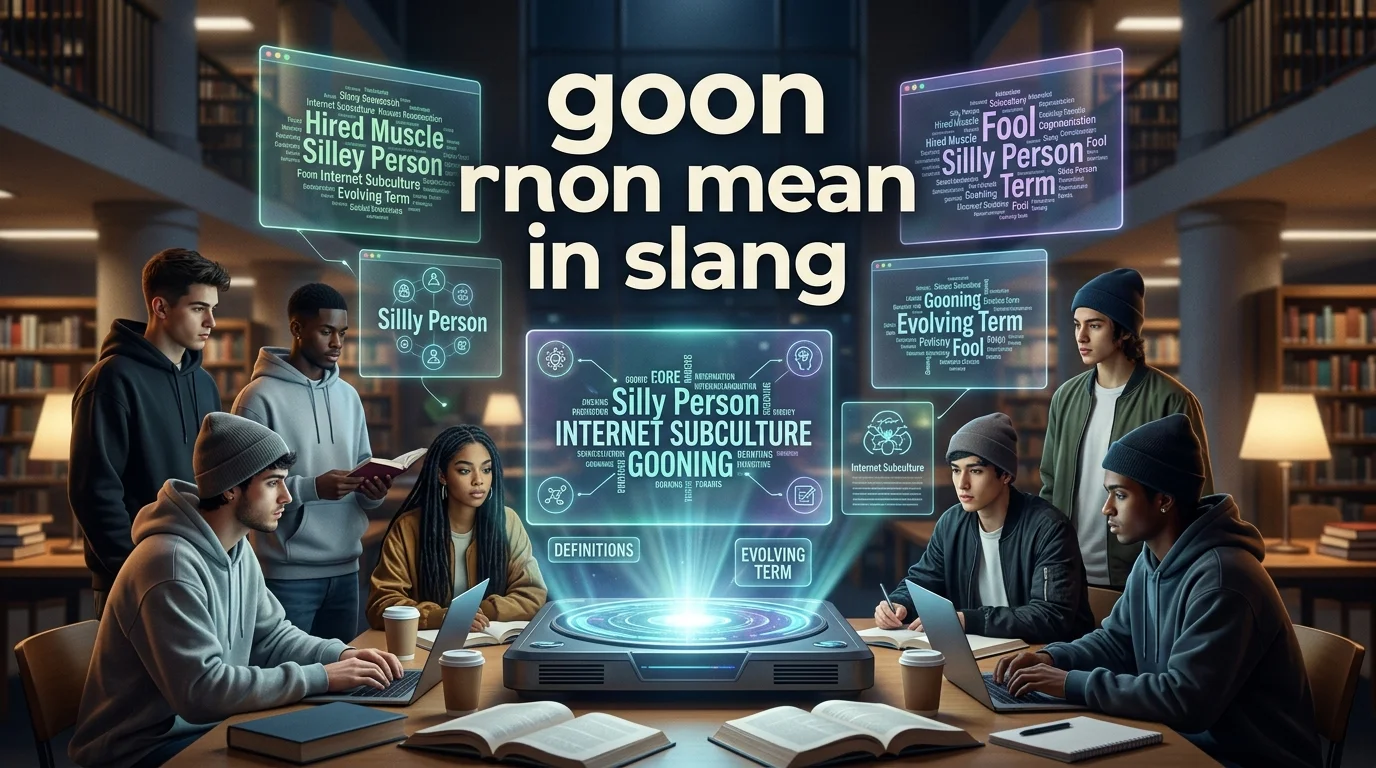
If you have spent even five minutes scrolling through TikTok, reading X threads, or lurking in Discord servers lately, you have probably stumbled across the word “goon.” You might remember the term from classic mobster movies or old comic books, where a goon was simply a muscular henchman doing a boss’s dirty work.
However, the internet has completely hijacked the word and twisted its meaning. Today, seeing the term drop in a chat can leave you scratching your head, wondering whether someone is talking about video games, foolish behavior, or something far more adult and explicit.
Understanding modern digital slang is about keeping up with cultural shifts and avoiding awkward social missteps. This guide breaks down what “goon” means in slang today, dissects its awkward evolution, explores its dark corners, and shows you how to navigate its usage without embarrassing yourself online.
What Does Goon Mean in Slang? Unpacking the Shift
Language moves at an incredible speed on the internet, and words often shed their original definitions overnight. The word “goon” is a prime example of a term that currently holds two vastly different slang definitions simultaneously.
Depending on who you are talking to, the word can be a lighthearted, silly insult or a hyper-specific piece of NSFW (Not Safe For Work) adult terminology.
When someone searches for what this word means in modern conversations, they are usually trying to figure out which of these two paths the speaker is walking down.
Classic/Casual Meaning: A silly, clumsy, or foolish person; a rough henchman.
Modern NSFW Meaning: Someone engaging in prolonged, hypnotic adult content consumption.
Knowing the difference between these definitions is crucial because using the term in the wrong setting can lead to massive social misunderstanding.
Goon Mean in Slang: Quick Meaning and Definitions
Core Definitions
To put it plainly, the word breaks down into two primary modern interpretations:
- The Casual/Gaming Definition: A goofy, silly, or foolish individual who acts brainless or awkward. It is also used in sports (especially hockey) to describe an aggressive player brought in to fight or intimidate opponents.
- The Internet/NSFW Definition: A slang term describing someone who enters an extended, trance-like state of continuous self-gratification while consuming adult media, often referred to as “gooning.”
Quick Examples in Conversation
“Don’t listen to him, he’s just being a total goon today.”
“That hockey match got wild after their team sent out the goons.”
“He stayed up until 4 AM locked in his room, totally gooning out on his computer.”
Origin & Background: How the Word Evolved
The Classic Roots
The word originally entered the English lexicon back in the 1930s. Comic strip creator E.C. Segar introduced a character named “Alice the Goon” in the famous Popeye comics. Alice was a tall, somewhat slow-witted, and awkward creature.
Shortly after, people began using the word to describe foolish, clumsy, or slow-moving individuals. By the mid-20th century, the term adapted to describe hired thugs, ruthless enforcement bodyguards, or low-level mobsters who relied on brute strength rather than intellect.
The Sports and Early Gaming Era
During the 1970s and 1980s, ice hockey firmly adopted the term. A “goon” became a permanent label for an enforcer—a player whose main job was not necessarily scoring goals, but physically protecting star players and starting fights with the rival team.
As online forum culture took off in the early 2000s, websites like Something Awful adopted the term “Goon” as a proudly self-deprecating badge of honor for its forum members.
The Modern NSFW Internet Shift
Around the mid-2010s, specialized adult subcultures on platforms like Reddit, Tumblr, and 4chan repurposed the word. It transformed from describing physical thugs to describing an addictive, psychological state associated with excessive adult media consumption.
Algorithms on TikTok, X, and Instagram pushed memetic variations of the word into mainstream youth culture, blurring the line between pure irony and explicit meaning.
Real-Life Conversations: How It Looks in Texts
To understand how this slang functions in daily life, let us examine realistic chat scenarios across different platforms.
Scenario 1: WhatsApp Chat Between Friends
Alex: Yo are we still hopping on Fortnite tonight or what?
Jordan: Nah bro, Kevin is being a total goon and forgot to install the update.
Alex: Classic Kevin. Man has two lightbulbs fighting for third place in his brain.
Scenario 2: Instagram DM
Maya: Why did Sam post 15 stories in a row of himself wearing a clown hat at the mall?
Chris: Honestly he’s just in his goon era. He literally does anything for a laugh now.
Maya: I can’t handle his brainrot anymore lol.
Scenario 3: TikTok Comment Section
User_99: Bro spent 12 hours straight grinding for a digital skin that doesn’t even boost stats 💀
GamingLover: Actual goon behavior, bro needs to go outside and touch real grass immediately.
Scenario 4: Text Message Exchange
Taylor: Did you see the match last night? The referee completely lost control.
Morgan: Yeah, the coach literally sent out his goons in the third period just to start a brawl.
Emotional & Psychological Meaning Behind the Word
Beyond simple dictionary definitions, words carry subtle emotional signals that tell us how the speaker feels.
What the Word Expresses
Using this slang usually signals a mix of lighthearted mockery, social detachment, or self-aware irony. When used in a non-explicit way, it allows people to gently poke fun at someone’s awkwardness without causing genuine offense.
In its darker, internet-native context, it reflects an exaggerated detachment from reality—a feeling of being completely consumed by screen time, dopamine overload, and hyper-fixation.
Psychological Context
Modern internet culture relies heavily on self-deprecating humor as a coping mechanism for isolation and digital burnout. Calling oneself or a friend a “goon” softens the blow of foolish behavior by turning it into a relatable joke.
Real-Life Scenario:
Imagine sitting in a quiet university library during finals week. You watch your classmate stare blankly at a single page of notes for forty-five minutes straight, occasionally giggles at a nonsensical meme, and completely forgets to eat lunch.
You lean over and whisper, “You’re completely lost in the juice right now, aren’t you?” That vacant, dopamine-fried state of mind is precisely the brain-fogged reality the modern slang attempt to capture.
Usage in Different Contexts
Understanding context is everything when dealing with ambiguous internet language.
Social Media (TikTok, X, Reddit)
On public social platforms, the word is frequently weaponized as a meme. It often refers to absurd, mindless, or obsessed behavior. However, because of shadowbanning and content moderation, creators frequently use it cheekily to hint at adult themes without triggering automated filters.
Friends & Relationships
Among close friends, calling someone a goon is usually affectionate ribbing. It implies that the person is being silly, goofy, or acting like a lovable idiot.
In romantic relationships, however, you should exercise extreme caution. Unless both partners are thoroughly immersed in modern internet culture and share the exact same humor, using the term can easily lead to awkward misunderstandings due to its explicit connotations.
Work and Professional Settings
Do not use this word at work.
Whether you mean the old-school definition (a thug) or the casual slang (a goofball), the risk of someone recognizing the explicit internet definition is extremely high. Keep this word far away from corporate emails, Zoom meetings, and professional networking events.
Context Appropriateness Breakdown:
Casual Gaming/Sports Chats: HIGH
Group Texts with Close Friends: HIGH
Social Media Memes: MODERATE (Mind the double meaning)
Dating/Relationships: LOW
Workplace/Professional: ZERO
When NOT to Use It
Navigating modern slang requires a healthy dose of situational awareness.
High-Risk Environments
- Professional Office Spaces: Calling a coworker a goon during a presentation can lead to a quick, uncomfortable meeting with Human Resources.
- Formal Family Gatherings: Older family members may interpret it as a harsh insult (calling someone a criminal thug), while younger tech-savvy relatives might cringe at the NSFW implications.
- Cross-Cultural Conversations: Non-native English speakers will likely look up the literal definition or stumble across explicit descriptions, causing unnecessary confusion.
Common Misunderstandings and Tone Confusion
The primary source of confusion around this word stems from the massive generational and subcultural divide in how it is interpreted.
Literal vs. Figurative Meaning
Older generations (Baby Boomers and Gen X) almost exclusively understand the word as a physical thug or an aggressive hockey player.
Gen Z and younger Millennials are vastly more likely to associate the word with either extreme “brainrot” meme culture or explicit internet subcultures.
Gen X / Boomers  ---> Thug, criminal, aggressive hockey enforcer
Millennials      ---> Goofy person, old-school forum user, thug
Gen Z / Gen Alpha ---> Brainrot meme, foolish gaming behavior, explicit NSFW state
Misinterpreting the speaker’s underlying intent can turn a completely harmless, silly comment into a highly awkward conversation.
Slang Comparison Table
To give you a clearer picture of where this term fits into the modern lexicon, here is how it compares to similar, opposite, and related slang expressions.
| Term | Meaning | Tone / Vibe | Context Level |
| Goon | A goofy person OR an explicit state of adult content fixation | Sarcastic, edgy, multi-layered | Highly contextual |
| Simp | Someone who does way too much for person they like | Mocking, teasing | Casual social media |
| Coomer | Someone hopelessly addicted to adult internet content | Critical, meme-heavy | Internet forums |
| Bungler | A clumsy, incompetent person | Gentle, innocent | Everyday conversation |
| Gigachad | An ultra-confident, muscular, physically ideal male | Complementary, ironic | Memes and gaming |
| Touch Grass | An instruction to go outside and reconnect with reality | Corrective, dismissive | Online arguments |
Key Insight
While terms like “simp” focus on how someone treats another person, this specific slang focuses almost entirely on an individual’s isolated mental state—whether that means acting hopelessly goofy or being trapped in a digital rabbit hole.
9 Common Variations and Types of the Slang
Modern internet users love modifying base slang words into nouns, verbs, and adjectives. Here are the most common variations you will see online today.
1. Gooning
The active verb form describing the process of being deeply immersed in mindless internet consumption or adult media trance states.
2. Gooncave
A dedicated room, desk, or gaming setup specifically optimized for endless, uninterrupted screen time and media consumption.
3. Goonsquad
A group of close friends who hang out together, often acting goofy, playing games, or causing minor, harmless chaos.
4. Goonette
A female variation of the slang, used to describe a woman who participates in the same silly behavior or subcultures.
5. Goon Brain
A state of extreme mental fatigue or brain fog caused by spending far too many hours staring at screens and consuming rapid media.
6. Gooning Out
The act of completely tuning out the real world to stare blankly at a screen, game, or video feed for hours.
7. Goon Master
A humorous, exaggerated title given to someone who is considered the ultimate expert at idling, gaming, or lurking online.
8. Hockey Goon
The classic sports usage referring directly to a rough player brought onto the ice specifically to pick fights and intimidate rivals.
9. Silly Goon
An innocent, old-school variation used to fondly call someone a playful goofball or airhead.
How to Respond When Someone Uses It
If someone drops this word in your direction, your response depends entirely on the tone and context of the situation.
Casual & Playful Replies
- “Guilty as charged, my brain has been running on low battery all day.”
- “Hey, leave my three remaining brain cells out of this!”
Funny & Witty Replies
- “I’m not acting silly, I’m just operating on a higher wavelength you can’t comprehend.”
- “Bold words coming from someone who spent two hours looking for their lost phone while holding it.”
Mature & Corrective Replies
- “Let’s keep the conversation professional and focus on getting this project finished.”
- “I’d prefer we don’t use that kind of slang in this group chat.”
Respectful Boundaries
- “I know you’re joking, but that word has some weird online meanings now, so let’s stick to normal jokes.”
Regional and Cultural Usage Differences
The way people process this term varies wildly depending on geographical location and cultural background.
Western Culture (US, UK, Canada, Australia)
In North America and Australia, the word easily toggles between hockey culture, old-school mob references, and modern internet slang. British English often leans toward using it as a light insult for a bumbling, awkward person.
Asian & Middle Eastern Culture
In regions where English is learned predominantly through formal education or traditional media, the word is almost universally understood through its classic definition: a thug or brute. Modern internet variations are usually restricted to heavily online youth demographics.
Generational Differences
Gen Z / Gen Alpha: Highly aware of both the meme culture and the explicit subtext.
Millennials: Familiar with forum culture, sports usage, and general goofiness.
Gen X & Boomers: Exclusively recognize the word as a thug, criminal, or comic character.
Is It Safe for Kids and Teenagers?
Parents and educators should exercise caution regarding this word. While the term historically functioned as a harmless, innocent word similar to “goofball,” its modern digital evolution carries heavy NSFW subtext.
If a younger teenager is repeatedly using the word or featuring it in their online profiles, they are likely imitating popular TikTok memes without fully understanding the explicit origin.
However, because the term is heavily intertwined with explicit adult communities online, open guidance is recommended.
Parental Guidance Rating:
Classic/Casual Sense: PG (Harmless goofiness)
Modern Internet Usage: PG-13 (Heavy meme exposure)
Subcultural Usage: R (Explicit adult media association)
Conversations around this term should focus on digital literacy, helping teens understand that repeating every trendy online word can carry hidden, uncomfortable meanings in the real world.
Frequently Asked Questions
Is the word considered a swear word?
No, it is not traditionally classified as a curse word. However, because its secondary modern definition is tied directly to explicit adult content, it is widely considered inappropriate for formal, academic, or professional environments.
What does “gooning” mean in video games?
In online gaming communities, it typically refers to turning off your brain and playing recklessly, making silly mistakes, or spending hours grinding for useless items instead of playing strategically.
Why did the meaning of the word change so suddenly?
Internet subcultures frequently adopt obscure or old-fashioned words and give them new meanings. Social media algorithms accelerate this process by spreading niche slang into mainstream youth culture within months.
How can I tell which meaning someone is using?
Look closely at the surrounding context. If someone is talking about sports, physical fights, or acting silly, they mean the classic definition. If the conversation involves extreme screen time, weird late-night internet habits, or explicit memes, they are tapping into the modern internet slang.
Is calling someone a goon an insult?
It depends entirely on the tone. Among close friends, it is usually a lighthearted joke about someone being silly. Among strangers or in a workplace, it can sound disrespectful or uncomfortably provocative.
Conclusion
Slang is a living, breathing reflection of how human culture transforms alongside technology. The word “goon” has completed a fascinating, albeit chaotic journey from a 1930s comic strip character to a hockey rink enforcer, finally landing as a complex piece of internet terminology.
Understanding these subtle shifts in language keeps you informed, culturally aware, and protected from embarrassing conversational mistakes.
The key to mastering modern slang is knowing your audience. Save the edgy internet terms for your gaming group chats, keep your workplace communications completely professional, and never be afraid to ask for clarification when a word sounds out of place!