The Surge Behind the Search
If you have spent any time watching true crime documentaries or following high-profile celebrity court cases on social media, you have probably heard the word.
Suddenly, a judge bangs a gavel, the courtroom erupts into murmurs, and the news anchors announce that a trial has been thrown out.
Naturally, this leaves viewers scrambling to their phones to search for what does a mistrial mean in real time.
We often think of the justice system as a straight line. Someone is charged, they go to court, and a jury says “guilty” or “not guilty.”
However, the legal world is incredibly messy. Sometimes, the rules of a fair trial get broken, or a jury simply cannot agree.
Understanding this concept completely changes how you consume news, podcasts, and even everyday conversations where legal jargon has started bleeding into modern slang.
What Does a Mistrial Mean? – Quick Meaning
The Core Definition
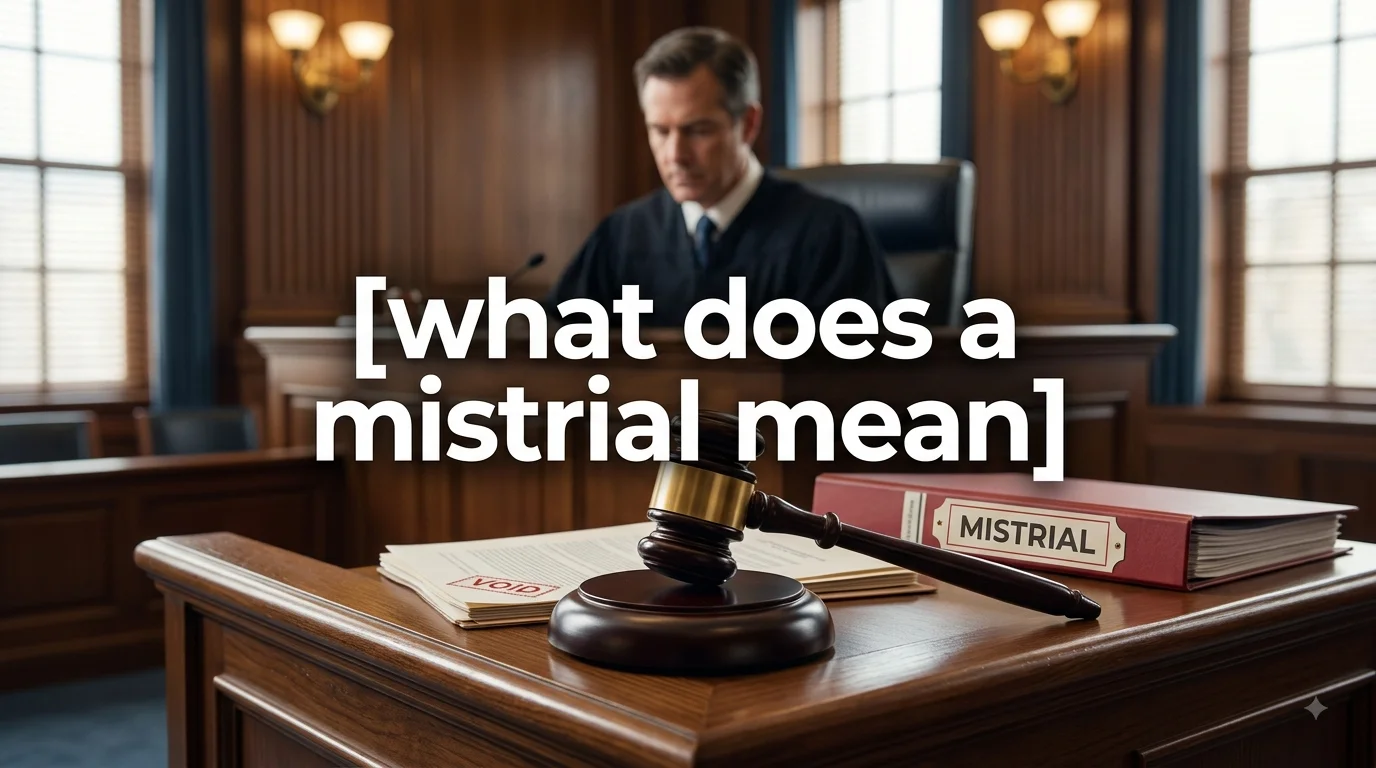
At its core, a mistrial is a trial that has been terminated and declared invalid before a verdict is ever reached.
It essentially hits the “reset” button on the entire legal proceeding. Legally speaking, it is as if the trial never actually happened.
This usually occurs because a fundamental error took place that prevents the defendant from receiving a fair trial.
Key reasons a judge might call one:
- The jury is hopelessly deadlocked and cannot reach a unanimous decision.
- A key figure (like a judge, juror, or attorney) acts inappropriately or unlawfully.
- Highly prejudicial evidence is shown to the jury by mistake.
- An unexpected emergency prevents the trial from continuing.
How People Talk About It
To get a better feel for it, here is how you might hear the phrase used in real life.
“The defense attorney accidentally revealed the defendant’s past criminal record to the jury, leaving the judge no choice but to declare a mistrial.”
“After five grueling days of deliberation, the foreman announced they were deadlocked, resulting in a mistrial.”
“Honestly, this whole group project is a mistrial. We need to scrap it and start over.”
Origin & Background
Where It Came From
The concept of fairness in court goes back centuries, rooted deeply in English Common Law.
Historically, if a court proceeding was tainted, it was considered a violation of a person’s fundamental rights. The prefix “mis-” comes from Old English and Latin, meaning wrong or badly.
When combined with “trial,” it literally translates to a trial gone wrong.
Cultural Influence
For decades, television shows like Law & Order and The Practice brought courtroom drama into our living rooms.
We grew up watching fictional lawyers shout “objection” and dramatically request mistrials to save their clients at the last second.
This created a cultural fascination with legal loopholes and courtroom strategy.
Social Media Impact
Today, the true crime boom has completely transformed how we interact with the justice system.
Live-streamed trials on YouTube and TikTok have turned everyday people into armchair detectives. When a major case hits a wall, millions of people instantly take to Twitter and Reddit to debate the judge’s ruling.
Consequently, legal terminology has slowly trickled into our everyday vocabulary.
Real-Life Conversations
WhatsApp (Friends debating a news story)
Person A: Did you see the breaking news about the trial?
Person B: Yes! I can’t believe the jury couldn’t agree.
Person A: Seriously. Twelve people and they couldn’t make a decision? What happens now?
Person B: It’s a mistrial. The prosecution has to decide if they want to start the whole thing over. So frustrating.
TikTok Comments (Under a True Crime video)
Person A: Wait, so he just gets to walk free now? 😳
Person B: No, a mistrial doesn’t mean innocent. It just means they have to do a do-over with a new jury.
Person A: Ohhh okay. The legal system is so confusing lol.
Instagram DMs (Reacting to a celebrity case)
Person A: The judge looked SO mad when that witness slipped up.
Person B: I thought for sure they were going to call a mistrial right there.
Person A: Honestly, they probably should have. The jury can’t un-hear that.
Text Messages (Using it as everyday slang)
Person A: How was the blind date last night??
Person B: Absolute disaster. He talked about his ex for two hours and spilled soup on my shoes.
Person A: Oh noooo 💀
Person B: Yeah, I’m declaring a mistrial. I need to go home and restart my week.
Emotional & Psychological Meaning
What Emotion It Expresses
When a high-profile case ends abruptly, the overriding emotion for the public is usually intense frustration.
We naturally crave resolution. Human psychology relies on stories having a clear beginning, middle, and end.
Therefore, when a jury deadlocks or a procedural error ruins the process, it feels deeply unsatisfying.
Why People Use It
For victims and their families, the emotional toll is devastating. They have to gear up to relive their trauma all over again in front of a brand new jury.
Conversely, for a defense team, it can feel like a massive sigh of relief or a strategic victory. It buys them time and gives them a preview of the prosecution’s strategy.
In everyday slang, people use the word to express the need for a total reset when a situation is hopelessly chaotic.
A Personal Scenario
I vividly remember following a local court case that had gripped our community for months.
I listened to daily podcast recaps, read every article, and anxiously awaited verdict day. When the judge announced a mistrial due to a single juror refusing to deliberate, my heart sank.
It was a stark reminder that the justice system isn’t a TV show; it is a fragile human process that can break down at any moment.
Usage in Different Contexts
Social Media & True Crime
Online, this phrase is used constantly by legal commentators and amateur sleuths.
You will see hashtags trending worldwide when a celebrity trial derails. Creators use the term to explain complex legal maneuvers to their audiences in 60-second bite-sized clips.
Friends & Relationships
Interestingly, younger generations have started using courtroom language to describe their personal lives.
If an argument goes completely off the rails, someone might joke, “Okay, mistrial, let’s drop this and order pizza.”
It serves as a humorous, dramatic way to say, “This situation is broken beyond repair.”
Work & Professional Settings
In an actual professional or legal setting, it is a highly serious term.
Lawyers do not ask for it lightly. Filing a motion for a mistrial requires extensive paperwork, legal precedent, and a solid argument that their client’s constitutional rights have been violated.
Casual vs. Serious Tone
It is crucial to read the room.
Calling a disastrous team meeting a “mistrial” is funny and relatable. However, using the term casually when discussing a real-life tragedy or violent crime can come across as deeply insensitive.
When NOT to Use It
Inappropriate Contexts
You should avoid using the term to describe a situation where someone was actually found not guilty.
People often conflate a trial being thrown out with a person being fully exonerated. Using the term incorrectly spreads misinformation about how the legal system actually functions.
Cultural Sensitivity
When real lives are at stake, avoid treating court cases purely as entertainment.
Behind every legal ruling, there are real victims, grieving families, and individuals whose freedom is on the line. Throwing the word around like a punchline on Twitter can minimize their suffering.
Situations Where It May Cause Misunderstanding
Never use it interchangeably with an “acquittal.”
If you tell a friend that a local politician’s case ended in a mistrial, they might assume the politician was cleared of all charges. You must clarify that the trial was simply aborted, not resolved.
Common Misunderstandings
The “Double Jeopardy” Myth
The most common myth is that a mistrial triggers the “Double Jeopardy” clause of the 5th Amendment, meaning a person can never be tried again.
This is largely false. If a trial ends because of a hung jury or a procedural error out of the prosecution’s control, the state is almost always allowed to retry the defendant.
Double jeopardy typically only attaches if the judge rules the prosecution intentionally caused the error to save a losing case.
Tone Confusion
People often assume that this ruling always favors the defense.
While defense attorneys frequently request them, prosecutors can sometimes request them too, especially if the defense breaks a major rule.
Furthermore, a do-over can actually drain a defendant’s financial resources, making a second trial much harder to win.
Literal vs Figurative Meaning
As the word slips into modern slang, some people get confused when it is used figuratively.
If someone says a botched product launch was a “mistrial,” they don’t mean a judge got involved. They simply mean it was a catastrophic failure that requires a complete do-over.
Comparison Table
| Term | Meaning | Can They Be Retried? | Slang Equivalent |
|---|---|---|---|
| Mistrial | Trial aborted due to an error or deadlocked jury. | Yes (usually). | “Let’s scrap this and start over.” |
| Acquittal | The jury finds the defendant NOT guilty. | No (Double Jeopardy applies). | “Cleared / Beat the allegations.” |
| Dismissal | The judge throws the case out before or during trial. | Sometimes, depending on the reason. | “Canceled before it began.” |
| Hung Jury | A jury that cannot reach a unanimous verdict. | Yes. (This is a cause of a mistrial). | “We can’t agree on anything.” |
Key Insight
The defining difference between these terms boils down to finality. An acquittal means the story is permanently over and the defendant is legally free. A mistrial, however, is merely an intermission; the curtain has dropped, but the play will likely start again from act one on a different day.
Variations / Types (Minimum 8–10)
1. Hung Jury
Short Meaning: The jury is deadlocked.
1-line explanation: After days of arguing, the jury cannot reach a unanimous agreement, forcing the judge to end the trial.
2. Prejudicial Error
Short Meaning: The jury heard something they shouldn’t have.
1-line explanation: A witness blurts out banned information (like a prior conviction) that unfairly taints the jury’s opinion.
3. Juror Misconduct
Short Meaning: A juror breaks the rules.
1-line explanation: A jury member researches the case on Google or talks to the media, compromising their neutrality.
4. Prosecutorial Misconduct
Short Meaning: The state plays dirty.
1-line explanation: The prosecutor hides evidence or makes wildly inappropriate comments to sway the jury.
5. Death or Illness
Short Meaning: A key player is incapacitated.
1-line explanation: The judge, a central attorney, or a crucial juror falls seriously ill, and no alternates are available.
6. Lack of Jurisdiction
Short Meaning: The court doesn’t have authority.
1-line explanation: It is discovered mid-trial that the specific court does not legally have the power to hear this specific type of case.
7. Tainted Evidence
Short Meaning: The proof is compromised.
1-line explanation: A central piece of physical evidence is suddenly proven to be fake or illegally obtained mid-trial.
8. The “Metaphorical” Mistrial (Slang)
Short Meaning: A social disaster.
1-line explanation: Used in everyday conversation to describe a date, event, or project that needs to be completely abandoned.
How to Respond When Someone Uses It
Casual Replies
If a friend uses it to describe a dramatic news story, keep it conversational.
“I know, right? I can’t believe they have to start all over again. The lawyers must be exhausted.”
Funny Replies
If someone uses it as slang to describe a ruined night out or a terrible date, lean into the joke.
“Motion granted! Let’s leave this terrible party, grab some fries, and retry this weekend.”
Mature Replies
If discussing a serious, real-life case with complex social implications, respond thoughtfully.
“It’s definitely frustrating, but I suppose it’s better for the system to pause rather than risk an unfair conviction.”
Respectful Replies
If speaking to someone who was a victim or closely involved in a derailed case, show deep empathy.
“I am so incredibly sorry you have to go through this process all over again. I am here to support you.”
Regional & Cultural Usage
Western Culture
In the United States, trials by jury are a massive part of the legal framework.
Because unanimous verdicts are required in criminal cases, mistrials are a fairly common, well-understood phenomenon. The dramatic nature of US media deeply sensationalizes these moments.
Asian & European Culture
In many European and Asian legal systems, juries are either not used at all, or they operate through a panel of professional judges.
Because a single judge or a panel is making the decision, a “hung jury” doesn’t exist. Trials are rarely aborted in the same dramatic fashion, making the concept feel distinctly American to international observers.
Global Internet Usage
Thanks to globally streamed court cases, the term has crossed borders.
People in the UK, Australia, and parts of Asia now frequently use American courtroom terminology on Twitter and TikTok to discuss international pop culture scandals.
Generational Differences
Millennials mostly learned this phrase by watching prime-time cable television and procedural dramas.
Gen Z, however, interacts with the word actively. They use courtroom jargon in their TikTok commentary, treating legal vocabulary as an extension of internet slang to describe both real crimes and petty influencer drama.
Is It Safe for Kids?
The word itself is entirely safe and educational.
Teaching a child about the justice system, fairness, and the rule of law is a wonderful civics lesson.
However, you should exercise caution regarding the context. The cases that typically result in these dramatic rulings often involve violent crimes or sensitive subject matter that may not be appropriate for young children to research on their own.
FAQs
What happens immediately after a mistrial is declared?
The jury is dismissed, and the trial is officially over. The prosecution must then decide whether they want to drop the charges, offer a plea deal, or schedule a brand new trial with a different jury.
Does a mistrial mean the defendant is innocent?
No. It only means the trial process was flawed or incomplete. The defendant’s legal status remains exactly as it was before the trial started—presumed innocent, but still facing active charges.
How long does the prosecution have to retry the case?
It varies by state and jurisdiction, but the prosecution typically has a set window (often 60 to 90 days) to initiate a new trial, depending on the court’s schedule and the defendant’s right to a speedy trial.
Can a judge deny a request for a mistrial?
Yes, absolutely. Lawyers frequently request them during heated moments, but judges often deny the motion, instructing the jury to simply ignore a mistake rather than throwing the entire trial out.
Who pays for the second trial?
The taxpayers fund the court costs and the prosecution. However, the defendant is usually responsible for paying their own defense attorneys all over again, which can be financially devastating.
Are mistrials common?
They are relatively rare. The vast majority of criminal cases end in plea bargains. Of the cases that do go to trial, only a small percentage result in a jury deadlock or a fatal procedural error.
Conclusion
Navigating the legal system can feel like trying to read a foreign language.
When you hear a judge declare a mistrial, it is easy to assume that justice has failed or that a criminal has walked free on a technicality.
However, understanding this concept reveals the deep complexities of how our courts actually work. It is a vital safeguard designed to ensure that when a verdict is finally reached, it is as fair and untainted as humanly possible.
Whether you are debating the latest true crime documentary with your friends, or just jokingly using the phrase to describe a catastrophic Monday morning, you now have the full context behind the gavel drop.
The next time a massive celebrity case abruptly derails, you will be the most informed person in the room.