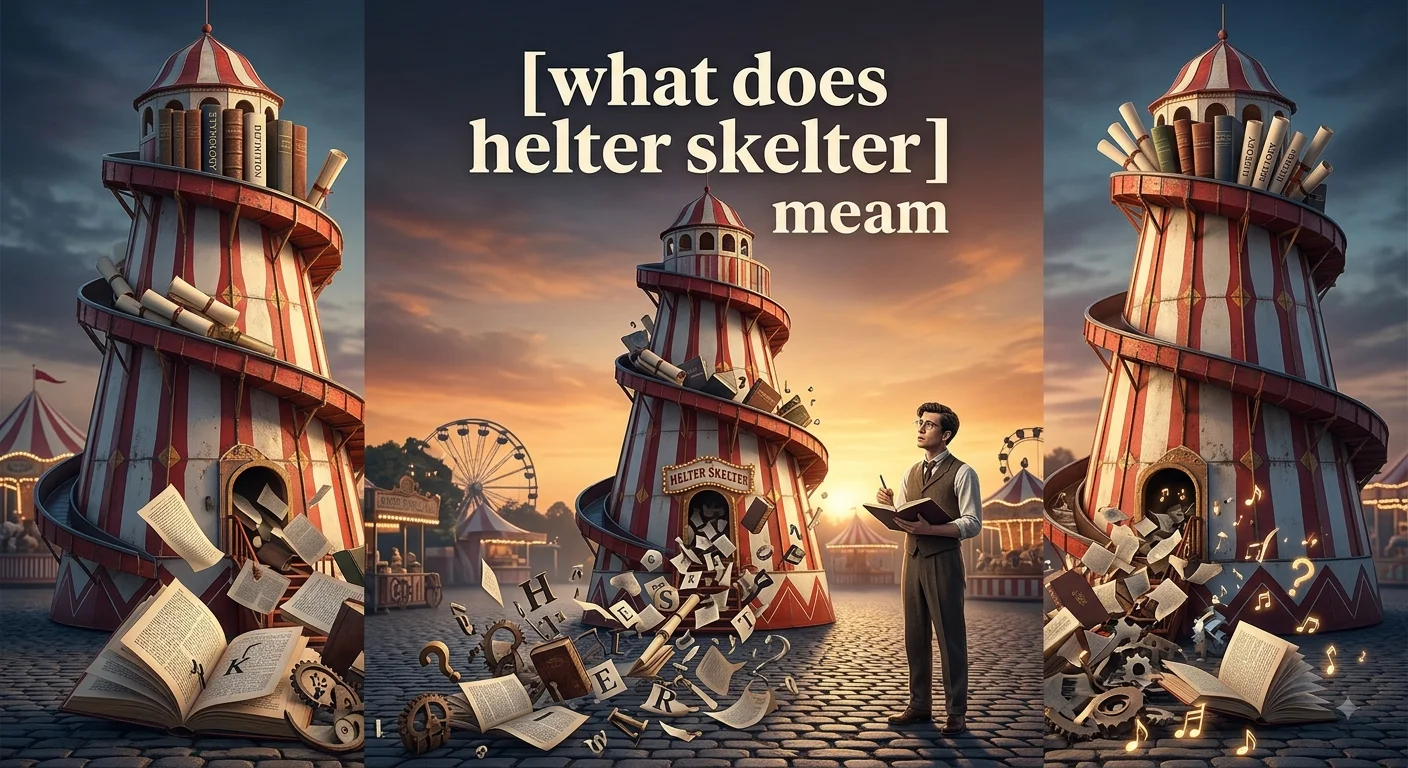
Have you ever found yourself in the middle of a week so chaotic that everything felt like it was spinning completely out of control?
You might hear a coworker describe their morning commute as “pure helter skelter,” or read a music review describing a wild, messy guitar solo using the exact same phrase. It sounds slightly playful, almost like a nursery rhyme, yet it carries an undeniable sense of rush and confusion.
Many people search for what this peculiar phrase actually means because it pops up in unexpected places—from classic rock history to modern group chats. Understanding its full nuance helps you decode everyday conversations, grasp pop culture references, and express your own chaotic moments with precision.
Unpacking the Chaos: What Does Helter Skelter Mean?
At its core, helter skelter means done in a hurried, confused, or disorderly manner. It describes situations, movements, or environments where structure collapses and pure randomness takes over.
When used as an adverb, it refers to running or moving in headlong, messy haste. As an adjective, it characterizes something marked by total disorder or lack of organization.
Quick Definitions at a Glance
- Primary Meaning: Disorderly haste, confusion, or turmoil.
- Literary/Visual Meaning: Running headlong or tumbling downward in a scattered frenzy.
- British Culture Meaning: A tall, spiral fairground slide that users ride down on a burlap mat.
Here is how the phrase looks in everyday language:
“The sudden rainstorm sent everyone running helter skelter across the park to find cover under the pavilion.”
“Our product launch turned into a helter skelter mess after the main server crashed an hour before going live.”
“She packed her bags in a helter skelter rush, tossing passports and socks into the same side pocket.”
Origin and Background: From Fairgrounds to Pop Culture
The history of this phrase is as rich and winding as the spiral slide it eventually came to represent.
1500s: Rhyming Reduplication (Helt-Skelte) ➔ 1800s: British Fairground Spiral Slides ➔ 1968: The Beatles & Pop Culture ➔ Present: Modern Digital Communication
Linguistic Roots in Early Modern England
The phrase dates back to 16th-century England. Linguists classify it as a “rhyming reduplication”—a linguistic pattern where words are combined through rhythm and rhyme to emphasize speed or motion, much like pell-mell or hodge-podge.
The root likely traces back to the Middle English word helter, meaning to hurry, paired with skelter, which evokes fleeing or scattering. Together, they create a word that sounds like the very chaos it describes.
The British Fairground Revolution
In late 19th-century Britain, “Helter Skelter” took on a physical form. Amusements parks built tall, wooden, lighthouse-like towers with a spiral slide wrapped around the exterior.
Riders climbed to the top, sat on a simple mat, and plunged downward in a dizzying, fast-paced spin. The name was a perfect fit: fast, dizzying, slightly out of control, yet thrilling.
The Beatles and Darker Cultural Association
In 1968, The Beatles released their famous track titled Helter Skelter on the White Album. Paul McCartney explicitly wrote the song to simulate audio chaos—loud guitars, screaming vocals, and heavy drums—using the fairground slide as a metaphor for the rise and fall of society.
Unfortunately, the term took a dark turn in the late 1960s when cult leader Charles Manson misinterpreted the song’s lyrics, using the phrase to describe his apocalyptic vision. Despite this dark chapter, the phrase successfully reclaimed its original, harmless meaning in mainstream language over the following decades.
Real-Life Conversations: How People Use It Today
To understand how this phrase functions in real life, let’s look at how people drop it into modern text messages and digital conversations.
WhatsApp Group Chat: Last-Minute Event Planning
Sarah: Hey guys, are we still meeting at 7 PM for dinner?
Mark: Honestly, my whole day has been completely helter skelter. I’m still stuck at the office finishing reports.
Sarah: Oh no! Do you want us to push it back to 8:30 PM?
Mark: Yes please, that gives me time to decompress and stop running around like crazy.
Instagram DMs: Travel Mishaps
Elena: Your photos from Italy look amazing! How was the flight over?
David: The views were great, but catching our connecting flight in Frankfurt was helter skelter!
Elena: Yikes, did you almost miss it?
David: We had 15 minutes to cross three terminals with full backpacks. Pure panic!
TikTok Comment Section: Festival Recap
User_1: The crowd organization at the entrance looked so wild in that clip 😳
User_2: It really was! Security gates broke down and everyone moved helter skelter toward the main stage.
User_1: Glad you made it inside safely!
Emotional and Psychological Meaning
Words do more than transfer raw information; they carry distinct psychological weight and subtle emotional signals.
What Emotion Does the Phrase Express?
Using this expression signals overwhelmed amusement rather than deep, dark despair. It acknowledges that things are messy, but it softens the blow with a rhythmic, almost bouncy tone.
It captures that specific state of mind where events move faster than your ability to process them. You feel scattered, rushed, and slightly out of breath, yet you retain enough self-awareness to observe the madness.
Why People Choose It Over Plain Words
Saying “everything was messy” feels flat and clinical. Choosing “helter skelter” adds texture and imagery, invoking pictures of scattered leaves, tumbling fairground rides, or rushing crowds.
It communicates vulnerability without sounding helpless. It tells the listener that while your day fell apart, you can still step back and describe it with creative flair.
A Quick Personal Insight into Workplace Haste
During an early career stint managing live community events, our registration software crashed five minutes before doors opened to a line of 500 attendees. What followed was a flurry of handwritten nametags, shouted instructions, and improvised seating charts.
When describing the morning to late-arriving colleagues, calling it “disorganized” felt far too corporate and cold. Calling it a “helter skelter scramble” captured the exact human reality: frantic energy, sweat, shared laughter, and survival instinct.
Usage in Different Contexts
Adapting your vocabulary to your setting is crucial for effective communication. Here is how this idiom fits across various environments:
┌─────────────────────────────────────────────────────────────┐
│                      Context Spectrum                       │
├──────────────────────────────┬──────────────────────────────┤
│  Informal / Creative         │  Professional / Academic     │
│  (Social, DMs, Stories)      │  (Reports, Emails, Speeches) │
│                              │                              │
│  • Highly effective          │  • Use sparingly            │
│  • Adds color and emotion    │  • Swap for "disorganized"    │
│  • Conveys vivid action      │    or "unstructured"        │
└──────────────────────────────┴──────────────────────────────┘
Social Media & Digital Spaces
On platforms like X (formerly Twitter), Threads, or Instagram, the phrase works exceptionally well. It serves as a vivid descriptor for fast-moving news cycles, viral trends, or chaotic personal vlogs.
Friends & Personal Relationships
In personal relationships, the phrase adds humor to stressful moments. It allows you to vent about a terrible morning without bringing down the emotional tone of the entire conversation.
Work and Professional Settings
Use caution in formal business environments. Telling a client that your team managed a project in a “helter skelter manner” implies unprofessionalism and lack of planning.
In professional emails, opt for terms like unstructured, uncoordinated, or rapidly evolving. Save the idiom for casual side chats with trusted colleagues over coffee.
When NOT to Use It
Even flexible idioms have clear boundaries where their usage becomes inappropriate or tone-deaf.
Serious Emergencies or Tragedies
Never use the phrase to describe genuine, traumatic disasters. Referring to a serious building evacuation or a natural disaster as “helter skelter” minimizes human suffering and sounds calloused.
High-Stakes Professional Statements
Avoid using the phrase in formal press releases, legal documents, or performance reviews. It lacks the precision and weight required for authoritative, formal writing.
Cultural Sensitivity and Historical Context
Be mindful when speaking with audiences deeply familiar with 1960s American true crime history. While most of the world associates the phrase with British slides or general chaos, older generations might still associate it with the Manson trial.
Common Misunderstandings
Clear communication relies on eliminating subtle misunderstandings before they cause confusion.
Confusing “Helter Skelter” with “Helter Shelter”
A common phonetic mistake is mishearing the phrase as “helter shelter.” Because “shelter” is a common English word related to safety, people assume the phrase means seeking refuge in a hurry. The correct term uses skelter, emphasizing fleeing or rushing.
Assuming It Means “Evil” or “Dangerous”
Due to pop culture history, some listeners assume the term inherently carries a dark, menacing connotation. In modern English grammar, it remains completely neutral-to-playful, referring simply to disorder.
Literal vs. Figurative Missteps
If a British friend says, “Let’s go on the helter skelter,” they are inviting you to ride a literal slide at a fairground. Context dictates whether the usage is physical or figurative.
Expressing Chaos: Related Terms Compared
Understanding where this phrase fits among similar English idioms helps refine your expression.
| Term | Tone | Meaning Focus | Best Used For |
|---|---|---|---|
| Helter Skelter | Playful, Vivid | Hasty, scattered confusion | Fast-paced personal chaos |
| Pell-Mell | Classic, Literary | Disorderly, headlong rush | Physical crowds or movement |
| Hodge-Podge | Mild, Casual | A random mix of items | Physical objects or ideas |
| Willy-Nilly | Lighthearted | Haphazardly, without plan | Decisions made without thought |
| Topsy-Turvy | Childlike, Gentle | Upside down, inverted order | Systems or schedules flipped |
Key Insight
While terms like hodge-podge focus on a messy collection of things, helter skelter focuses specifically on chaotic action and rapid, unstructured movement.
Variations and Shades of Meaning
Depending on the sentence structure, the phrase shifts light nuances.
1. The Helter-Skelter Rush
Refers to a sudden, panic-driven movement of people trying to get somewhere fast without structure.
2. Helter-Skelter Mindset
Describes an internal psychological state where thoughts fly around too fast to organize.
3. A Helter-Skelter Schedule
Refers to a calendar packed with back-to-back commitments without travel time or breaks.
4. Running Helter-Skelter
The classic adverbial form, describing physical movement without clear direction.
5. Helter-Skelter Development
Used by urban planners or journalists to describe rapid, unregulated construction in expanding cities.
6. A Helter-Skelter Atmosphere
Describes a party, venue, or event characterized by loud noise, constant movement, and high energy.
7. Helter-Skelter Defense
A sports term describing a defensive team scrambling frantically without maintaining their positions.
8. Helter-Skelter Market Conditions
Used informally by traders to describe stock markets fluctuating rapidly due to breaking news.
How to Respond When Someone Uses It
When a friend or colleague describes their situation using this idiom, matching their tone keeps the conversation flowing smoothly.
Casual Replies
“Sounds like a wild day! Hope you finally get a chance to sit down and catch your breath.”
“Yikes, I hate those kinds of mornings. Let me know if you need help catching up.”
Funny Replies
“Sounds like you survived the carnival ride! Did you at least get cotton candy at the end?”
“Hold on tight! Just make sure you don’t lose your shoes on the way down.”
Mature & Empathetic Replies
“That sounds genuinely draining. Take all the time you need to reset today.”
“It takes a lot of mental energy to navigate a day like that. Go easy on yourself tonight.”
Respectful Professional Replies
“Thank you for navigating that sudden shift so quickly. Let’s touch base tomorrow once things settle.”
Regional and Cultural Usage
Language changes across borders and generations, giving words distinct regional flavors.
       ┌────────────────────────────────────────────────────────┐
       │               Global Cultural Nuance                   │
       └───────────────────────────┬────────────────────────────┘
                                   │
         ┌─────────────────────────┼─────────────────────────┐
         ▼                         ▼                         ▼
   United Kingdom            United States             Global/Gen Z
  Fairground slide          Purely figurative          Fast, absurd
  & everyday idiom          idiom for chaos           internet humor
Western Culture (UK vs. US)
In the United Kingdom, the phrase is part of everyday vocabulary due to the omnipresence of traditional fairground slides. Most Britons visualize the physical ride immediately when hearing the term.
In the United States, the physical ride is far less common, so Americans treat the phrase purely as an abstract idiom for confusion or rapid motion.
Asian and Middle Eastern Cultures
For non-native English speakers in Asian and Middle Eastern international business hubs, idioms like this are often learned through literature or media rather than daily conversational immersion. They are typically used in academic or formal writing contexts rather than spoken slang.
Generational Differences: Gen Z vs. Millennials
Millennials often recognize the term through classic rock music or traditional idioms passed down by parents.
Gen Z uses the term less frequently in daily speech, often preferring modern alternatives like fever dream, main character energy, or simply pure chaos. However, when Gen Z does use it, it is often in creative online storytelling to describe absurd, fast-paced situations.
Is It Safe for Kids?
Yes, the phrase is completely safe and appropriate for children.
It contains no profanity, crude imagery, or offensive linguistic roots. In fact, because of its rhyming nature, children often enjoy the sound of the word. Reading books that contain traditional idioms helps expand a child’s reading comprehension and vocabulary depth.
Frequently Asked Questions
Is helter skelter hyphenated?
It can be written both with and without a hyphen. Generally, use a hyphen (helter-skelter) when it acts as an adjective before a noun (e.g., “a helter-skelter morning”), and leave it as two words when used as an adverb (e.g., “they ran helter skelter”).
Is helter skelter positive or negative?
It is mostly neutral to slightly negative, as it implies disorder. However, because of its rhythmic sound, it carries a lighter, less dramatic tone than words like catastrophe or havoc.
What is the opposite of helter skelter?
Direct opposites include methodical, orderly, systematic, organized, and tranquil.
Is helter skelter British or American slang?
While understood across the English-speaking world, its origins and physical fairground association make it predominantly British in origin, though widely used in American English.
Does the phrase have anything to do with military tactics?
No, it originated as rhyming speech in Middle English and later became associated with amusement parks, though military historians occasionally use it to describe disorganized retreats.
Wrapping Up the Chaos
Navigating the English language can sometimes feel like a helter skelter ride itself—full of unexpected turns, historical shifts, and quirky rhyming expressions.
The next time your schedule falls into temporary disorder or your group chat erupts into fast-paced banter, you will have the exact right phrase to describe it. Embrace the occasional messiness of life, hold on tight, and communicate your experience with clarity and confidence.