Decoding the Internet: Why Everyone Is Asking What SMH Means
Language moves faster today than ever before, and digital slang constantly rewrites how we connect. You are scrolling through your group chat, reading TikTok comments, or checking Instagram DMs, and there it is: three simple letters that seem to carry an entire mood.
Understanding internet acronyms isn’t just about learning modern vocabulary. It’s about staying connected to how people genuinely communicate emotions across screens.
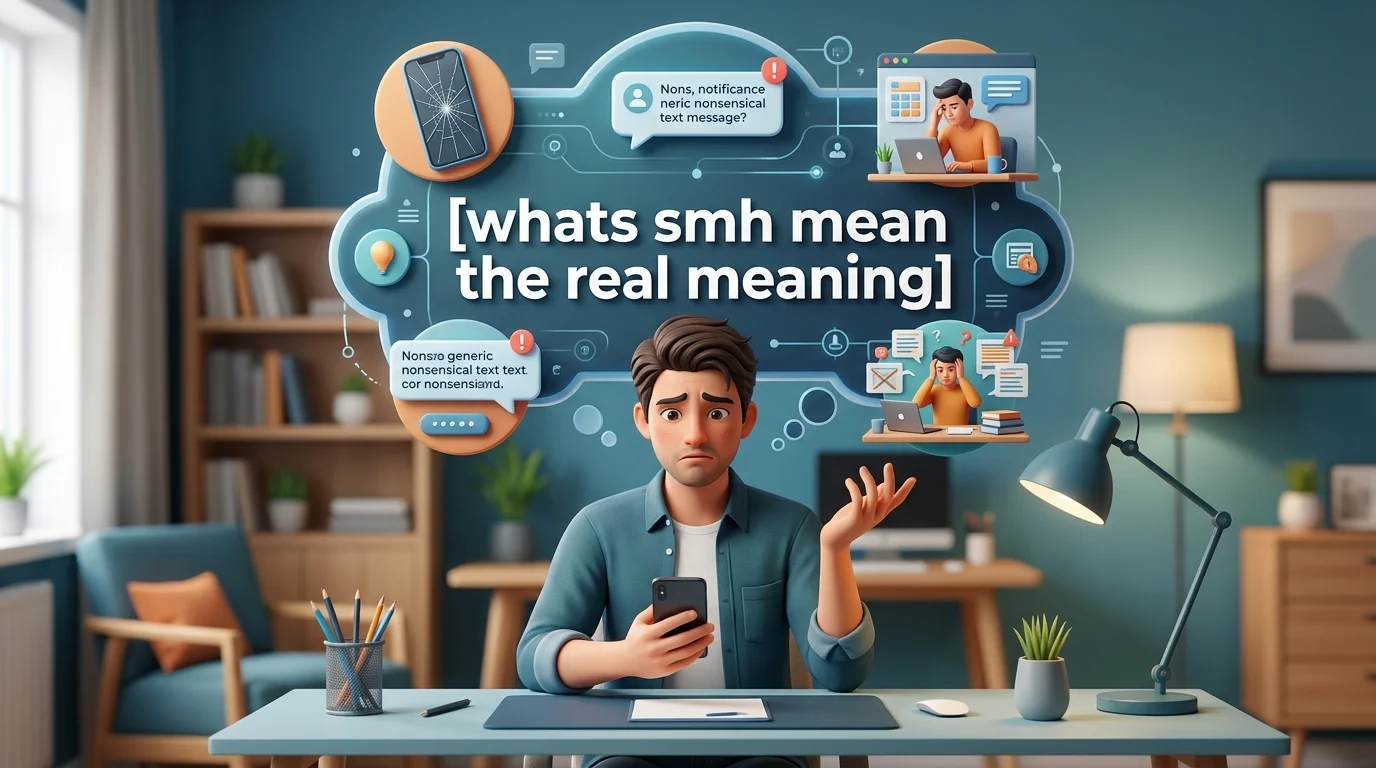
People search for whats smh mean the real meaning because the tone behind those three letters can feel elusive. Is someone angry, sarcastic, or simply disappointed? Let’s clear up the confusion completely.
Whats SMH Mean: The Real Meaning Simplified
Definition & Quick Summary
At its core, SMH stands for “Shaking My Head.”
It is a digital shorthand used to express disappointment, disapproval, disbelief, or amusement at something foolish or frustrating.
Key Characteristics of SMH
- Core Meaning: Shaking My Head
- Primary Emotion: Disapproval, disbelief, mild annoyance, or ironic humor
- Tone: Highly contextual (ranges from playful teasing to serious disappointment)
- Format: Usually typed in lowercase (
smh), but uppercase (SMH) adds extra emphasis
“He dropped his slice of pizza cheese-side down on the rug again. smh”
“People are still falling for that fake celebrity giveaway link? SMH.”
“I forgot my keys inside the house for the third time this week… smh my head.”
Origin & Background: How SMH Took Over the Web
The Early Days of Internet Chat
Long before smartphone keyboards, early internet users relied on text-based forums, IRC chatrooms, and Urban Dictionary to share quick reactions. The acronym first surfaced in the early 2000s as online gaming and instant messaging platforms like MSN Messenger exploded in popularity.
Typing out full physical descriptions took too long during fast conversations. Shortened physical actions—like LOL (Laughing Out Loud) or ROFL (Rolling On the Floor Laughing)—became standard shorthand.
Social Media Amplification & Cultural Shift
When Twitter (now X) and smartphone texting took over in the late 2000s, space constraints made acronyms essential. SMH evolved from a niche chat room term into a global cultural phenomenon.
Over the past decade, memes, GIF culture, and short-form video platforms like TikTok cemented SMH into modern digital language. It shifted from simply describing a physical action to representing a universal psychological response to modern absurdity.
Real-Life Conversations: SMH in the Wild
Scenario 1: The Group Text (WhatsApp)
Maya: Did Alex really just cancel on dinner five minutes before we were supposed to meet?
Jordan: Yep. Said he got distracted playing video games.
Maya: smh he does this every single time.
Scenario 2: Direct Messages (Instagram DMs)
Liam: Look at this photo of my attempt to bake a birthday cake.
Sophia: Liam… is that burnt or charcoal? 😂
Liam: It tastes like sadness.
Sophia: SMH you had one job!
Scenario 3: Video Comments Section (TikTok)
User_123: I put my phone in the microwave to charge it faster because I saw a video online…
DigitalNative: Please tell me this is a joke.
User_123: It started sparking instantly!
DigitalNative: smh people will believe anything on this app.
Scenario 4: Everyday Casual Texting
Sam: Guess who just walked all the way to the grocery store and forgot their wallet?
Taylor: No way… you again?
Sam: Me again. Sitting in the parking lot smh.
Emotional & Psychological Meaning: What Lies Beneath the Letters
The Psychology of Disapproval
Human communication relies heavily on body language. Over 70% of face-to-face interaction is non-verbal. When we communicate through glass screens, we lose subtle physical cues like eye rolls, sighs, and head shakes.
SMH restores that lost non-verbal layer. Typing those three letters projects an explicit mental image of your physical reaction to the reader.
Why We Use It
- Low-Effort Boundary Setting: It signals disagreement without initiating a heavy argument.
- Shared Disillusionment: It creates instant camaraderie around shared frustrations.
- Emotional Catharsis: It lets off mild conversational steam instantly.
A Personal Observation on Digital Nuance
A close friend once texted me during a busy workday: “Just spent twenty minutes looking for my glasses while wearing them.”
My immediate reply was simply “smh.” That single acronym communicated empathy, gentle teasing, and complete understanding without needing a long, formal paragraph.
Usage in Different Contexts
Social Media & Public Forums
On public feeds, SMH acts as a community commentary tool. Users attach it to news headlines, viral videos, or questionable public opinions to signal crowd disagreement instantly.
Friends & Romantic Relationships
Among close friends, SMH is almost always playful. It marks affectionate teasing when a partner or friend does something silly or predictably clumsy.
Professional & Work Settings
Avoid using SMH in professional work emails, Slack channels, or client interactions. It carries an informal, slightly dismissive tone that can easily appear unprofessional or passive-aggressive to managers and clients.
| Context | Appropriateness | Recommended Alternative |
|---|---|---|
| Texting Friends | High | “smh”, “unbelievable 😂” |
| Social Media Comments | High | “smh”, “shaking my head” |
| Internal Team Chat (Slack) | Low | “That’s unfortunate”, “Oh no” |
| Professional Email | Unacceptable | “I share your concern regarding this matter.” |
When NOT to Use SMH
Serious Life Events & Tragedy
Never send “SMH” in response to sad news, grief, or serious personal hardship. Responding to bad news with shorthand comes across as cold, insensitive, and dismissive.
Resolving Active Conflicts
When working through an active disagreement with a friend or partner, using SMH can feel passive-aggressive. It shuts down dialogue rather than opening space for resolution.
Cross-Cultural Misunderstandings
When speaking with non-native English speakers or older generations unfamiliar with internet slang, acronyms cause unnecessary confusion. Direct, clear phrasing works best.
Common Misunderstandings About SMH
Misunderstanding 1: Tone Misinterpretation
The biggest mistake people make with SMH is assuming it always signals severe anger. In reality, modern internet users apply it far more frequently for lighthearted facepalms than genuine rage.
Misunderstanding 2: Literal Redundancy
A famous internet running joke involves the phrase “smh my head.”
Literally translated, it means “shaking my head my head.” While technically redundant, internet users intentionally type this for dramatic, comedic exaggeration.
Misunderstanding 3: Confusing Acronyms
Many readers occasionally mistake SMH for So Much Hate or Smack My Head. While context dictates everything, the overwhelming majority of online usage strictly means Shaking My Head.
Comparing Internet Slang Expressions
| Expression | Meaning | Primary Emotional Tone | Context Best Suited For |
|---|---|---|---|
| SMH | Shaking My Head | Disappointment, disbelief | Reacting to foolish actions |
| FFS | For F***’s Sake | Frustration, anger | High annoyance or stress |
| NGL | Not Gonna Lie | Honesty, vulnerability | Sharing candid thoughts |
| TBH | To Be Honest | Frankness, clarity | Giving direct opinions |
| Facepalm | Physical hand to face | Embarrassment, disbelief | Reacting to self-inflicted mistakes |
| LMAO | Laughing My A** Off | Amusement, laughter | Pure humor and funny situations |
Key Insight
SMH occupies a unique middle ground in digital communication—it bridges the gap between pure humor (like LOL) and genuine frustration (like FFS), making it one of the most versatile tone indicators online.
10 Variations and Spin-Offs of SMH
1. SMDH
- Meaning: Shaking My Damn Head
- Explanation: Adds extra emphasis when basic disappointment isn’t strong enough.
2. SMH MY HEAD
- Meaning: Shaking My Head My Head
- Explanation: An intentionally redundant, sarcastic joke popular on Reddit and Twitter.
3. NSMH
- Meaning: Not Shaking My Head
- Explanation: Used rare-side to express approval or surprise at a surprisingly good outcome.
4. SMFH
- Meaning: Shaking My F***ing Head
- Explanation: An intense, profane variation reserved for extreme disbelief or outrage.
5. Shakes Head
- Meaning: Roleplay action format
- Explanation: Descriptive text format often used in narrative-style forum posts.
6. SMH-ing
- Meaning: The act of shaking one’s head
- Explanation: Verbification of the acronym used to describe someone’s persistent disapproval.
7. SMH Real Big
- Meaning: Extreme disappointment
- Explanation: Colloquial phrase used to highlight huge mistakes or ridiculous news.
8. Big SMH
- Meaning: Major disapproval
- Explanation: Shortened slang variant emphasizing a severe lack of judgment.
9. SML
- Meaning: Shaking My Life (or Smiled My Last)
- Explanation: A dramatic cousin of SMH focusing on personal bad luck or tragicomedy.
10. Direct Emoji Substitution (🤦♂️ / 🤦♀️)
- Meaning: Facepalm emoji
- Explanation: The visual counterpart to SMH, often paired together for maximum effect.
How to Respond When Someone Sends You SMH
Casual & Lighthearted Replies
- “I know, I know… I messed up!”
- “In my defense, it sounded like a good idea at the time.”
- “Don’t judge me too harshly!”
Funny & Witty Replies
- “My head is shaking right along with yours.”
- “At least I keep things interesting around here!”
- “Hey, someone has to keep the entertainment high.”
Mature & Thoughtful Replies
- “I understand why you feel that way. Let me fix it.”
- “Fair point. I could have handled that better.”
- “I hear you, let’s look at another approach.”
Regional, Cultural, and Generational Usage
Western Internet Culture
In North America, Europe, and Australia, SMH functions as an everyday conversational staple. It appears across all mainstream platforms, from group chats to viral commentary channels.
Asian & Middle Eastern Digital Contexts
Across non-Western digital spaces, English acronyms like SMH are frequently adopted by bilingual youth. However, local language equivalents or visual emojis (like the facepalm 🤦) often take precedence in casual regional apps like WeChat or Line.
Gen Z vs. Millennials: The Generational Divide
Millennials tend to use SMH literally to signal actual annoyance or tragicomic events.
Gen Z uses SMH far more ironically, often pairing it with hyperbole or absurd humor (“smh my head”). Older generations may misinterpret the acronym entirely or rarely use it.
Is SMH Safe for Kids and Teens?
Content Awareness for Parents
Yes, SMH is completely safe. The acronym itself contains no profanity, vulgarity, or harmful content.
However, parents should remember that variations like SMFH contain strong language. Monitoring overall online interaction context remains good practice, but the core term smh is harmless internet slang.
Frequently Asked Questions
What does SMH mean in texting?
SMH stands for “Shaking My Head.” Text users send it to express disappointment, disapproval, disbelief, or lighthearted frustration regarding a silly situation.
Is SMH a rude response?
It depends heavily on context. Among friends, it is usually harmless teasing. In professional or serious conversations, it can come across as dismissive or passive-aggressive.
Does SMH mean “So Much Hate”?
While a small minority occasionally misinterprets it that way, the true, universally recognized definition of SMH is “Shaking My Head.”
What is the difference between SMH and SMDH?
SMDH stands for “Shaking My Damn Head.” The addition of “damn” adds extra emotional weight and emphasis to the expression.
Can I use SMH in a work email?
It is best to avoid slang in professional emails. Use formal language like “That is concerning” or “I share your frustration” instead.
Master Digital Communication with Confidence
Understanding modern internet vocabulary allows us to navigate digital conversations with clarity, emotional intelligence, and ease.
SMH is far more than three random letters on a keyboard—it is a expressive tool that brings human body language right onto our digital screens. Use it naturally among friends, keep it out of formal work emails, and keep enjoying the evolving tapestry of online culture.