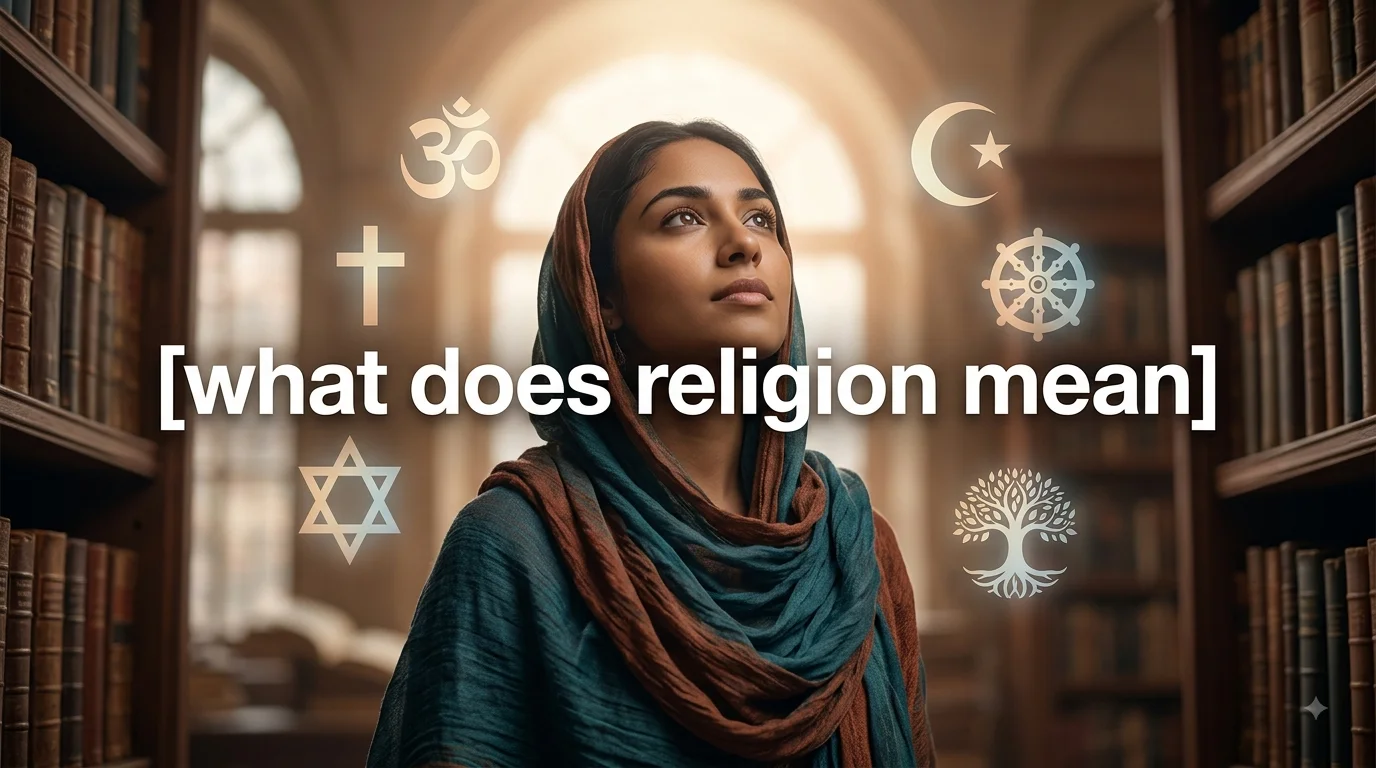
Understanding What Religion Really Means
Ask ten different people to define the word “religion,” and you will likely receive ten completely different answers. For a grandmother sitting in a church pew, it represents an unbroken lineage of sacred tradition and generational solace. For a sociology researcher analyzing societal structures, it functions as a foundational framework for community cohesion and moral organization.
When people search online for what does religion mean, they are rarely just looking for a dry, one-sentence dictionary entry. Most of us arrive at this question during moments of personal transition, cultural curiosity, or internal debate. Perhaps you saw a friend post an online update declaring they are “spiritual but not religious,” or maybe you felt confused by how modern slang uses the term to describe extreme devotion to skincare routines or football teams.
This guide strips away the academic jargon to explore the practical, historical, emotional, and modern realities of religion. By examining where the word originated, how society uses it today, and why it holds such deep psychological weight, you will gain a clear, human perspective on one of humanity’s oldest concepts.
What Does Religion Mean? A Quick Overview
At its most fundamental level, religion is a structured system of beliefs, practices, values, and worldviews that connects human beings to spiritual elements, moral codes, and ultimate meaning. It provides a blueprint for understanding where we came from, how we should live, and what happens after death.
Relational Core: A bridge between the human experience and the unseen, sacred, or ultimate reality.
To break this complex concept down into clear pieces, religion typically consists of four distinct pillars:
- Belief Systems: A shared set of ideas regarding the cosmos, divinity, morality, and the afterlife.
- Rituals and Practices: Structured actions, such as prayer, meditation, fasting, gathering, or sacred festivals, that reinforce communal and personal faith.
- Ethical Frameworks: Clear guidelines defining right from wrong, helping members navigate complex human relationships and choices.
- Community and Belonging: A collective identity that unites individuals across geography, generations, and social classes.
Quoted Perspectives on Meaning
“Religion is a system of human recognition of a higher unseen power that commands worship and shapes moral conduct.”
“Beyond ritual, religion represents humanity’s collective struggle to find order in an unpredictable universe.”
“To understand what religion means is to understand how human beings transform basic survival into purpose.”
Origin and Historical Background
The word itself carries a rich history that mirrors human development across millennia. Its root leads back to the Latin term religio, which ancient Romans used to describe a deep sense of reverence, obligation, or sacred duty to divine forces.
The Etymological Evolution
Language scholars frequently trace the word back to the Latin verb religare, which literally translates to “to bind together” or “to tie fast.” This linguistic origin offers incredible insight into the purpose of early human faith systems. Ancient societies required a unifying social fabric to hold communities together long before modern nation-states, legal frameworks, or global communication systems existed.
Cultural Influence Across Eras
In early human history, faith was deeply intertwined with daily survival. Ancient Egyptian, Mesopotamian, and Vedic traditions did not treat spiritual life as a separate weekend activity. Instead, it dictated agricultural cycles, governance, medicine, and architecture.
As trade routes expanded, philosophical systems crossed borders. The Silk Road, for example, transformed how Buddhism, Islam, and Christianity spread and adapted across diverse continents, blending local customs with core spiritual tenets.
How Social Media and the Internet Shifted the Meaning
In the digital age, internet culture transformed how people talk about spiritual identity. Online platforms democratized access to theological texts, allowing young generations to explore world traditions outside their family background.
Furthermore, social media repurposed the term metaphorically. Today, internet users frequently describe intense devotion to a niche lifestyle—such as “the religion of crossfit” or “skincare as a religion”—referencing the discipline, community, and routine associated with traditional faith systems.
Real-Life Conversations
To understand how people talk about faith and belief today, look at everyday text exchanges. Modern conversations around faith range from deep personal reflections to casual, humorous comments about everyday obsessions.
WhatsApp Message Exchange
Elena: Hey, are you coming to Sunday brunch this week?
Marcus: I can’t make it this week! It’s Easter service, and my family always goes together.
Elena: Oh right! I forgot you guys still do that. Are you going because you want to, or just for your mom?
Marcus: A bit of both honestly. I don’t agree with every single rule, but the quiet reflection time and family togetherness actually mean a lot to me.
Instagram DM Thread
Sarah: Did you see Maya’s story? She posted that she’s officially leaving her local church group.
David: Yeah, I read her post. It sounds like she’s stepping away from organized dogma, but she said she still prays every night.
Sarah: That makes sense. A lot of people our age want the spiritual connection without the institutional pressure.
TikTok Comment Section
User_Alpha: Imagine giving 10% of your paycheck to a building… couldn’t be me.
User_Beta: It’s not about the building bro. It’s about funding local food banks and having a tight-knit group that actually shows up when your life falls apart.
Mobile Text Exchange
Chloe: I swear, staying consistent with this 5 AM morning routine is becoming my new religion!
Liam: Haha, please don’t start chanting in the living room at dawn!
Chloe: No promises! But seriously, having that daily ritual keeps my brain grounded.
Emotional and Psychological Meaning
Stripping away institutions and scriptures reveals that religion is fundamentally driven by deep human emotional needs. Humans naturally crave order, safety, and understanding.
Existential Safety <---> Psychological Comfort <---> Purpose-Driven Living
Psychologically, religious practices act as powerful buffers against anxiety and existential dread. The awareness of our own mortality creates a natural psychological weight. Belief systems alleviate this anxiety by framing human life within a vast, meaningful story where death is not a cold ending, but a transition or natural cycle.
Why People Seek Belonging Through Belief
Belonging remains one of the strongest drivers of human behavior. Modern society often leaves individuals feeling isolated, isolated behind screens and demanding work schedules. Traditional spiritual groups offer a rare physical sanctuary where people of varying ages, income levels, and backgrounds gather regularly around shared ideals rather than commercial interests.
A Real-World Perspective on Faith
Consider a quiet hospital waiting room late at night. When medical answers fail and uncertainty looms, watch how people instinctively lean into ritual. A woman softly rolling wooden beads through her fingers, or a man whispering an ancient prayer handed down by his grandfather, is not engaged in abstract theology. They are reaching for emotional anchor points in the middle of a storm. That lived reality is the true emotional heart of faith.
Usage in Different Contexts
The term changes color depending on where and how it is spoken. Understanding these subtle contextual shifts prevents awkward miscommunications.
Social Media Dynamics
Online, people use the word in both literal and figurative ways. Users participate in religious discussions on dedicated forums, while others use the word hyperbolically to describe intense loyalty to pop culture, brands, or daily wellness routines.
Friends and Personal Relationships
In casual social settings, talking about faith requires tact and empathy. Friends often use the word to explore identity, family traditions, or personal growth. It can serve as a bridge to understand a friend’s values or, if approached aggressively, a source of unnecessary friction.
Professional and Workplace Environments
Within a modern corporate or professional environment, religion is categorized alongside legal protections and cultural diversity. Human resource frameworks treat spiritual beliefs as a protected aspect of identity that requires mutual respect, holiday accommodations, and strict freedom from discrimination.
+------------------+-------------------------------------------------------+
| Context          | Expressed Meaning & Function                          |
+------------------+-------------------------------------------------------+
| Social Media     | Identity expression, community, or hyperbolic metaphor |
| Casual Friendships| Shared moral values, family heritage, background talk |
| Workplace        | Diversity, equal protection, schedule accommodation   |
| Academic         | Sociological structures, historical human movement    |
+------------------+-------------------------------------------------------+
When NOT to Use the Term
While open discussions foster empathy, using religious terms carelessly can cause offense or create deep misunderstandings.
Inappropriate Contexts and Flippant Uses
Avoid trivializing deeply sacred traditions when speaking with individuals who hold those beliefs dear. Describing a trivial hobby like shopping or fantasy football as your “religion” around someone experiencing solemn religious observance can sometimes feel disrespectful or dismissive.
Cultural and Cross-Faith Sensitivity
Never assume that your personal definition applies universally. For instance, Western perspectives often view religion through the lens of specific doctrines and weekly services. However, many Indigenous traditions and Eastern cultures do not distinguish between daily life, nature, and spirituality—to them, separating “religion” into a standalone box makes very little sense.
Potential Misunderstandings
- Confusing Faith with Zealotry: Avoid assuming that anyone who claims a faith identity holds extreme or rigid views.
- Assuming Disinterest Means Hostility: Recognizing that someone is non-religious does not mean they hate spiritual discussions or lack strong moral values.
Common Misunderstandings
Misconceptions around spirituality create artificial divides. Clearing up these common errors leads to far healthier, more informed conversations.
Organized Religion vs. Personal Spirituality
One of the largest modern points of confusion is equating institutional religion with spiritual belief.
- Organized Religion: Features formal governance, explicit doctrines, historical institutions, and structured communal services.
- Personal Spirituality: Focuses on an individual’s personal connection to the transcendent, internal peace, and self-discovery, often unattached to formal institutions.
Literalism vs. Symbolic Understanding
Outsiders often make the mistake of assuming all believers interpret ancient religious texts literally. Across almost every global tradition, scholars, mystics, and everyday followers engage with scriptures symbolically, allegorically, and contextually, viewing stories as deep metaphors for internal human growth.
Comparison of Related Terms
To understand the core keyword clearly, it helps to compare it directly with adjacent concepts that people frequently confuse.
| Concept / Term | Primary Focus | Key Distinction | Typical Practice |
|---|---|---|---|
| Religion | Shared doctrine, communal ritual, institution | Organized structure with collective accountability | Weekly gatherings, ancient texts, shared creeds |
| Spirituality | Individual internal peace, cosmic connection | Personal experience without strict institutional rules | Meditation, nature walks, personal reflection |
| Philosophy | Reason, logic, critical inquiry into existence | Focuses on logical thought rather than divine revelation | Academic debate, critical writing, ethical analysis |
| Culture | Regional customs, language, shared history | Can exist entirely separate from spiritual beliefs | Folk art, national holidays, regional food |
| Dogma | Rigid, unyielding rules set by an authority | Leaves zero room for personal interpretation or doubt | Strict adherence to written mandates |
Key Insight
While philosophy relies primarily on human logic and spirituality centers on individual feeling, religion uniquely weaves shared doctrine, emotional comfort, and collective community into a single long-lasting structure.
Variations and Related Concepts
Understanding the wider vocabulary surrounding belief systems helps clear up confusion during conversations. Here are nine key variations you will encounter:
Monotheism
The belief in a single, supreme, all-powerful God. Example traditions include Islam, Judaism, and Christianity.
Polytheism
The veneration and worship of multiple distinct deities representing different elements of life and nature. Seen clearly in historical Norse mythology and ancient Greek traditions.
Pantheism
The belief that the universe itself and God are identical, viewing all nature as divine. Treats the cosmos as an interconnected, living spiritual reality.
Agnosticism
The view that the ultimate truth regarding God or the supernatural is currently unknown or inherently unknowable. Focuses on intellectual honesty regarding the limits of human knowledge.
Atheism
The absence of belief in the existence of gods or divine beings. Relies on naturalistic, empirical explanations for the physical world.
Humanism
An ethical stance emphasizing the value, agency, and moral capacity of human beings without relying on divine intervention. Centers human empathy and logic as the ultimate guides for morality.
Deism
The belief in a creator who set the universe in motion but does not interfere in human affairs or perform miracles. Gained major popularity among Enlightenment thinkers and founding scholars.
Animism
The worldview that objects, places, and creatures all possess a distinct spiritual essence or living soul. Forms the foundational perspective of many ancient and indigenous traditions.
Inter-faith
Movements and dialogues designed to build cooperation and mutual respect across totally different religious traditions. Focuses on shared moral values while respecting distinct cultural heritages.
How to Respond When Someone Mentions Their Beliefs
Knowing how to navigate discussions about belief helps maintain healthy relationships. Here are thoughtful ways to respond depending on the social context:
Casual & Friendly Responses
“That’s awesome! I love how much comfort and stability that routine brings into your life.”
“I didn’t know you practiced that! I’d love to hear more about your tradition sometime if you’re open to sharing.”
Lighthearted & Humorous Responses
“Hey, whatever keeps your life on the right track and keeps you sane in this crazy world, I’m all for it!”
“If that daily routine is your secret to staying so calm, maybe I need to join you next week!”
Mature & Balanced Responses
“Even though we might hold slightly different personal worldviews, I really respect the core ethics and discipline behind your tradition.”
“It’s really refreshing to see someone stay grounded in their core values despite how chaotic things get around us.”
Respectful Responses During Differences
“I really appreciate you sharing that part of your identity with me. It gives me a much better understanding of where you’re coming from.”
“I see things from a slightly different perspective, but I deeply value the common human compassion we both care about.”
Regional and Cultural Nuances
The meaning and daily expression of faith shift dramatically as you travel around the globe.
Western Perspectives
In North America and Western Europe, religious practice has become increasingly individualized. Secularization has led to a major rise in people identifying as “spiritual but not religious.” Faith is widely viewed as a personal choice rather than a mandatory civic duty.
Eastern Traditions
Across Asian cultures—such as in India, China, or Japan—traditions like Hinduism, Buddhism, Taoism, and Confucianism often function more as holistic ways of living rather than rigid institutions. Individuals frequently practice elements of multiple traditions simultaneously without experiencing any internal conflict.
Middle Eastern Dynamics
In the Middle East, faith is deeply woven into the social, legal, and linguistic fabric of daily life. Greetings, legal frameworks, family structures, and community calendars are directly tied to long-standing traditions, making it an inseparable part of social identity.
Gen Z / Young Millennials <---> Modern Digital Spiritual Hybridity
Older Generations          <---> Traditional Institutional Roots
Generational Shifts: Gen Z vs. Millennials vs. Older Generations
Older generations often prioritize institutional loyalty, physical attendance, and historical tradition. Conversely, Millennials and Gen Z lean toward eclectic, personalized practices. Younger demographic groups frequently merge ethical consumerism, mental health practices, and ancient contemplative habits into a customized personal framework.
Is the Subject Safe and Appropriate for Youth?
When discussing faith with children and teenagers, the subject is completely safe and intellectually beneficial when framed with openness, curiosity, and empathy.
[Curiosity & Knowledge] ---> [Cultural Literacy] ---> [Empathy & Reduced Bias]
Exposing young minds to diverse belief systems fosters global literacy and helps prevent prejudice. The key is to teach children about what different global neighbors believe without using fear tactics, pressure, or dogmatic threats. Focus on core universal values like kindness, gratitude, honesty, and community care.
Frequently Asked Questions
Can someone be spiritual without being religious?
Yes. Being spiritual typically involves cultivating an internal sense of peace, cosmic awe, or connection to nature on your own terms. Being religious usually means participating in a structured community with specific doctrines, formal rituals, and historical texts.
What is the world’s oldest living religion?
Hinduism is widely considered by scholars to be the world’s oldest active religion, with roots and foundational texts dating back over 3,500 years into ancient history.
Is Buddhism considered a religion or a philosophy?
Buddhism contains elements of both. While it lacks a central creator god, its rich sacred traditions, ethical codes, monastic structures, and spiritual goals regarding rebirth lead most global scholars to categorize it as a non-theistic religion.
Why do religions have so many rituals?
Rituals serve as physical anchors for internal abstract beliefs. Performing structured actions helps lower psychological stress, strengthens community bonds, and marks major life transitions like births, marriages, and passings.
How does religion differ from culture?
Religion refers to the specific spiritual beliefs, worldviews, and practices concerning the divine or moral order. Culture is the broader umbrella that encompasses regional food, art, music, language, and social habits. While they often overlap, you can share a culture without sharing the same faith.
Why do definitions of this word vary so much?
Definitions vary because human experiences differ. An academic defines faith through data and societal impact, while an individual practitioner defines it through deep emotional comfort, family history, and personal encounters with the sacred.
Summary
At its core, understanding what does religion mean requires looking far beyond simple dictionary definitions. Religion is a dynamic, living aspect of human culture that balances our need for individual purpose with our deep desire for community connection.
Whether viewed as a sacred divine covenant, a historical social system, or an internal search for peace, faith continues to shape how billions of people navigate their lives, treat their neighbors, and face the unknown future.
By approaching the subject with open curiosity rather than judgment, we can appreciate the rich, multi-layered tapestry of human belief and foster far genuine compassion across our diverse world.