We have all been in a situation where someone crossed a line, made a massive mistake, or broke our trust. In those heavy moments, a single question tends to hover in the air: What does it mean to pardon someone, and should you actually do it?
People search for this concept for deeply personal reasons. Sometimes, you are trying to navigate a painful rift in a relationship and need to know if letting go of resentment makes you strong or naive. Other times, you might be following a high-profile court case on the news, trying to figure out why a government official just wiped away a criminal conviction.
The confusion usually stems from how easily we mix up pardoning, forgiving, excusing, and forgetting. They sound like the exact same thing on the surface, but in practice, they operate in completely different ways.
Understanding this distinction changes how you navigate emotional conflict, manage professional relationships, and process personal pain. Let us break down what pardoning really signifies, where it comes from, and how it plays out in our modern world.
What Does It Mean to Pardon Someone? – Quick Meaning
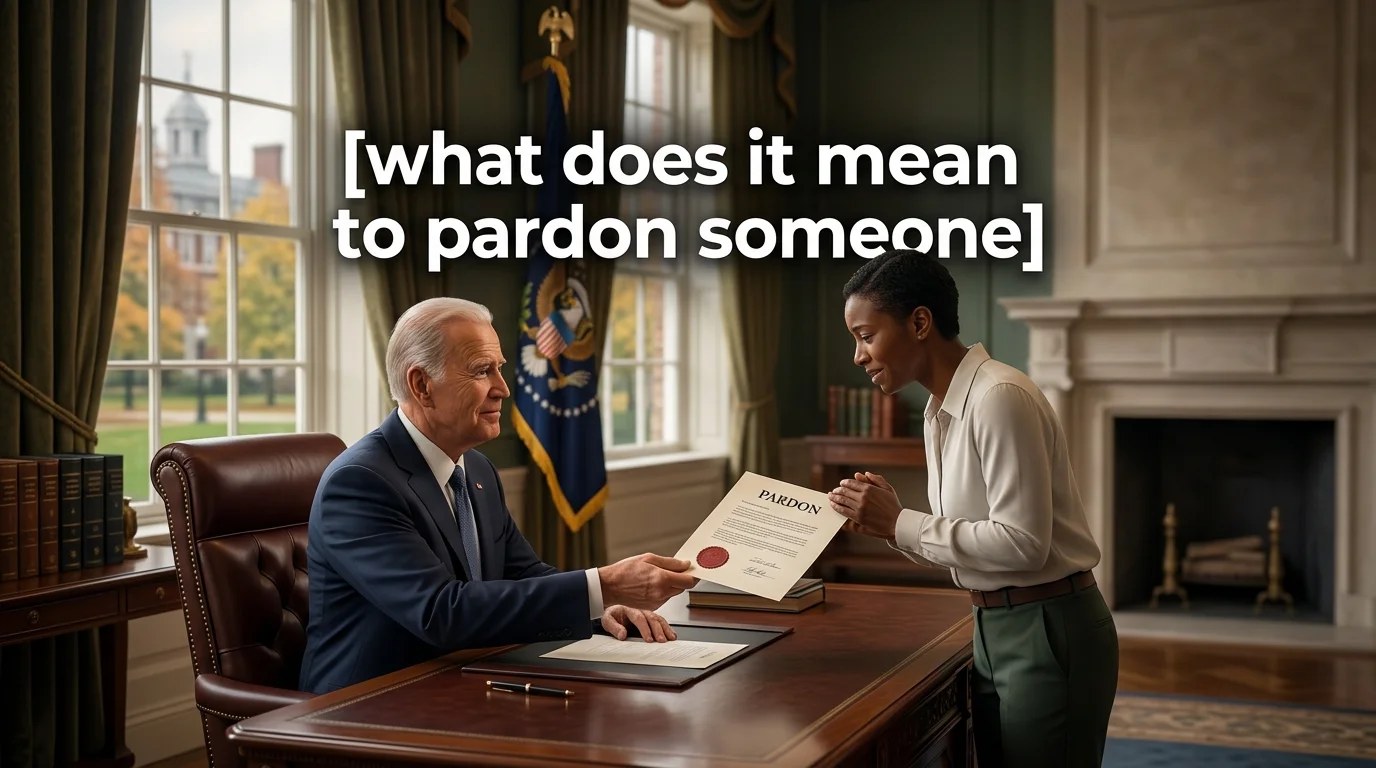
At its core, to pardon someone means to officially release them from the punishment, penalty, or guilt associated with an offense. It is a deliberate choice to absorb or cancel a legal or moral debt that the offender rightly owes.
When you pardon a person, you are not saying that their action was acceptable. Instead, you are acknowledging that a wrongdoing occurred, but you are choosing to remove the penalty attached to it.
“To pardon is to look at a debt that is legitimately owed and say, ‘You no longer have to pay this back to me.'”
“In a legal sense, a pardon wipes away the legal consequences of a crime, restoring the person’s civil rights as if the punishment were completed.”
“In daily life, granting a pardon means choosing not to hold a person’s blunder over their head as leverage.”
Core Elements of a True Pardon
- Acknowledgment of Guilt: A pardon cannot exist without a recognized transgression.
- Cancellation of Penalty: The primary action is removing the consequence or punishment.
- Restoration: It opens the door for the person to regain their standing, whether in society or in a relationship.
Origin & Background of the Term
The word “pardon” carries a rich history that bridges ancient religious traditions, medieval monarchies, and modern legal systems.
Etymology and Historical Roots
The term entered the English language in the 13th century through Old French (pardonner), which traces back to the Vulgar Latin word perdonare. The prefix per- means “completely,” while donare means “to give.”
Literally, to pardon means “to give completely” or “to grant as a free gift.” Early usage was deeply tied to royal decrees and religious absolution, where a king or religious authority possessed the sole power to grant absolute mercy to subjects.
Cultural Evolution and Social Media Impact
In classical history, pardoning was a top-down power dynamic. Kings pardoned rebels to show supreme authority, and legal systems adopted executive clemency to act as a safety valve against overly harsh judicial punishments.
In the digital age, the language of pardoning has leaked out of courtrooms and into social media discourse. Internet culture often swings rapidly between “cancel culture” and public redemption arcs.
Online communities regularly debate whether a creator or public figure deserves a public pardon after an old mistake surfaces. The term has evolved from a formal legal mechanism into a cultural framework for deciding who gets a second chance in the public eye.
Real-Life Conversations
To see how this plays out outside of textbooks, let us look at how the concept shows up in our daily messaging apps and digital interactions.
WhatsApp: Navigating a Deep Personal Betrayal
Person A: I honestly don’t know if I can move past what Sarah did at work. She threw me under the bus during the client pitch.
Person B: She definitely messed up, but she owned it in front of the manager today.
Person A: Owning it is fine, but what does it mean to pardon someone who shattered your trust?
Person B: It doesn’t mean trusting her with your secrets tomorrow. It just means you stop letting her mistake consume your peace today.
Instagram DMs: Discussing a Public Scandal
Person A: Did you see that influencer’s apology video? People in the comments are saying we should pardon him.
Person B: Idk, it felt pretty staged to me.
Person A: True, but if he served his time off the app and apologized, at what point do we let people move on?
Person B: Pardoning someone requires real accountability, not just a sad thumbnail with no makeup.
Text Messages: Family Tension After a Broken Promise
Person A: Dad called. He wants to know if you’re coming to Thanksgiving after last year’s blowup.
Person B: I’m still angry about what he said to my partner.
Person A: I get it. You don’t have to pretend it didn’t hurt, but pardoning him might help you drop that heavy anchor you’ve been carrying.
Person B: I’ll think about it. Giving a pardon is way harder than people make it sound.
Emotional & Psychological Meaning
Beyond legal definitions, pardoning carries immense psychological weight. It is an act that transforms both the person granting it and the person receiving it.
The Inner Shift of Clemency
Emotionally, choosing to pardon someone is an assertion of personal agency. Holding onto a grudge keeps you emotionally tied to the person who wronged you.
Psychologically, when you refuse to pardon, you remain trapped in the moment of the offense. Deciding to grant mercy breaks that emotional tether, allowing you to reclaim your narrative.
What It Reveals About Modern Communication
Our modern communication culture is fast-paced and quick to judge. Choosing to pardon signals a rare level of emotional maturity.
It demonstrates an understanding that human beings are complex, flawed, and capable of growth. It moves us away from disposable relationships and toward long-term resilience.
A Real-World Scenario:
A few years ago, a business partner mismanaged our joint account, costing us a major client. My immediate impulse was to sever ties and pursue every legal avenue possible.
After weeks of anger, I realized that while the mistake was severe, it was rooted in incompetence, not malice. Choosing to pardon his financial liability allowed us to close the business gracefully without dragging ourselves through years of bitter litigation.
Usage in Different Contexts
The context in which you use or offer a pardon dictates its gravity and tone.
1. Legal and Political Contexts
In constitutional law, a pardon is an executive power granted to presidents, governors, or monarchs. It completely waives the legal punishment for a crime and restores civil rights, such as the right to vote or hold public office.
2. Social Media and Public Relations
Online, “pardoning” refers to community forgiveness after a public figure faces backlash. It often involves public apologies, restorative actions, and a gradual return to public platforms.
3. Personal Relationships
Among friends and family, pardoning means lifting an emotional debt. It signifies that you will no longer bring up a past mistake during future arguments or use it as emotional leverage.
4. Workplace and Professional Settings
In a professional environment, pardoning a subordinate or colleague means overlooking a critical mistake after corrective measures have been implemented, allowing them to rebuild their professional reputation.
When NOT to Use It
While mercy is powerful, applying a pardon in the wrong scenario can be harmful or inappropriate.
Situations to Avoid
- Ongoing Abuse or Harm: Pardoning an active abuser without safety measures or systemic change enables toxic behavior.
- Absence of Remorse: Offering a pardon to someone who actively denies their wrongdoing trivializes the damage caused.
- Formal Legal Settings (as a Layperson): In court proceedings, using informal terms of mercy can complicate legal documentation. Precision is crucial.
Cultural Sensitivities
In cultures with a strong emphasis on restorative justice, pardoning is a communal process involving restitution. Offering a quick, individualistic pardon without consulting affected group members can cause deep offense.
Common Misunderstandings
People frequently confuse pardoning with similar emotional and legal concepts. Clearing up these misconceptions prevents significant miscommunication.
Pardoning vs. Forgiving vs. Excusing
- Pardoning: A formal or conscious decision to cancel a penalty or consequence.
- Forgiving: An internal emotional process of letting go of anger and resentment, regardless of consequences.
- Excusing: Deciding that the offense was not actually wrong due to extenuating circumstances (e.g., “He was tired, so it’s fine”).
The Myth of Forgetting
A common myth is that pardoning someone means wiping your memory clean. You can fully pardon an individual while maintaining healthy boundaries based on the lesson you learned.
Comparison Table: Understanding the Terminology
| Term | Focus | Does it remove punishment? | Is remorse required? | Primary Setting |
| Pardon | Action/Consequence | Yes | Often, but not always | Legal, Formal, Relational |
| Forgiveness | Internal Emotion | Not necessarily | No | Personal, Psychological |
| Amnesty | Group/Systemic | Yes | No | Political, Government |
| Absolution | Spiritual/Moral | Yes | Yes | Religious, Theological |
| Clemency | Penalty Reduction | Partially/Fully | Varies | Judicial, Executive |
Key Insight
While forgiveness heals the heart of the victim, a pardon changes the status of the offender. You can forgive someone in silence, but a pardon requires an explicit decision that impacts real-world consequences.
8 Variations & Related Expressions
Understanding related terms helps you express nuances in mercy and conflict resolution accurately.
1. Executive Clemency
- Meaning: An umbrella legal term for reducing or wiping out a criminal sentence.
- Explanation: Used when a governor or president lightens a court-ordered penalty.
2. Presidential Pardon
- Meaning: Full legal forgiveness granted by a head of state for federal crimes.
- Explanation: Wipes away all legal disabilities caused by a conviction.
3. Absolute Pardon
- Meaning: A unconditional release from legal consequences.
- Explanation: Restores full rights without any future stipulations or obligations.
4. Conditional Pardon
- Meaning: A release from punishment that depends on meeting specific requirements.
- Explanation: The offense is wiped clear only if the person stays out of trouble for a set period.
5. Posthumous Pardon
- Meaning: A pardon granted after the offender has passed away.
- Explanation: Often used to correct historical injustices and restore a deceased person’s legacy.
6. Begging Pardon
- Meaning: A polite, conversational phrase used to apologize for small interruptions.
- Explanation: Common in formal English when asking someone to repeat themselves.
7. Granting Grace
- Meaning: Extending unmerited favor to someone who made a mistake.
- Explanation: Focuses on the compassionate attitude behind the act of pardoning.
8. Restorative Justice
- Meaning: A process focused on rehabilitating offenders through reconciliation with victims.
- Explanation: Prioritizes repairing harm over simply imposing punitive damages.
How to Respond When Someone Uses It
Depending on whether the context is casual, serious, or humorous, here is how you can respond when someone brings up the concept of a pardon.
Casual Responses
- “I appreciate you saying that, let’s just move forward.”
- “Thanks for understanding, I really dropped the ball there.”
- “All good, we’re even!”
Funny Responses
- “I’ll grant the pardon, but it’s going to cost you a coffee.”
- “Your formal request for clemency has been approved by the board.”
- “Pardon granted, but you’re still on dish duty tonight.”
Mature & Respectful Responses
- “I accept your apology, and I’m ready to leave this behind us.”
- “Thank you for recognizing the impact of what happened. I really value our relationship.”
- “It takes courage to ask for that kind of grace. Let’s work on rebuilding trust.”
Regional & Cultural Usage
The concept of pardoning changes drastically as you travel across different cultures and generations.
       [ Legal / Executive Power ]  ---> (Top-Down Clemency)
                  │
   ┌──────────────┴──────────────┐
   ▼                             ▼
[ Western / Legalistic ]     [ Eastern / Collectivist ]
- Focus: Individual Rights   - Focus: Community Harmony
- Outcome: Clear Record      - Outcome: Restored Relationship
Western Culture
In Western societies, particularly in legalistic frameworks like the US and UK, pardoning is heavily structured around individual rights, official decrees, and clear legal boundaries.
Asian Culture
In many Asian cultures, concept-of-self is intertwined with community harmony. Pardoning often involves indirect communication, restoring family honor, and long-term societal reintegration rather than a simple verbal statement.
Middle Eastern Culture
Middle Eastern traditions often blend legal pardoning with religious principles of mercy (Amn or Afw). Publicly granting a pardon to an offender can elevate the social standing and honor of the victim’s family.
Generational Differences (Gen Z vs. Millennials)
Millennials tend to view pardons through the lens of mental health, self-care, and personal boundary-setting.
Gen Z often engages with the concept through internet culture, using terms like “canceled” or “rehabbed,” applying severe social scrutiny before collective pardons are granted in online spaces.
Is It Safe for Kids?
When discussing this topic with children, context is key.
In everyday conversation, “pardon me” is simply a polite phrase for teaching manners, excusing a cough, or asking someone to repeat a sentence. It is entirely safe and recommended for social etiquette.
When explaining legal or serious pardons to kids, frame it around fairness and second chances. Teach them that pardoning means giving someone a fresh start after a mistake, but emphasize that safety and honesty must always come first.
Frequently Asked Questions
What is the main difference between pardoning and forgiving?
Forgiving is an internal emotional release of anger, while pardoning is a decision to remove a specific penalty, debt, or legal consequence from the person who caused harm.
Does a legal pardon mean you are innocent?
In most legal systems, a pardon does not erase the fact that a crime occurred. Instead, it forgives the punishment and restores civil rights that were lost due to the conviction.
Can a pardon be revoked once it is granted?
Generally, once a formal or legal pardon is fully delivered and accepted, it cannot be revoked unless it was obtained through proven fraud or misrepresentation.
Why do people say “pardon me” in conversation?
It is a traditional, polite idiom derived from the formal concept of asking for mercy. People use it to excuse minor social slip-ups, such as bumping into someone or mishearing a phrase.
Is it possible to pardon someone who isn’t sorry?
Yes. You can unilaterally decide to drop a penalty or emotional debt regardless of the offender’s attitude, though doing so requires strong personal boundaries.
Conclusion
Understanding what it means to pardon someone gives you a powerful tool for navigating human relationships and societal norms. It is far more than a legal loophole or a polite phrase used at the dinner table.
Pardoning is a deliberate act of strength that cancels a debt, clears a path forward, and chooses mercy over endless retaliation. Whether you are extending grace to a friend who dropped the ball or processing a complex news story, granting a pardon is ultimately about creating space for growth, repair, and genuine peace of mind.