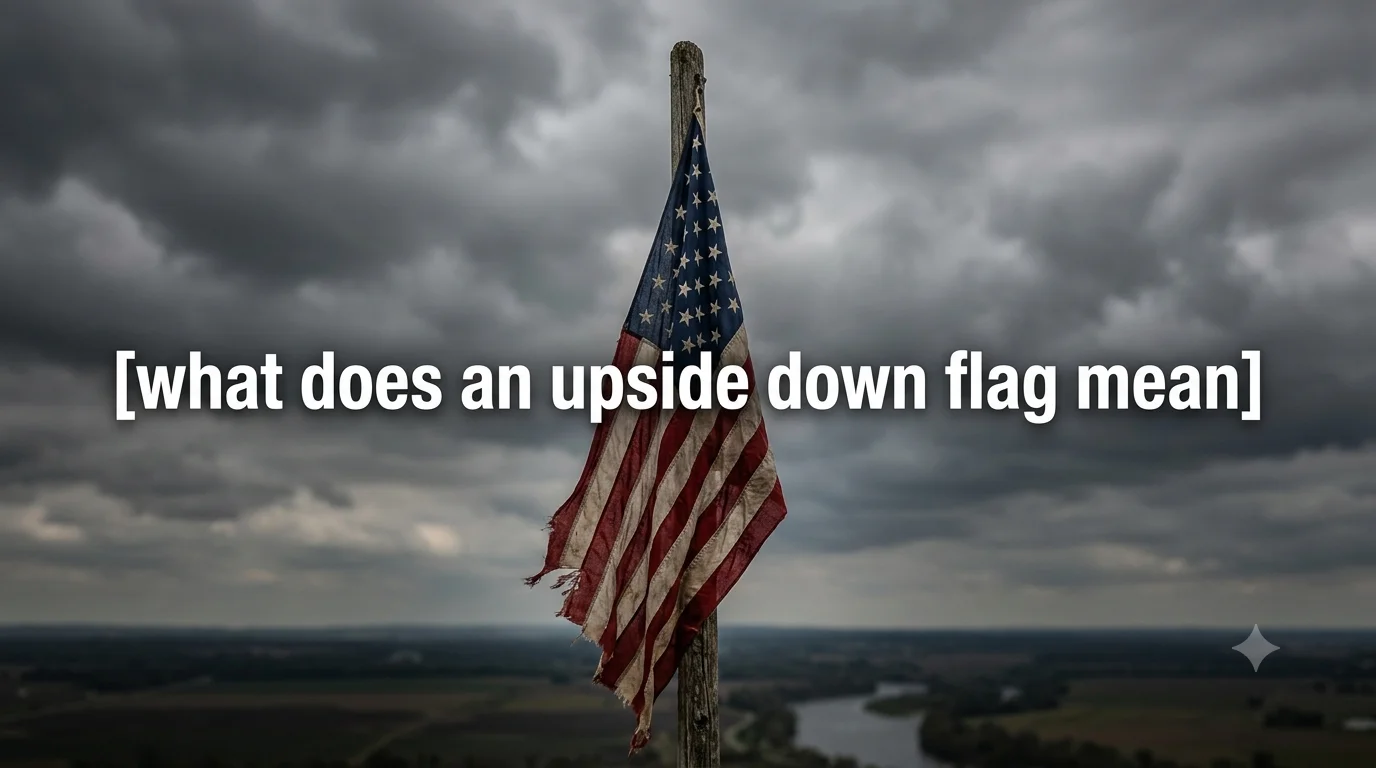
Seeing a flag flying upside down almost instantly stops you in your tracks. Whether you spot it outside a local building, on a neighborhood flagpole, or scrolling through your social media feed, the image feels inherently striking and unsettling.
Humans are wired to recognize visual order. When a prominent national or official symbol is inverted, our brains immediately register that something is wrong.
So, what does an upside down flag mean? Is it a desperate signal for help, a legal violation, or a form of political protest?
People search for this topic because the inverted flag carries deep emotional weight, strict military protocol, and evolving social meaning. Understanding the distinction between its historical purpose and its modern cultural usage helps clear up widespread confusion.
What Does an Upside Down Flag Mean? A Quick Overview
At its absolute core, flying a flag upside down is an internationally recognized signal of dire distress. It communicates that life or property is in extreme, immediate danger.
Historically, this signal was never meant to express political dissatisfaction, anger, or disagreement. It was designed as an practical, visual cry for rescue when no other form of communication was available.
“The flag should never be displayed with the union down, save as a signal of dire distress in instances of extreme danger to life or property.”
— United States Flag Code (Title 4, Chapter 1, Section 8a)
Key Takeaways of the Inverted Flag
- Official Purpose: Represents life-threatening emergency or dire distress.
- Maritime Origin: Used by sailors stranded at sea to signal passing ships without relying on sound.
- Modern Evolution: Frequently adopted in political protests to symbolize national crisis or systemic decline.
- Legal Status: Fully protected under the First Amendment as freedom of speech in the United States.
Origin and Background: How the Inverted Flag Came to Be
Maritime Roots and Nautical Survival
Long before radio transmissions, satellite phones, or digital SOS signals existed, ocean vessels relied entirely on visual communication. Flags were the primary tool for identifying a ship’s home nation, intentions, and status across vast ocean distances.
If a ship took on water, suffered a fatal fire, or faced a crew mutiny, sailors hoisted their national colors upside down. Passing ships recognized the inverted display miles away, instantly realizing that the vessel required emergency intervention.
In maritime life, hoisting a flag upside down was not a statement; it was a desperate bid for survival.
Military Protocol and Code
As standardized flag codes developed in the 19th and 20th centuries, military branches formalized this tradition. In military settings, displaying the flag upside down—referred to as hoisting the “union down”—signaled that an outpost, fort, or vessel was under siege or overwhelmed.
Because military discipline demands utmost respect for the flag, displaying it upside down by accident was considered a major blunder. It was reserved strictly for catastrophic events.
       HISTORICAL EVOLUTION OF THE UPSIDE DOWN FLAG

  [ Nautical Era ]  --->  [ Military Code ]  --->  [ Modern Protest ]
  Visual SOS at sea       Formalized protocol      Symbolic statement
  for life/death          for under-siege          of political or
  emergencies.            outposts.                cultural crisis.
Social Media Impact and Modern Evolution
In recent decades, the upside-down flag migrated from physical flagpoles to digital screens. The symbol exploded across platforms like X (formerly Twitter), Instagram, and TikTok as a visual shorthand for discontent.
During times of intense political division, civil unrest, or controversial court decisions, individuals hoist inverted flags outside their homes or add the inverted flag emoji to their profiles. The meaning shifted from physical danger to perceived ideological or national crisis.
Real-Life Conversations: How People Talk About It
Understanding how everyday people discuss this topic highlights the tension between traditional flag etiquette and modern symbolic usage. Here are realistic exchanges across popular platforms.
Scenario 1: Text Exchange Between Neighbors
Alex: Hey, did you notice Mr. Henderson’s flag today? It’s hanging upside down. Is everything okay over there?
Jordan: Yeah, I saw it too. I actually walked over to check if he had a medical emergency. Turns out he’s just protesting the recent election results.
Alex: Wow, really? That scared me. I thought he was having a stroke or something.
Scenario 2: Instagram Comment Section
User_1: Why is everyone posting photos with the upside-down flag filter today? Did something catastrophic happen?
User_2: People are using it to express that they feel the country is heading in the wrong direction after the supreme court ruling.
User_1: Oh, got it. I thought it was strictly for actual life-or-death emergencies like fires or military attacks.
Scenario 3: TikTok Video Discussion
Creator: Walked outside my house today and saw three upside-down flags on my block. Here is why this breaks traditional protocol…
Commenter A: It’s protected free speech! People have every right to show they feel the nation is in distress.
Commenter B: Freedom of speech, sure. But it cheapens a real distress signal that military members fought to defend.
Scenario 4: Professional Slack Channel
Sam: Quick heads-up: our client’s profile image contains an inverted flag icon. Should we address this before the presentation?
Taylor: Good catch. Let’s make sure our team stays completely neutral on it. It’s clearly a political statement, so we shouldn’t bring it up during the call.
Emotional and Psychological Meaning
Displaying a nation’s standard upside down carries intense emotional weight. Flags are strong cultural anchors, representing collective identity, shared values, and historical sacrifice. Inverting that symbol creates immediate psychological friction.
+-----------------------------------------------------------------+
|                    PSYCHOLOGICAL IMPLICATIONS                   |
+-----------------------------------------------------------------+
|  EMOTION          | PSYCHOLOGICAL EFFECT                        |
|-------------------|---------------------------------------------|
| Urgency & Alarm   | Triggers an immediate "check for danger"    |
|                   | instinct.                                   |
| Alienaion         | Signals total disconnect from current status |
|                   | quo.                                        |
| Grief & Sorrow    | Expresses belief that core values are       |
|                   | dying.                                      |
| Defiance          | Serves as a visible challenge to authority. |
+-----------------------------------------------------------------+
What Emotion It Expresses
When someone intentionally flies an upside-down flag today, they usually communicate deep alienation, grief, or urgent anger. They want to convey that the system around them feels broken beyond standard political repair.
It expresses a sense of powerlessness, signaling: “Things have gone so wrong that normal words are no longer enough.”
What It Reveals About Modern Communication
Modern digital culture thrives on intense visual cues. Long-form debates often get pushed aside for immediate visual statements.
Using an inverted flag allows someone to signal their stance instantly without writing a single paragraph. It transforms a historical signal of physical distress into an emotional billboard for personal frustration.
A Firsthand Perspective on Seeing the Symbol
A retired veteran shared a memory that captures this conflict clearly:
“During my service in the Navy, seeing a flag upside down meant immediate action—someone was drowning, or a ship was sinking. Years later, driving through my suburban neighborhood and seeing an inverted flag flying in a manicured lawn gave me a sudden jolt of adrenaline.
Realizing it was just a political opinion, not a life-or-death emergency, left me feeling conflicted. The symbol works because it shocks you, but overuse reduces its core meaning.”
Usage in Different Contexts
Context determines how an inverted flag is interpreted. What makes sense on a protest line may cause serious confusion in a professional setting.
       CONTEXT MATTERS: HOW THE INVERTED FLAG IS PERCEIVED

  [ Maritime / Military ]  =======>  Literal SOS / Life Safety Threat
  [ Civil Protest ]        =======>  Symbolic Political Discontent
  [ Social Media ]         =======>  Viral Identity / Opinion Tag
  [ Professional / Work ]  =======>  Potential Liability / Distraction
Social Media Platforms
Online, an inverted flag acts as a badge of identity. Users place it in bios, video thumbnails, or headers to instantly signal political alignment. On platforms driven by algorithms, highly provocative images like inverted flags drive high engagement, comments, and debate.
Friends and Relationships
Among friends, using or displaying an inverted flag often sparks passionate debates. If someone holds strong respect for military tradition, seeing a friend fly the flag upside down for political reasons can cause friction. Conversely, peers sharing similar frustrations may view it as a brave act of solidarity.
Work and Professional Settings
Displaying an upside-down flag in a professional setting—whether in a home office background during a video call or on a personal vehicle parked at work—is generally discouraged. Corporate environments prioritize neutral, inclusive spaces. Using controversial symbols can create unnecessary workplace tension or alienate clients.
When NOT to Use It
While freedom of speech protects the right to fly an inverted flag, certain situations make it inappropriate or counterproductive.
1. In Actual Non-Emergency Daily Life
If your intent is simply to show mild annoyance with a local policy, hoisting an inverted flag can cause unnecessary public panic. Emergency services have occasionally received 911 calls from concerned neighbors assuming a home was under home invasion or suffering an isolated crisis.
2. Official Ceremonial Events
During solemn events, memorial services, or non-partisan public gatherings, displaying an upside-down flag breaks long-standing etiquette. It draws attention away from the occasion and directs it toward political controversy.
3. International Travel or Diplomacy
Flying another country’s flag upside down while visiting or working abroad is often seen as an insult to the host nation. While protected under free speech in the U.S., many countries enforce strict laws against flag desecration or improper display.
Common Misunderstandings
Clear up common misconceptions surrounding inverted flags to navigate these discussions thoughtfully.
Myth 1: Flying a Flag Upside Down Is Illegal
Reality: In the United States, displaying the flag upside down is completely legal. While the U.S. Flag Code outlines proper etiquette, it operates as a set of advisory guidelines rather than enforceable criminal law. The Supreme Court established in Texas v. Johnson (1989) that flag-related expressions are protected under the First Amendment.
Myth 2: It Always Means the Person Dislikes the Country
Reality: Many individuals who fly an inverted flag view themselves as deeply patriotic. From their perspective, they are highlighting a serious internal crisis out of love for their nation’s core principles, hoping to restore it to health.
Myth 3: It Is an Act of Treason
Reality: Treason is strictly defined by law as levying war against the state or providing aid to its enemies. Expressing discontent through flag manipulation does not meet this legal standard.
Visual Comparison: Flag Displays and Symbolic Meanings
| Flag Display | Traditional / Official Meaning | Modern / Informal Usage | Primary Emotion Conveyed |
| Standard (Union Top-Left) | Honor, routine pride, national respect | Default display for daily use | Stability, unity, respect |
| Half-Staff / Half-Mast | Official mourning, remembrance of loss | Systemic loss or national grief | Sorrow, honor, reverence |
| Upside Down (Union Bottom) | Dire distress, life-or-death emergency | Political protest, systemic crisis | Alarm, urgency, defiance |
| Folded (Triangular) | Retirement, military funeral honors | Display case, ceremonial storage | Deep respect, sacred tradition |
Key Insight
While half-staff signals quiet grief and formal mourning authorized by leaders, an upside-down flag acts as an unapproved, bottom-up alarm signaling active crisis or open defiance.
Variations and Related Symbolic Expressions
People express distress, protest, or mourning through several visual variations of the flag.
1. The Upside-Down National Flag
- Meaning: Traditional or political distress signal.
- Explanation: Hoisting a standard national flag upside down to draw immediate attention to an emergency or national concern.
2. Black and White Flag with a Single Colored Line
- Meaning: Support for specific public service branches (e.g., Thin Blue Line, Thin Red Line).
- Explanation: Used to show solidarity with law enforcement or firefighters, though it often sparks debate regarding traditional flag modifications.
3. Flag Flown at Half-Staff
- Meaning: National or regional mourning.
- Explanation: Lowered halfway down the pole following the death of key figures or tragic national events.
4. Tattered or Battle-Worn Flag
- Meaning: Endurance through hardship.
- Explanation: Displayed intentionally to convey resilience during tough times, though standard protocol dictates retiring damaged flags respectfully.
5. Black-Out / All-Black Flag
- Meaning: No quarter given / unyielding stance.
- Explanation: Historically used in war to state that surrender would not be accepted; modern groups sometimes use it to signal absolute defiance.
6. Burning or Defaced Flag
- Meaning: Extreme political protest.
- Explanation: The radical destruction of a flag to reject the political system it represents.
7. Flag Draped Over a Casket
- Meaning: Ultimate honor for military veterans or public servants.
- Explanation: Symbolizes a lifetime of dedicated service to the nation.
8. Digital Inverted Flag Emoji
- Meaning: Online political alignment.
- Explanation: Used in bio sections or comment threads to quickly display ideological positions without lengthy posts.
How to Respond When Someone Uses It
Encountering an upside-down flag—whether online or down your street—can spark complex interactions. Here are measured ways to respond depending on your goals.
       CHOOSE YOUR RESPONSE STRATEGY

  [ Casual Response ]   ---> "Hey, just making sure everything is okay over here!"
  [ Mature Response ]   ---> "I see you feel strongly about this. What's on your mind?"
  [ Neutral Response ]  ---> "I noticed your flag display. Interesting perspective."
  [ Respectful Check ]  ---> "Hey neighbor, wanted to check if you needed real help."
Casual Replies
- “Hey! Just wanted to make sure everything’s okay over there—saw your flag!”
- “Looks like you’re sending a message with that flag setup today.”
Funny or Lighthearted Replies
- “Did the wind turn your flagpole upside down, or are we officially declaring a neighborhood emergency?”
- “If we’re turning flags upside down, I guess it’s time to order pizza and ride out the storm!”
Mature and Direct Replies
- “I noticed your flag is inverted. Are you pointing toward a specific policy issue, or just showing general concern?”
- “I respect your right to express yourself, even if we view flag etiquette a bit differently.”
Respectful Check-Ins (For Neighbors)
- “Good morning! I saw the flag was inverted and wanted to check in personally to make sure you don’t have a real emergency inside.”
Regional and Cultural Usage Differences
Flag symbolism carries different cultural weights across the globe.
Western Culture (United States and Canada)
In North America, robust free speech protections mean displaying an inverted flag for protest is relatively common. While controversial, courts protect it as symbolic speech. In Canada, inverted flags occasionally appear during civil demonstrations, though Canadian flag etiquette strongly cautions against it.
Asian Culture
In countries like Japan, South Korea, or Singapore, public symbols carry immense societal weight. Altering or inverting a national flag in public is widely viewed as deeply disrespectful and socially taboo. In some Asian jurisdictions, defacing or improperly displaying national symbols carries direct legal penalties.
Middle Eastern Culture
Across the Middle East, flags frequently feature sacred text, religious declarations, or historic calligraphy (such as the Saudi Arabian flag). Inverting or altering these flags is not seen merely as political commentary—it can be viewed as an offensive act against core religious beliefs.
Generational Differences: Gen Z vs. Millennials vs. Boomers
- Gen Z: Tends to view symbols as fluid, expressive tools for online branding, meme culture, and rapid social commentary.
- Millennials: Often evaluate inverted flags through the lens of institutional critiques, using them during organized rallies or public campaigns.
- Older Generations (Gen X / Boomers): Often hold a literal, protocol-based view of the flag, frequently seeing inversion as a direct insult to veterans and military sacrifice.
Is It Safe for Kids?
Explaining an upside-down flag to children requires simple, clear context awareness.
If a child asks why a flag is upside down, clarify that while its original purpose was a nautical cry for emergency help, adults today sometimes use it like a giant sign to say they are worried about their country’s direction.
                  EXPLAINING THE FLAG TO KIDS

  [ The Original Rule ]              [ The Modern Usage ]
  "Like calling 911 on a boat."      "Like holding up a big sign to show
                                      you're upset about a rule."
Assure them that seeing an inverted flag in their neighborhood does not mean an immediate physical danger is happening at their home. It helps children distinguish between actual physical safety threats and adult political opinions.
Frequently Asked Questions
Is flying an upside-down flag illegal in the US?
No, it is not illegal. While the U.S. Flag Code recommends against it except during emergencies, the Supreme Court protects flag displays under First Amendment free speech rights.
What is the difference between half-staff and an upside-down flag?
Half-staff is an official act of mourning for lives lost or respected leaders, authorized by government officials. An upside-down flag is an unapproved display used by individuals to signal dire distress or political crisis.
Can you go to jail for flying a flag upside down?
No. You cannot be arrested or imprisoned simply for flying a national flag upside down in the United States, as symbolic speech is constitutionally protected.
What should I do if my neighbor’s flag is upside down?
If you suspect an actual physical emergency (such as an elderly neighbor needing medical aid), check on them or contact local authorities. If it is clearly a political statement, you can choose to discuss it calmly or simply respect their right to free expression.
Is the flag upside down emoji available on smartphones?
Most standard emoji keyboards do not feature a built-in upside-down flag. Users typically combine standard flag emojis with upside-down face emojis or post inverted flag images directly.
Navigating Powerful Symbols Wisely
The upside-down flag remains one of the most visually striking symbols in modern life. From its origins as a lifesaving signal for sailors at sea to its present role in public protest, it forces people to stop, look, and reflect.
Knowing what an upside-down flag means helps you cut through confusion and participate thoughtfully in conversations around national symbols, historical etiquette, and personal expression.
Whether you view it as a strict emergency signal or a form of protected speech, using and interpreting visual symbols carefully keeps our shared conversations grounded and respectful.