Unpacking the Display Tech Everyone Is Talking About
Shopping for a new smartphone, smart TV, or gaming monitor often leads directly to four mysterious letters: OLED. Tech specs bombard buyers with promises of pitch-black dark modes and vivid colors. Beyond electronics stores, the term pops up in gaming group chats, movie threads, and online subcultures.
Understanding display terms shouldn’t require an engineering degree. Millions search this query every month trying to demystify technical jargon before dropping hard-earned money on a new screen. Clear answers prevent buyer’s remorse and help shoppers pick hardware that actually fits their lifestyle.
What Does OLED Mean? – Quick Meaning
Clear Definition
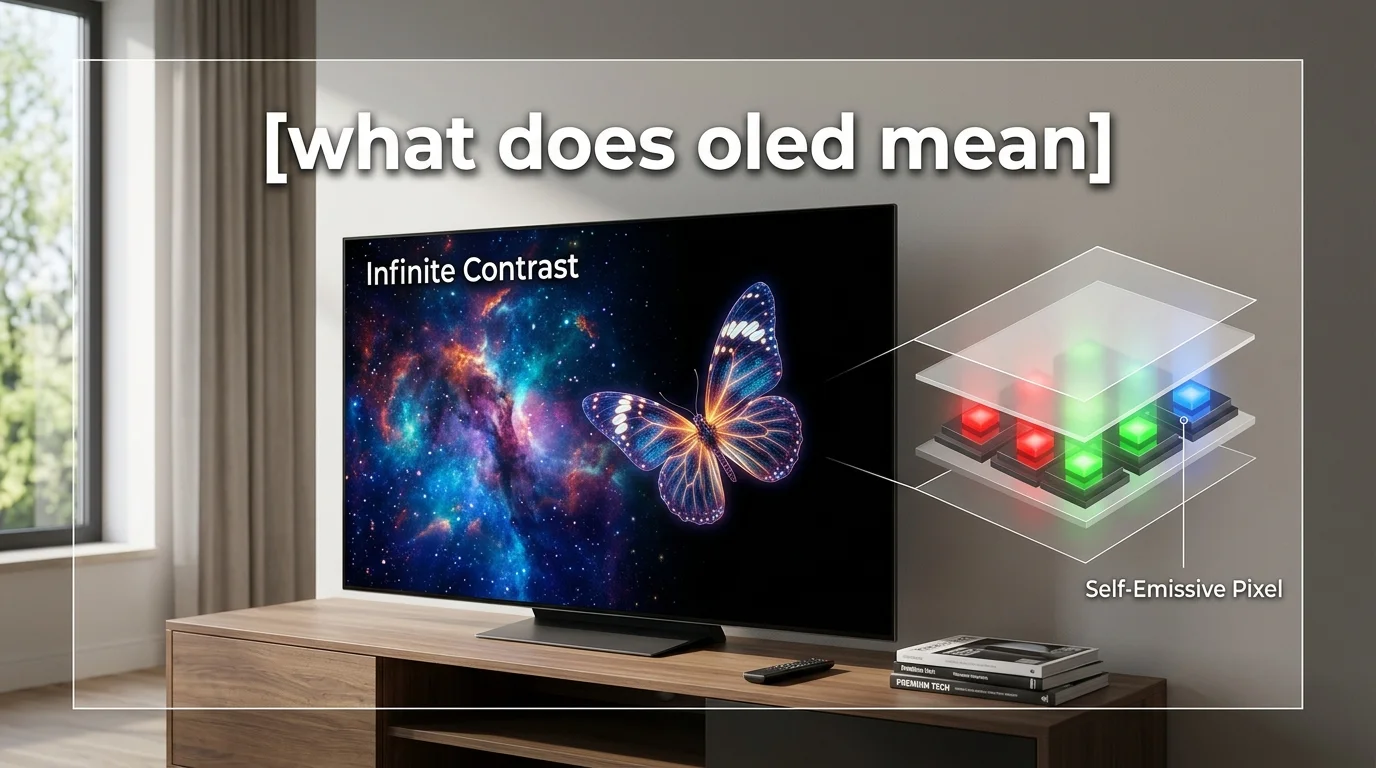
OLED stands for Organic Light-Emitting Diode. It represents a display technology where each microscopic pixel generates its own light independently when an electric current passes through organic compound layers.
- Self-Emissive Pixels: Unlike traditional LCD screens that rely on a giant LED backlight, every single OLED pixel lights up on its own.
- True Black Levels: To display the color black, an OLED pixel turns off completely, emitting zero light.
- Infinite Contrast: Turning off pixels creates an infinite contrast ratio between the brightest whites and darkest shadows.
“I switched my living room setup to an OLED TV last night, and watching cinematic sci-fi films finally feels like a real movie theater experience.”
“My phone battery lasts noticeably longer ever since enabling system-wide dark mode on this OLED screen.”
“Notice how dark scenes in horror games look washed out on LCD screens, whereas OLED displays maintain perfect shadow details.”
Origin & Background
Where It Came From
The underlying physics dates back to 1987 when researchers Ching W. Tang and Steven Van Slyke at Eastman Kodak patented the practical organic light-emitting device. Early commercial implementations appeared in car stereos during the late 1990s before expanding into small digital cameras.
Modern Evolution & Cultural Impact
Smartphones brought OLED panels into billions of pockets during the 2010s. Social media platforms like Instagram and TikTok accelerated adoption as creators demanded vivid color accuracy for video editing on the go. High-end smartphone marketing turned OLED into a signifier of premium quality.
Gamers on Twitch and Reddit transformed “OLED” into everyday vernacular. The term evolved from technical specification sheet text into a cultural benchmark for high performance, smooth response times, and premium visual fidelity.
Real-Life Conversations
Example 1: The Group Chat Debate (WhatsApp)
Alex: Hey guys, is buying an OLED monitor actually worth double the price of standard IPS panels?
Jordan: Bro, once you experience real pitch-black shadows in space games, you can never go back to backlit screens. Total game changer.
Example 2: Smartphone Shopping (Text Message)
Mom: Looking at two phones online. One says AMOLED and the other says LCD display. Which one should I get?
Sam: Definitely get the AMOLED one Mom! Photos look way sharper and reading text in sunlight is much easier on your eyes.
Example 3: Home Theater Upgrade (Instagram DM)
Taylor: Did you end up mounting that new TV in your living room?
Chris: Yeah, turned off all the lights for movie night last night. The letterbox bars above and below the film completely blend into my dark wall!
Example 4: Tech Review Comment Section (TikTok)
User1290: People sleeping on OLED laptop screens don’t realize how much better photo editing gets.
TechCreator: Absolute facts! Color grading on self-emitting displays saves so much guessing work.
Emotional & Psychological Meaning
Viewing content on a self-emissive screen triggers a distinct sensory response. Traditional LCD screens constantly leak backlight glow through dark pixels, creating a murky grey tint in dim rooms. Eliminating that backlight creates visual clarity that feels immersive and premium.
Modern visual culture values minimalism and depth. Users report reduced eye fatigue during late-night reading sessions because dark themes emit significantly less ambient light.
A Personal Moment with Display Tech:
Testing a mid-range laptop with a cheap backlit display during a late flight revealed jarring light bleed around movie subtitles. Upgrading to a mobile device with a self-emissive panel completely changed dark-cabin screen time. The crisp text floated effortlessly against pure darkness without blinding nearby passengers.
Usage in Different Contexts
Social Media & Content Creation
Designers, photographers, and video editors discuss display types constantly. Panel color coverage ensures that edited media looks identical across client devices.
Friends & Gaming Communities
In casual gaming groups, discussing display upgrades signals an investment in competitive responsiveness. Gamers care about near-instant pixel response times that eliminate ghosting during fast movement.
Professional & Work Settings
Enterprise procurement teams evaluate panels based on energy efficiency and text sharpness. Programming environments benefit tremendously from high-contrast code editors that remain legible over long work shifts.
| Context | Purpose / Intent | Tone |
| Gaming Community | Flaunting visual setup & low latency | Enthusiastic / Competitive |
| Design Studio | Verifying color accuracy & dynamic range | Professional / Technical |
| Retail Shopping | Evaluating feature-to-price ratios | Practical / Analytical |
| Social Media | Sharing aesthetic desktop setups | Visual / Trendy |
When NOT to Use It
Inappropriate Contexts
Avoid technical jargon when communicating with audiences seeking basic device purchasing advice. Throwing around terms like “self-emissive organic compounds” confuses non-technical buyers looking for simple battery life recommendations.
Misunderstanding Hazards
Do not confuse OLED with high-brightness commercial digital signage. While self-emissive panels excel in dark and light-controlled rooms, extreme direct sunlight environments sometimes favor ultra-bright mini-LED backlights.
Common Misunderstandings
Tone & Terminology Confusion
- The “LED” Confusion: Many buyers assume “LED TVs” are similar to OLED. Standard LED TVs are simply traditional LCD panels backlit by light-emitting diodes.
- Burn-In Myths: Early panels suffered from permanent image retention under static display conditions. Modern panel management algorithms and pixel-shifting features have rendered burn-in rare for typical consumers.
Comparison Table
| Display Technology | Lighting Method | Black Levels | Contrast Ratio | Ideal Use Case |
| OLED | Self-emitting pixels | True Black (0 nits) | Infinite | Dark room cinema, competitive gaming, HDR |
| LCD / LED | Global LED backlight | Dark Grey | Moderate (1,000:1) | Budget electronics, general office work |
| Mini-LED | Dimming-zone backlight | Near Black | High (100,000:1) | Extremely bright living rooms, outdoor use |
| QLED | Quantum dot LCD backlight | Dark Grey | Moderate to High | High ambient brightness rooms |
Key Insight
Self-emissive panels deliver unparalleled contrast by shutting off light production completely at the pixel level, whereas backlit technologies must continuously block unwanted backlight leaking through liquid crystal layers.
Display Variations & Subtypes
AMOLED (Active-Matrix OLED)
Used in almost all modern smartphones to control individual pixels faster while consuming less electrical power.
Super AMOLED
An integrated screen design where touch-sensor layers bind directly onto the display glass rather than sitting as a separate top layer.
QD-OLED (Quantum Dot OLED)
Combines blue self-emitting layers with quantum dot color converters to produce higher peak brightness and wider color coverage.
WOLED (White OLED)
Utilizes white subpixels alongside red, green, and blue filters to extend display panel lifespan and boost overall brightness output.
PMOLED (Passive-Matrix OLED)
An older, simpler control scheme suitable for tiny sub-screens like fitness trackers or digital smartwatch faces.
P-OLED (Plastic OLED)
Employs flexible plastic substrates instead of rigid glass, enabling curved smartphone edges and foldable display screens.
Micro-OLED
Microscopic displays built directly onto silicon wafers, designed specifically for virtual reality headsets and smart glasses.
Tandem OLED
Stacks multiple light-emitting layers vertically to double screen brightness durability while reducing operational power draw.
How to Respond When Someone Mentions Display Tech
Casual Replies
“Yeah, the contrast on those screens is wild. Movies look incredible in a dark room.”
Funny Replies
“My wallet is still crying, but hey—at least my space games have real black skies now!”
Mature / Analytical Replies
“It really depends on your room lighting. For dim rooms it’s unbeatable, but ultra-bright spaces might suit Mini-LED better.”
Technical Replies
“The instant sub-millisecond response time is honestly a bigger upgrade for competitive gaming than the contrast boost.”
Regional & Cultural Usage
Western Markets
North American and European consumers heavily associate self-emissive panels with home theater installations, premium flagship smartphones, and enthusiast PC gaming builds.
Asian Tech Hubs
In South Korea, Japan, and China, panel manufacturing serves as a massive industrial cornerstone. Consumers follow panel generations closely, viewing display upgrades as essential lifestyle updates.
Generational Differences
Gen Z mobile-first users expect deep dark modes and high-refresh panels as baseline standard features on modern smartphones, whereas older generations often prioritize screen size over lighting architecture.
Is It Safe for All Audiences?
Yes, display terms are completely safe, neutral technical nomenclature suitable for all age groups, academic research, and commercial environments.
Frequently Asked Questions
Does OLED drain battery faster than LCD?
When displaying dark themes or true black backgrounds, self-emissive screens consume significantly less power because black pixels draw zero energy. Bright white pages draw comparable power to backlit screens.
Can OLED panels suffer from screen burn-in?
While burn-in remains technically possible under static display conditions lasting thousands of hours, modern screen protection software, automatic dimming, and pixel-refreshing cycles make it rare for everyday use.
What is the main difference between QLED and OLED?
QLED uses a traditional LED backlight shining through quantum dot film, whereas self-emissive panels generate light directly at each pixel without requiring any backlight panel.
Why are OLED displays more expensive?
Manufacturing self-emissive organic semiconductor layers requires cleanroom fabrication environments and precise material deposition processes, resulting in higher production costs than backlit liquid crystal panels.
Are these screens good for reading text?
High-density self-emissive screens offer sharp text rendering, especially in dark mode environments where high contrast reduces surrounding light glare.
Do these displays work well in bright rooms?
Modern high-peak-brightness panels handle bright rooms effectively, though ultra-bright Mini-LED screens still lead in raw sustained light output for sunlit environments.
Conclusion
Understanding display technology boils down to one fundamental innovation: control over light at the single-pixel level. Choosing self-emissive displays transforms how we consume movies, play games, and interact with pocket devices daily. Armed with this knowledge, evaluating your next TV, monitor, or smartphone purchase becomes straightforward and confident.