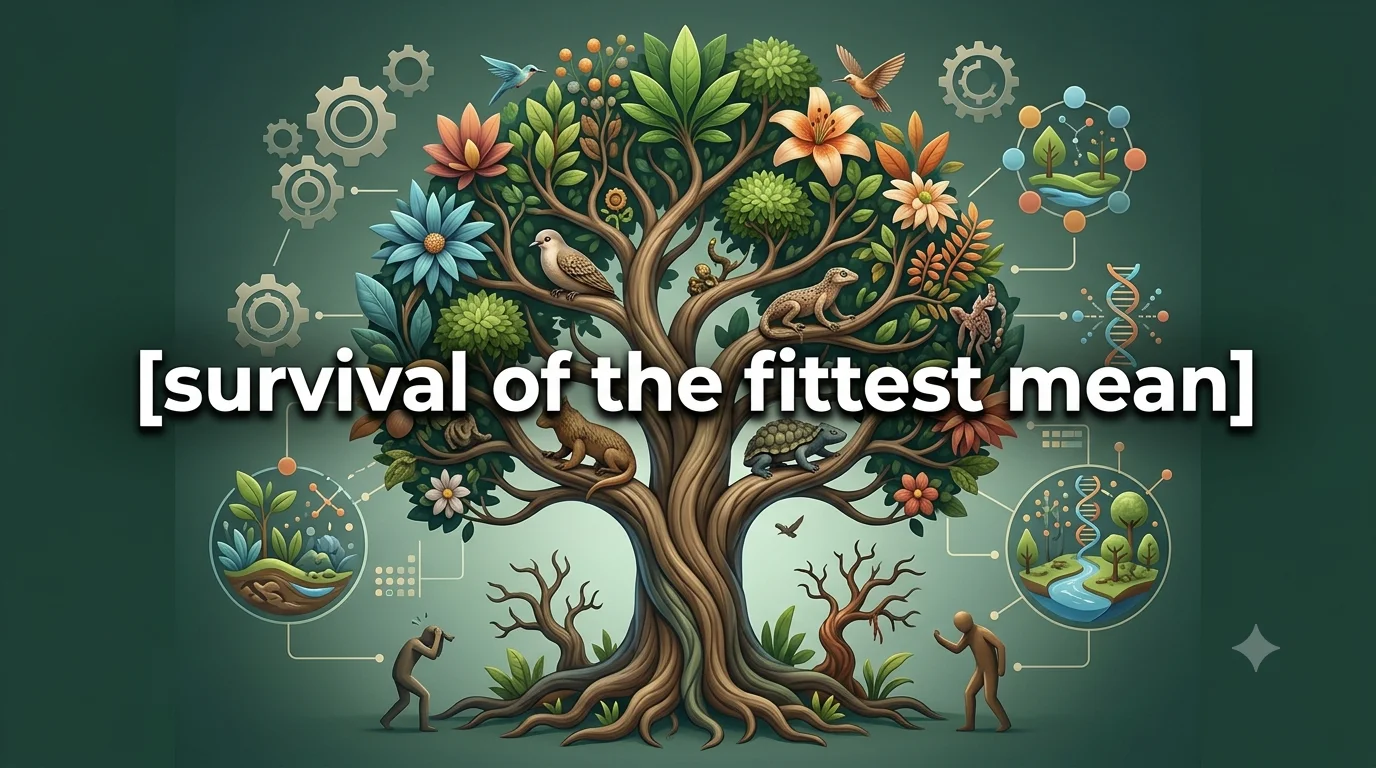
Unpacking the Real Meaning of Survival of the Fittest
Few phrases in the English language carry as much power, weight, and misunderstanding as “survival of the fittest.” Most people encounter it in science class, hear it thrown around in corporate boardrooms, or see it used as a sarcastic caption on social media videos.
When people search for what survival of the fittest means, they are usually trying to solve a specific confusion. Does it mean the strongest person wins? Is it about physical strength, ruthless competition, or simply adapting to change?
At its core, the phrase describes an evolutionary principle where organisms best adapted to their environment are most likely to survive and reproduce. Over time, however, the phrase drifted far beyond biology into sociology, popular culture, and daily conversation.
Understanding this phrase helps clear up major misconceptions about science, history, and human behavior. It turns out that being “fit” rarely means having the biggest muscles or the most aggressive personality.
What Does Survival of the Fittest Mean? A Quick Breakdown
Clear Definition
In scientific terms, “survival of the fittest” means evolutionary adaptation. “Fittest” refers to evolutionary fitness—an organism’s ability to survive, reproduce, and pass its genetic material to the next generation within a specific environment.
In modern everyday language, the phrase often describes situations where only those who adapt to stress, change, or intense competition manage to succeed.
- Evolutionary Fitness: The capacity to pass on genes to offspring that also survive to reproduce.
- Biological Adaptation: Developing physical or behavioral traits that match a specific environment.
- Modern Figurative Meaning: Thriving in tough situations by remaining flexible and resilient rather than relying solely on brute force.
Real-World Examples
“In a rapidly changing job market, learning new digital skills is pure survival of the fittest.”
“Polar bears surviving freezing Arctic waters while other mammals fail is a classic example of survival of the fittest.”
“When the sudden storm hit our campsite, only the hikers with proper waterproof gear made it through comfortably—survival of the fittest in action.”
The Origin and Background of the Phrase
Where It Came From
Contrary to popular belief, Charles Darwin did not invent the phrase “survival of the fittest.”
The expression was coined by British philosopher and sociologist Herbert Spencer in his 1864 book Principles of Biology. Spencer drew parallels between Darwin’s biological theories and his own economic and sociological ideas.
Darwin later adopted the phrase in the fifth edition of On the Origin of Species in 1869. He used it as a synonym for “natural selection,” believing it offered a clear explanation of how environmental pressures favor certain organisms over others.
Cultural Influence and Social Darwinism
As the phrase gained traction, thinkers began applying it to human societies, giving rise to “Social Darwinism.” This controversial ideology incorrectly argued that wealth, power, and social status were markers of biological superiority.
This misapplication led to harmful political movements and justification for social inequality in the late 19th and early 20th centuries. It distorted Darwin’s biological insight into a defense of ruthless capitalism and imperial expansion.
Social Media Impact and Language Evolution
In the modern internet era, the phrase has evolved once again. TikTok creators, Instagram influencers, and meme-makers use the term dramatically or humorously.
It has shifted from a strict biological principle to a piece of internet shorthand for handling minor inconveniences, awkward public moments, or hyper-competitive social environments.
Real-Life Conversations Using the Phrase
Scenario 1: WhatsApp Group Chat (Workplace Chaos)
Alex: Did you see the new schedule? They moved the client presentation up to tomorrow morning!
Jordan: Yeah, complete madness. I guess it’s survival of the fittest in this department tonight.
Alex: Order some pizza. We are definitely going to need those extra calories to survive this night shift.
Scenario 2: Instagram DMs (Gym and Fitness Culture)
Taylor: You still going to that 6 AM leg day class tomorrow?
Sam: Absolutely. Only five people showed up last week because the instructor is brutal.
Taylor: Haha, survival of the fittest at its finest! Count me in.
Scenario 3: TikTok Comment Section (Trending Fail Video)
User_123: Watching everyone try to walk across that black ice outside the coffee shop is wild 💀
Commenter_A: The way that guy in boots walked right past everyone who slipped!
Commenter_B: Survival of the fittest in the winter, honestly. Wear proper shoes!
Scenario 4: Family Text Message (Holiday Shopping)
Mom: The mall parking lot is an absolute zoo today! People are fighting over spots.
Chris: Good luck, Mom! Keep your eyes open.
Mom: It is survival of the fittest out here today, but I am coming home with those sales!
The Emotional and Psychological Meaning
What Emotion It Expresses
When people use the phrase today, it usually carries a mix of humor, stress, and quiet determination. It signals a recognition that a situation is difficult, competitive, or unpredictable.
Using the term creates a psychological shield. By framing a challenge as a natural test of endurance, individuals distance themselves emotionally from temporary discomfort.
Why People Use It
Humans naturally seek patterns to explain struggle. Referring to a tough job market, an intense exam period, or a chaotic social event as “survival of the fittest” provides immediate context.
It transforms personal stress into a universal human experience. It shifts the narrative from feeling victimized by circumstance to stepping up to face a challenge.
What It Reveals About Modern Communication
Modern speech leans heavily on dramatic exaggeration and biological metaphors. Calling a minor challenge “survival of the fittest” reflects how fast-paced and high-pressure modern life feels to many people.
A Personal Experience with Adaptation
A few years ago, a close friend lost her long-term administrative job when her company shifted entirely to automated digital systems. While many colleagues panicked, she immediately enrolled in an intensive night course to learn modern project management software. Within three months, she landed a higher-paying role at an energetic tech startup. She didn’t win by fighting the old system; she succeeded because she adapted to the new environment—a perfect reflection of what true fitness means in the real world.
Usage in Different Contexts
Social Media
On platforms like X, TikTok, and Instagram, the phrase is often used sarcastically. Users attach it to short videos of people navigating everyday obstacles, bad weather, or crowded events.
It serves as a quick caption that adds humor to minor struggles, emphasizing how dramatic everyday situations can feel online.
Friends and Relationships
Among friends, the phrase acts as lighthearted teasing. It often comes up when someone stumbles during a hike, forgets an essential item on a trip, or struggles with a mutual challenge.
In these contexts, it reinforces camaraderie by framing group outings or shared difficulties as fun, low-stakes endurance tests.
Work and Professional Settings
In business environments, the expression describes competitive markets, industry shifts, or company restructurings.
While it highlights the need for innovation and agility, professional leaders must use it carefully. Relying too heavily on this language can foster a toxic, hyper-competitive company culture that discourages teamwork.
| Context | Tone | Intent | Example Usage |
| Social Media | Sarcastic / Dramatic | Humorous exaggeration | “Trying to get concert tickets today: survival of the fittest.” |
| Friendships | Lighthearted / Playful | Gentle teasing during effort | “You forgot your coat? Survival of the fittest, my friend!” |
| Business | Professional / Strategic | Emphasizing market adaptation | “Agile companies survive market crashes through survival of the fittest.” |
| Biology Class | Academic / Objective | Explaining evolutionary science | “Genetic mutations drive survival of the fittest in local populations.” |
When NOT to Use the Phrase
Inappropriate Contexts
Never use “survival of the fittest” when discussing personal tragedies, medical crises, natural disasters, or severe financial hardship.
Applying a phrase that implies “only the best survive” to human suffering lacks empathy. It can mistakenly suggest that victims of hardship were somehow less deserving of safety or health.
Cultural Sensitivity and Misunderstandings
Avoid using the term in contexts where it might be interpreted as an endorsement of Social Darwinism or systemic inequality.
Because the phrase carries a dark historical baggage related to discrimination and eugenics, keep its application strictly confined to biological science, lighthearted banter, or broad market dynamics.
Common Misunderstandings About the Phrase
Misconception 1: “Fittest” Means the Strongest or Fastest
The most widespread mistake is assuming “fittest” refers to physical strength, speed, or size.
In evolutionary biology, “fit” means best suited to the current environment. A small, quiet mammal that hides underground may be far more “fit” during an asteroid impact than a massive, powerful dinosaur.
Misconception 2: Survival Is an Individual Sport
Many people assume the phrase implies absolute self-reliance and cutthroat individualism.
In reality, cooperation, empathy, and social living are often the exact traits that make a species “fit.” Wolves hunt in packs, bees work in hives, and early humans survived precisely because they protected one another.
Misconception 3: Evolution Has an Ultimate End Goal
People often assume survival of the fittest means species are constantly getting “better” or “more advanced” in an absolute sense.
Evolution has no final destination. Traits that make an organism fit in a warm rainforest become useless or harmful if the environment turns into a freezing desert overnight.
Comparing Related and Opposite Expressions
| Expression | Type | Meaning | Key Distinction |
| Survival of the Fittest | Target Phrase | Organisms best adapted to their environment survive | Focuses on environmental adaptation |
| Law of the Jungle | Similar Expression | A situation with no rules where force wins | Emphasizes chaos and lack of morality |
| Dog Eat Dog | Similar Expression | Unscrupulous, ruthless competition | Describes aggressive human behavior |
| Symbiosis | Related Concept | Mutually beneficial interaction between species | Focuses on mutual aid rather than competition |
| Artificial Selection | Opposite Mechanism | Humans breed organisms for specific desired traits | Driven by human preference, not nature |
Key Insight
While phrases like “dog eat dog” describe aggressive human competition, true biological “survival of the fittest” often favors peaceful cooperation, subtlety, and environmental alignment over destructive force.
10 Variations and Related Phrases Explained
- Natural SelectionThe primary mechanism of evolution where environmental pressures shape traits.Represents the scientific foundation behind survival of the fittest.
- Evolutionary FitnessA quantitative measure of an organism’s reproductive success.Focuses purely on how many offspring reach reproductive age.
- Adapt or DieA blunt modern idiom demanding quick adjustment to changing circumstances.Emphasizes the urgency of adapting to new conditions.
- Law of the JungleA phrase describing an environment without rules or moral order.Highlights ruthless self-preservation over systemic balance.
- Selective PressureExternal conditions that make certain traits advantageous for survival.Identifies environmental forces like climate, predators, or food shortages.
- Survival InstinctAn innate biological drive in living organisms to stay alive.Refers to immediate physical responses to danger rather than genetic adaptation.
- The Fittest Will PrevailA formal, optimistic variation of the core concept.Used in business or sports to predict long-term success for strong performers.
- Environmental AdaptationThe physical or behavioral changes an organism undergoes to thrive.Focuses on the specific traits built over time to match surroundings.
- Reproductive SuccessThe ultimate measure of fitness in evolutionary biology.Determines whether advantageous traits actually make it to the next generation.
- Economic DarwinismThe application of evolutionary ideas to free-market business competition.Describes how inefficient companies fail while innovative firms grow.
How to Respond When Someone Uses the Phrase
Casual Replies
- “No kidding! I’m just trying to make it through the week.”
- “Right? You have to adapt fast around here.”
- “Tell me about it! It’s a wild world out there today.”
Funny Replies
- “If this is survival of the fittest, my couch-potato traits are putting up a strong fight!”
- “I am definitely not feeling very ‘fit’ for this morning meeting!”
- “May the odds be ever in our favor, then!”
Mature and Thoughtful Replies
- “It really shows how crucial flexibility is when unexpected changes happen.”
- “True, though I think staying cooperative usually gives us a better chance than going alone.”
- “It is a great reminder that adaptation beats stubbornness every single time.”
Respectful Replies (Academic or Formal Contexts)
- “Exactly, provided we remember ‘fitness’ is all about matching the specific environment.”
- “That is a great point regarding how market pressures force companies to innovate.”
- “Precisely. Adaptation remains the key driver of long-term sustainability.”
Regional, Cultural, and Generational Usage
Western Culture
In North America and Western Europe, the phrase is deeply integrated into business culture, sports commentary, and casual idioms. It is frequently invoked to praise individual resilience, entrepreneurial spirit, and competitive drive.
Asian Culture
In many East Asian cultures where community and collective harmony are prioritized, direct references to competitive “survival of the fittest” are less common in casual conversation.
When discussed, the concept is often framed through the lens of collective adaptation and group resilience rather than individual triumph.
Middle Eastern Culture
Across the Middle East, traditional values place high importance on hospitality, community support, and divine providence.
Conversational idioms tend to emphasize shared endurance, faith, and family reliance during hardship, reserving “survival of the fittest” mostly for formal educational or economic settings.
Generational Differences: Gen Z vs. Millennials
- Millennials: Tend to use the phrase in career, financial, or fitness contexts, often reflecting on workplace competition or lifestyle challenges.
- Gen Z: Frequently uses the term ironically or hyperbolically in social media comments, memes, and casual banter to describe minor everyday inconveniences.
Is It Safe for Kids and School Contexts?
Yes, the phrase “survival of the fittest” is entirely safe and appropriate for children, provided it is explained within its proper biological context.
When introducing the concept to young learners, focus on nature, animal adaptations, and environmental harmony.
Parent and Educator Tip: Ensure kids understand that among humans, kindness, cooperation, and empathy are our strongest tools for survival—not physical aggression or pushing others down.
Frequently Asked Questions
Did Charles Darwin invent the phrase survival of the fittest?
No, philosopher Herbert Spencer created the phrase in 1864 after reading Darwin’s work. Charles Darwin later incorporated it into the fifth edition of On the Origin of Species in 1869 to help explain natural selection.
What is the best simple definition of survival of the fittest?
It is an evolutionary theory stating that organisms best adapted to their specific environment are most likely to survive, reproduce, and pass on their genetic traits to future generations.
Does “fittest” mean physically strongest in this phrase?
No, “fittest” refers to evolutionary fitness, which means being best suited to survive and reproduce in a specific environment. Camouflage, intelligence, and social cooperation are often far more useful than physical strength.
How is survival of the fittest used in business?
In business, it describes market competition where flexible companies that adjust to changing consumer demands survive, while rigid companies that fail to innovate go out of business.
Is survival of the fittest still a valid scientific concept?
Yes, when used as a lay term for natural selection, it remains a cornerstone of modern evolutionary biology. However, scientists prefer terms like “natural selection” or “differential reproductive success” for precision.
Master the Meaning of Survival of the Fittest
Understanding what survival of the fittest means requires looking past simple physical strength and cutthroat competition. At its heart, the phrase celebrates adaptability, resilience, and the subtle ways living things align with their changing environments.
Whether analyzing biological systems, navigating business challenges, or using the phrase casually with friends, remember that true fitness centers on flexibility.
By using the expression accurately in conversation, you can clearly communicate complex ideas about change, nature, and human resilience with confidence and clarity.