Decoding the Slang: What Does Ratio Mean Online?
Scrolling through Twitter, TikTok, or Instagram comments often reveals the word “ratio” dropped into completely non-mathematical conversations. Seeing a single word trigger thousands of likes while the original post gets dragged can feel confusing.
The internet evolves faster than traditional dictionaries can keep up. Words borrow new life from digital culture, leaving anyone outside specific online circles wondering what just happened.
Understanding slang isn’t just about keeping up with youth culture. It protects you from misinterpreting tone, accidentally offending someone, or missing the subtle power dynamics at play in modern digital spaces.
What Does Ratio Mean in Slang? – Quick Meaning
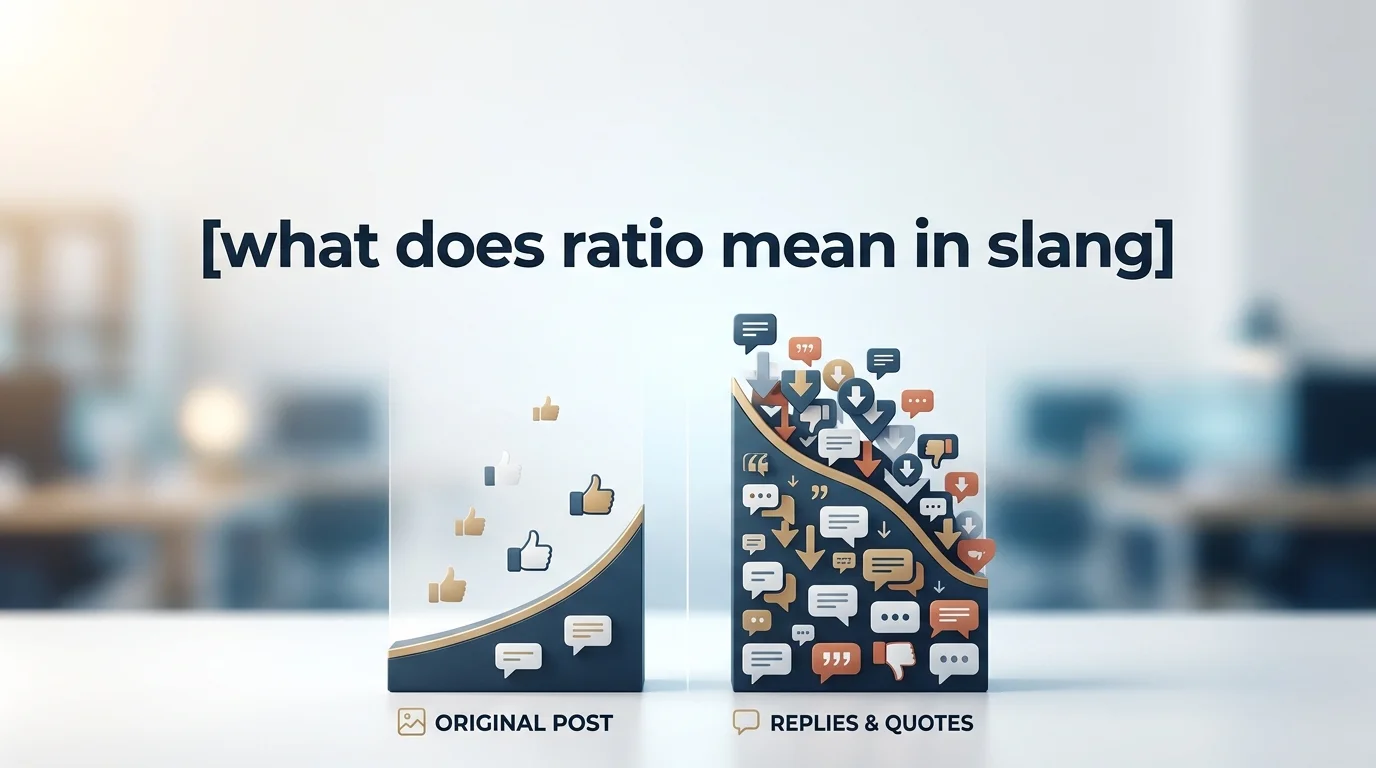
In slang, “ratio” refers to a situation where a reply or comment receives significantly more engagement—usually in the form of likes, retweets, or positive replies—than the original post it responds to.
Getting “ratioed” indicates that the public overwhelmingly disagrees with, dislikes, or finds fault with the original creator’s statement.
“He posted a terrible take on the game, but the top comment got double the likes. Absolute ratio.”
“Don’t bother arguing with that post, just look at the ratio in the replies.”
“Ratio + L + didn’t ask.”
The Core Indicators of a Ratio
- Negative Engagement Ratio: A high count of replies combined with extremely low likes on the original post.
- Counter-Like Ratio: A reply receiving exponentially more likes than the post it is responding to.
- The Quote-Tweet Spike: On platforms like X (Twitter), having vastly more quote-tweets than likes signals widespread public disapproval.
Origin & Background of the Slang
Where the Term Came From
The slang term originated on Twitter (now X) around 2017. Users noticed a distinct pattern in how public backlash manifested on the platform.
When a post is popular or universally liked, the number of likes far exceeds the number of replies. When a post is controversial, offensive, or universally disliked, people flood the reply section to argue, while almost nobody clicks the like button.
Cultural Influence and Social Media Expansion
Twitter users began calling this numerical disparity the “ratio of replies to likes.” Over time, the concept condensed into a single noun and verb: “ratio” and “getting ratioed.”
By 2020, the term migrated to TikTok, YouTube comment sections, and Instagram. On TikTok, where reply counts work differently, users simplified the concept: if a comment gets more likes than the video itself, or if a critical comment out-likes the creator, that comment successfully “ratioed” the post.
How the Meaning Evolved
What started as an observational metric transformed into an active social weapon. Internet users no longer just observed a ratio occurring naturally; they actively sought to cause one.
Commenters began writing simply “ratio” or “ratioed” under posts they disliked, rallying the crowd to like their comment as a democratic vote of disapproval against the original poster.
Real-Life Conversations
WhatsApp Chat
Person A: Did you see what Mark posted in the group chat about canceling the trip?
Person B: Yeah, everyone ignored his main text and just liked Sarah’s reply saying he was being ridiculous.
Person A: He got ratioed in our own group chat. That is brutal.
Instagram DMs
Person A: Why did that influencer turn off their comment section today?
Person B: She posted a really out-of-touch takes video yesterday.
Person A: Ah, let me guess… the comments took over?
Person B: Completely. The top comment calling her out had 50k likes, and her video only had 4k. Ultimate ratio.
TikTok Comment Section
Person A: This restaurant has the worst food in the entire city, nobody should eat here.
Person B: Ratio + their pasta is literally award-winning.
Person A: Check the likes on my comment vs yours before you talk.
Text Messages
Person A: I tried telling my little brother his outfit looked bad.
Person B: How did that go?
Person A: He told me “ratio,” showed me his fit pic likes, and walked out of the room. I have never felt so old.
Emotional & Psychological Meaning Behind the Slang
What Emotion the Slang Expresses
Using the word “ratio” conveys a mix of dismissiveness, collective judgment, and triumph. It represents the ultimate digital mic-drop, signaling that public opinion has spoken.
The term harnesses the power of crowd validation. It tells the original poster that their opinion stands isolated, rejected by the larger community consensus.
The Psychology of Online Public Disapproval
Human beings are wired to seek social proof and group belonging. Getting ratioed hits on a psychological level because it visually quantifies public rejection in real-time.
It transforms a subjective disagreement into an objective numerical loss. Seeing a counter-comment garner massive support creates a bandwagon effect, encouraging others to join the winning side.
A Real-Life Perspective
During a live community stream I watched recently, a guest made an unusually harsh critique of a local artist. The chat instantly stopped responding to the topic and flooded the screen with single-word replies.
Within thirty seconds, one viewer typed a simple counter-argument that gained thousands of pinned reactions. The streamer stopped, looked at the numbers, and acknowledged the shift immediately. The sheer speed of collective digital consensus reshaped the entire tone of the room in seconds.
Usage in Different Contexts
Social Media Platforms
On public platforms, “ratio” serves as an open-source moderation system. Users leverage it to punish bad takes, misinformation, or arrogant statements without needing platform admins to step in.
It thrives best in high-speed, comment-heavy environments like TikTok, X, and YouTube Shorts.
Friends and Relationships
Among friends, the term is frequently used ironically or sarcastically. Teasing a friend after a bad joke by saying “ratio” adds a layer of modern banter without real malice.
If used excessively or maliciously in personal groups, it can alienate people by reducing real emotional conversations to internet metrics.
Work and Professional Settings
The word “ratio” has almost no place in a professional workplace environment. Using it in emails, meetings, or slack channels can make you sound immature, unprofessional, or overly consumed by social media culture.
Describing a customer reaction as “receiving overwhelmingly negative feedback” carries the same meaning with proper professional weight.
Casual vs. Serious Tone
- Casual Usage: “Your take on that movie is terrible, ratio.” (Playful banter between peers)
- Serious Usage: “The company’s response to the scandal got ratioed within five minutes.” (Describing real PR backlash)
When NOT to Use It
Inappropriate Contexts
- Professional Performance Reviews: Never use internet slang to describe workplace feedback or peer evaluations.
- Serious Personal Arguments: Bringing social media terminology into deep personal conflicts invalidates genuine emotions.
- Grief or Crisis Situations: Attempting to “ratio” someone during discussions of tragedy, illness, or serious news shows severe emotional insensitivity.
Cultural Sensitivity and Misinterpretation
Older generations or individuals who stay away from social media will take the word literally, assuming you are talking about mathematics, financial proportions, or statistics.
Using it in cross-generational settings often creates awkward pauses and requires lengthy explanations that destroy the momentum of the conversation.
Common Misunderstandings
What People Get Wrong
Many people assume “ratio” simply means receiving a lot of negative comments. While high comment volume is part of it, the true definition relies on the contrast between engagement metrics.
A post with ten thousand negative comments isn’t necessarily ratioed unless those comments (or replies) outshine the post’s original support numbers.
Literal vs. Figurative Meaning
| Context | Meaning | Example |
| Literal (Mathematics) | A quantitative relationship between two amounts showing the number of times one value contains another. | “The ratio of flour to sugar in this recipe is 2:1.” |
| Figurative (Slang) | Public rejection of a post evidenced by higher engagement on replies than on the original content. | “His tweet got a major ratio because the take was so bad.” |
Slang Comparison Table
| Term | Slang Meaning | Usage Context | Tone |
| Ratio | Public rejection via counter-engagement | Social media comments, arguments | Dismissive, competitive |
| Canceled | Mass rejection and boycotting of a public figure | Public scandals, ethics debates | Serious, punitive |
| Fell Off | Losing popularity, quality, or relevance over time | Career updates, content trends | Critical, observational |
| L + Bozo | Dismissing someone after a clear loss or mistake | Direct arguments, online gaming | Mocking, triumphant |
| Read the Room | Being unaware of the emotional climate of a group | Awkward social situations | Direct, corrective |
Key Insight
Understanding these distinctions prevents misreading online social dynamics. While being “canceled” impacts a person’s long-term career, getting “ratioed” is usually a temporary defeat tied to a single bad statement or post.
Variations and Types of Ratio Slang
1. Simple Ratio
The classic scenario where a direct reply gets more likes than the original post.
2. Quote-Tweet Ratio
Occurs on X when a post receives thousands of quote-tweets criticizing it, but very few direct likes.
3. Ratio + L
Combining the term with “L” (Loss) to emphasize that the original poster lost the argument completely.
4. Ratio + Didn’t Ask
A popular comeback used to dismiss an unwanted opinion while simultaneously gathering crowd support.
5. Self-Ratio
When a creator makes a follow-up post admitting their previous take was terrible, effectively ratioing themselves.
6. Reverse Ratio
When someone attempts to ratio a post, but their reply gets heavily downvoted or ignored instead.
7. Instant Ratio
A post that receives immediate public pushback within seconds of going live.
8. The TikTok Ratio
Leaving a blank or one-word comment on TikTok that garners more likes than the video creator’s content.
9. Ratio Fell Off
A sarcastic variation used when a counter-comment fails to get the expected likes.
How to Respond When Someone Uses It
Casual Replies
- “Fair enough, the crowd has spoken!”
- “Hey, you win some, you lose some.”
- “I stand by my take regardless of the likes!”
Funny Replies
- “Math was never my strong suit anyway.”
- “Calling my lawyer to dispute these like counts.”
- “Deleting my account and moving to the woods.”
Mature Replies
- “I see a lot of people disagree with this perspective. Let’s talk about why.”
- “The metrics show this wasn’t well received, so let me clarify what I meant.”
- “I hear the feedback and understand why that take missed the mark.”
Respectful Replies
- “Appreciate the community calling me out on that mistake.”
- “Good point, the counter-argument makes more sense here.”
- “I spoke too soon on this one, thanks for setting the record straight.”
Regional & Cultural Usage
Western Culture
In North America and Europe, the slang is heavily tied to platform mechanics on X, TikTok, and Reddit. It is deeply embedded in youth culture, gaming communities, and political commentator circles.
Asian & Middle Eastern Digital Culture
Global English speakers in Asia and the Middle East use the term frequently within international gaming servers and English-speaking social media spaces. Local languages often adapt the English word directly rather than translating it.
Generational Differences
Gen Z (Born 1997–2012)
Uses “ratio” fluidly as both a noun, verb, and immediate insult. It forms a core part of their daily digital vocabulary.
Millennials (Born 1981–1996)
Understand and use the term mostly in text or online discussions, but rarely use it in face-to-face spoken conversations.
Gen X & Boomers
Generally view the word purely in its mathematical or statistical context, often missing the digital subtext completely.
Is It Safe for Kids?
The word “ratio” itself contains no profanity, explicit meaning, or inherently dangerous themes. It is completely safe from a linguistic standpoint.
Parents should monitor the behavior behind the word. Because it represents public dogpiling, heavy involvement in ratio culture can sometimes overlap with online toxicity, cyberbullying, or digital mob mentality.
Frequently Asked Questions
What does it mean to get ratioed?
To get ratioed means your social media post received significantly fewer likes than the replies criticizing it, showing public disagreement.
Is ratio a bad thing on social media?
Yes, getting ratioed generally means the online community dislikes your post, statement, or opinion.
What does ratio mean on TikTok?
On TikTok, it means a comment under a video has accumulated more likes than the video itself or the creator’s pinned comment.
What does “Ratio + L” mean?
It is a combined slang phrase meaning the original poster lost the argument (L) and was publicly rejected by the crowd (ratio).
How do you avoid getting ratioed?
Think carefully before posting controversial takes, verify your facts, and read the mood of your audience before sharing opinions online.
Can you ratio someone in real life?
While people occasionally say it as a joke out loud, true ratios require quantifiable digital engagement metrics like likes and retweets.
Conclusion
Language reflects the tools we use to communicate. The evolution of “ratio” from a basic mathematical term to a digital metric of social consensus proves how rapidly internet culture reshapes modern English.
Recognizing these terms keeps you connected to modern conversations, whether you are managing digital brand presence or talking with younger family members.
Next time you see a comment taking over a thread, you won’t have to guess what happened—you’ll spot the ratio immediately and navigate the conversation with confidence.