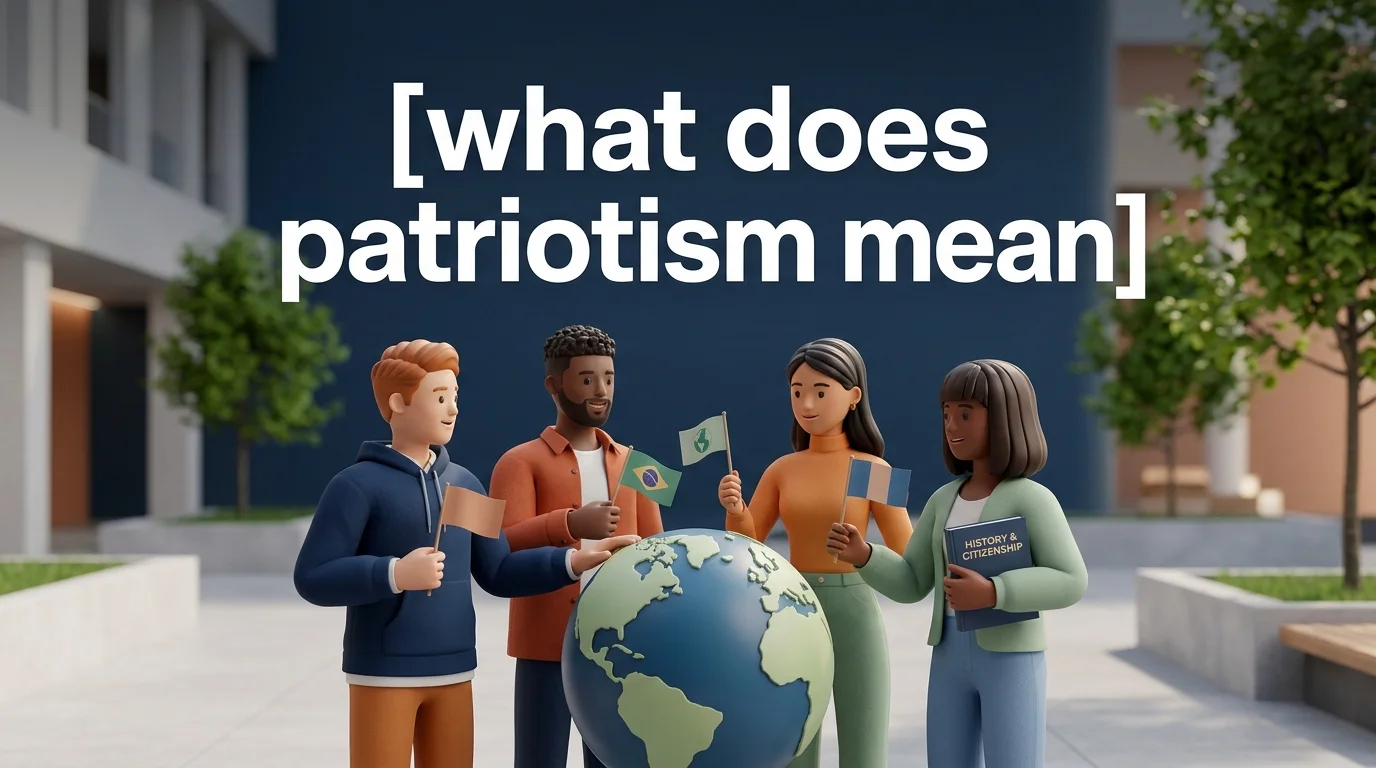
What Does Patriotism Mean in Today’s World?
Understanding what patriotism means often starts with a single memory. For many, it is standing on a chilly autumn morning, watching a parade pass by while a flag catches the breeze. For others, it is the quiet act of voting after a long workday.
People frequently search for this term because the world is changing fast. Global borders feel more porous online, yet national identities remain deeply emotional.
The confusion usually arises when love for one’s country gets tangled up with political arguments, military history, or loud public displays.
By looking at its true roots, we can separate genuine affection for a homeland from political noise. This clarity helps us understand both our history and our daily civic responsibilities.
What Does Patriotism Mean? A Quick Overview
The core definition
At its most fundamental level, patriotism is an emotional attachment to a nation, its land, its people, and its principles.
It is the belief that one has a stake in the collective well-being of their community. It combines gratitude for shared heritage with a willingness to contribute positively to the future.
- A felt sense of belonging to a specific national story.
- A commitment to the common good over purely personal gain.
- Respect for national traditions alongside a drive to make those traditions better.
“Patriotism is not short, frenzied outbursts of emotion, but the tranquil and steady dedication of a lifetime.” — Adlai Stevenson
“True patriotism springs from a desire to see one’s nation embody its highest ethical ideals.”
“Love of country is shown through service, sacrifice, and caring for the people next door.”
The Origin and Background of Patriotism
Historical roots
The word itself traces back to the Greek word patrios, meaning “of one’s fathers,” and patris, meaning “fatherland.” Ancient Greeks viewed devotion to the polis (the city-state) as the highest civic virtue.
During the Enlightenment, thinkers reframed the concept around shared liberty, human rights, and constitutional law rather than devotion to a monarch.
Evolutionary shifts in meaning
Centuries ago, devotion meant loyalty to a royal bloodline or a local feudal lord.
With the rise of democratic republics, the focus shifted to constitutional loyalty. You were no longer serving a king; you were serving a set of shared laws and values.
Ancient Greece (Devotion to the City-State)
       │
       ▼
Enlightenment Era (Loyalty to Shared Rights & Constitutions)
       │
       ▼
Modern Digital Age (Global Civic Awareness & Ethical Identity)
Digital age impact
Social media transformed national sentiment. Hashtags, digital campaigns, and viral sports moments mean people express their national identity online in real time.
This digital global arena often forces us to reflect on what our country stands for when the whole world is watching.
Real-Life Conversations: How We Talk About Patriotism
Text messages between siblings
Person A: Hey, are you coming to the town hall clean-up tomorrow morning?
Person B: Honestly, I’m exhausted. Why do you always volunteer for these things?
Person A: I just care about this neighborhood. If we don’t fix the park, nobody will. That’s what taking pride in our town actually looks like.
Person B: Fair point. Set an alarm for me; I’ll come help.
Instagram DMs after an international sports match
Person A: Did you see the national team after the match? They stayed behind to clean up the stadium!
Person B: Yes! That made me prouder than the actual scoreline.
Person A: Exactly. That is pure class and true representation of our values.
TikTok comment thread under a community video
Person A: True devotion to your country means never criticizing it. You should just be grateful!
Person B: Loving your country means wanting it to do better. Pointing out issues so we can fix them is the most responsible thing you can do.
The Emotional and Psychological Meaning
What the emotion actually expresses
Psychologically, national devotion satisfies a deep human need for community, shared purpose, and historical continuity. It grounds individual identity inside a larger, enduring narrative.
When people express this feeling, they are often expressing gratitude for the rights, safety, and cultural richness they enjoy.
Psychological roots
It acts as a social glue. Human beings are wired to form groups, and a nation provides a broad framework where millions of strangers can cooperate around shared legal systems and cultural norms.
Personal experience scenario
A few years ago, I visited a small rural library that was facing severe budget cuts. A group of local veterans and young high school students worked together for weeks to organize a fundraising drive to save it.
They did not fly huge banners or make speeches. They simply showed up, painted the walls, and raised the funds.
That experience showed me that real civic love is built through quiet, local work rather than loud declarations.
Usage of Patriotism in Different Contexts
Social media platforms
On platforms like Instagram or X, national identity is often tied to major sporting events, national holidays, or moments of cultural pride.
It tends to be visually driven—flags, iconic landscapes, and historical quotes dominate these spaces.
Personal relationships and friendships
Among friends, civic duty often shows up as community involvement. Supporting local businesses, voting together, or volunteering during local crises are everyday expressions of this sentiment.
   ┌─────────────────────────────────────────────────────────┐
   │                  EXPRESSIONS OF CIVIC PRIDE            │
   └─────────────────────────────────────────────────────────┘
                                │
        ┌───────────────────────┴───────────────────────┐
        ▼                                               ▼
  [INFORMAL / DAILY]                            [FORMAL / CIVIC]
  • Supporting local businesses                 • Voting in local/national elections
  • Neighborhood cleanup drives                 • Serving on civic boards
  • Celebrating national team victories         • Defending constitutional rights
Professional and workplace settings
In business, civic dedication often translates into social responsibility, supporting domestic labor, adhering to ethical practices, and investing in local community projects.
When NOT to Use or Express Patriotism
Inappropriate contexts
It is important to avoid weaponizing civic pride during discussions that call for universal human empathy. Using national pride to justify unfair treatment of others or to shut down honest discussion isn’t genuine love of country.
- Using flag displays to dismiss real community struggles.
- Demanding blind agreement during political debates.
- Expressing civic pride to make international colleagues feel excluded.
Cultural sensitivity
Every nation experiences civic devotion differently. Some cultures favor quiet, personal service, while others embrace public celebrations.
Forcing one style of expression onto another culture can lead to misunderstandings.
Common Misunderstandings About Patriotism
Confusing love of country with nationalism
The most common error is mixing up healthy devotion with rigid nationalism.
Nationalism often promotes the idea that one’s nation is superior to all others and above critique. Healthy civic love focuses on improving one’s home while respecting other nations.
   HEALTHY CIVIC LOVE                    RIGID NATIONALISM
┌─────────────────────────┐           ┌─────────────────────────┐
│ "I love my country and  │     VS    │ "My country is superior │
│ want it to be its best."│           │ to all others, always." │
└─────────────────────────┘           └─────────────────────────┘
The “blind obedience” myth
Loving your country does not mean supporting every government policy blindly. Historically, some of the greatest displays of civic pride came from citizens who protested unfair laws to help their nation grow.
Comparing Terms: Civic Devotion vs. Related Concepts
| Concept | Primary Focus | Emotional Tone | Attitude Toward Others |
|---|---|---|---|
| Civic Devotion | Love of land, people, & ideals | Constructive, grateful | Respectful of other nations |
| Nationalism | National superiority & power | Assertive, protective | Often mistrustful of outsiders |
| Chauvinism | Blind, uncritical loyalty | Aggressive, dismissive | Openly hostile to differences |
| Jingoism | Military dominance & threats | Belligerent, tense | Threatening toward rivals |
| Cosmopolitanism | Global citizenship above all | Universal, broad | Focuses on global unity |
Key Insight
While nationalism focuses on boundaries and superiority, true civic love focuses on values and internal improvement, ensuring the nation lives up to its promises for everyone.
10 Variations and Related Types of Patriotism
1. Constitutional Patriotism
Devotion centered on democratic values, human rights, and the rule of law rather than shared ancestry.
2. Civic Patriotism
Focuses on active participation in community life, voting, and local governance.
3. Cultural Patriotism
Pride in a nation’s art, literature, music, traditions, and historic achievements.
4. Critical Patriotism
Loving one’s country while actively pointing out its flaws to encourage positive reform.
5. Environmental Patriotism
Protecting a nation’s natural beauty, public parks, waterways, and natural resources.
6. Economic Patriotism
Choosing to support local industries, workers, and businesses to strengthen the home economy.
7. Military Patriotism
Deep respect and gratitude for service members who defend national security.
8. Sports Patriotism
Uniting behind national teams and athletes during global athletic competitions.
9. Symbolic Patriotism
Focusing on flags, anthems, and national monuments as markers of unity.
10. Local (Regional) Patriotism
A deep, specialized pride in one’s specific state, province, or city.
How to Respond When Someone Discusses Patriotism
Casual replies
“I agree. Supporting our local community is really the best way to show pride.”
Thoughtful replies
“It’s great to see people passionate about our country’s future, especially when it leads to positive action.”
Respectful challenges
“I love our country too, but I think pointing out where we can improve is part of taking care of it.”
Humorous replies
“I show my civic pride by actually paying my taxes on time and picking up after my dog!”
Regional and Cultural Usage Differences
Western perspectives
In Western democracies, civic pride is frequently tied to constitutional rights, personal liberties, and active political debate. Expressing dissent is often viewed as a valid form of civic engagement.
Asian perspectives
In many Asian societies, love of country is closely tied to collective harmony, social stability, respect for elders, and contributing to the nation’s economic progress.
Middle Eastern perspectives
Devotion to one’s homeland often weaves together national history, deep familial roots, religious heritage, and hospitality toward guests.
┌─────────────────────────────────────────────────────────────┐
│                 REGIONAL DYNAMICS OF CIVIC PRIDE             │
└─────────────────────────────────────────────────────────────┘
  • Western: Rights, Individual Liberties, Open Debate
  • Eastern: Social Harmony, Economic Progress, Collective Duty
  • Middle Eastern: Family Roots, Cultural Heritage, Hospitality
  • Global Online: Digital Activism, Shared Memes, Global Sports
Generational shifts
Older generations often associate civic devotion with military service, traditional symbols, and historical events.
Younger generations frequently express their dedication through climate action, social justice, local volunteering, and ethical consumption.
Is the Concept Safe and Healthy for Kids to Learn?
Yes, teaching children about civic pride is healthy when grounded in positive values. It helps young minds develop a sense of belonging, responsibility, and respect for their neighbors.
Parents and teachers can introduce the concept by emphasizing simple actions: caring for public parks, learning local history, helping neighbors, and understanding how rules keep communities safe.
Frequently Asked Questions
What is the simple definition of patriotism?
Patriotism is the love, pride, and devotion a person feels toward their country, alongside a commitment to contributing positively to its people and future.
How is patriotism different from nationalism?
Patriotism is love for one’s country based on shared values and care for its people. Nationalism involves the belief that one’s nation is superior to all others.
Can you criticize your country and still be patriotic?
Yes, constructive criticism aimed at fixing problems and improving society is often considered one of the highest forms of civic responsibility.
What are real-life examples of everyday patriotism?
Everyday examples include voting in local elections, volunteering at community centers, supporting local businesses, and obeying laws that keep people safe.
Why is patriotism important in modern society?
It fosters social unity, encourages civic duty, and inspires people to work together for the common good across political and personal differences.
Does patriotism mean supporting war?
No, civic devotion is about serving and improving the nation. While it respects those who defend the country, it focuses heavily on peaceful civic life and community care.
Conclusion
Understanding what patriotism means comes down to recognizing that real love for a country is an action, not just a feeling. It goes far beyond waving flags at a parade or shouting slogans during election season.
It lives in everyday choices—how we treat our neighbors, how we steward our local environments, and how we participate in our communities.
When we view civic pride as a ongoing responsibility to make our homeland better for everyone, it becomes a unifying force that bridges divides and builds a stronger future.