What Does Opp Mean in Slang and Why Is Everyone Using It?
Language evolves faster than most dictionaries can keep up with. If you have been scrolling through TikTok comments, reading Instagram captions, or overhearing teenagers chat on the street, you have likely run into the word opp.
At first glance, it sounds like an abbreviation for opportunity, option, or even operation. However, the internet uses it in a completely different way that carries real emotional weight.
People search for this term because slang changes overnight. A word that started in street culture can suddenly become a meme on group chats across the world. Understanding what opp means helps you decode modern online culture, avoid awkward social blunders, and stay connected with how young people express tension, humor, and loyalty today.
What Opp Means in Slang: A Quick Definition
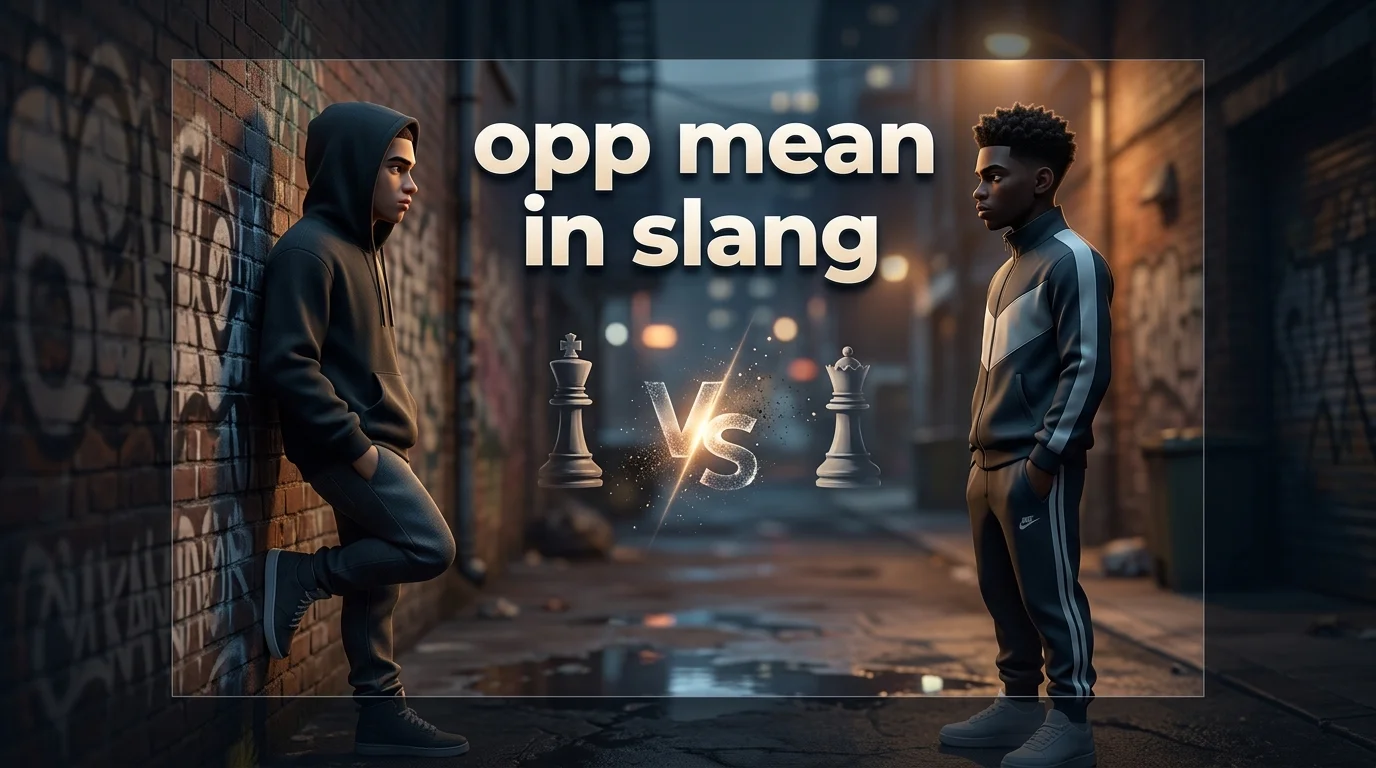
At its core, opp is short for opposition or opponent.
In modern slang, an opp refers to an enemy, rival, competitor, or anyone working against you. Depending on the context, the word can describe a serious personal adversary or a friend who just stole the last slice of pizza.
Primary Meanings of Opp
- The Opposition (Rival/Enemy): Someone who actively opposes you, talks behind your back, or competes against you.
- Law Enforcement (Street Context): In hip-hop culture, the term historically referred to the police or rival gang members.
- Playful Nemesis: A friend or family member who mildly inconveniences you in a funny way.
Quick Examples in Conversation
“I can’t go to that party tonight; my opp is going to be there.”
“Why are you taking her side? You’re acting like an opp right now.”
“My alarm clock going off at 6 AM is my biggest opp.”
Origin and Background: Where Did Opp Come From?
Understanding where slang comes from gives you true insight into its cultural weight. Words rarely appear out of nowhere; they are built through lived experiences and shared subcultures.
Rooted in Street Culture and Chicago Drill Music
The term opp originated within African American Vernacular English (AAVE) and street culture. It gained massive mainstream visibility through the rise of Chicago drill music in the early 2010s. Artists like Chief Keef, King Von, and Lil Durk used the word in their lyrics to refer to rival groups and local law enforcement.
In those early contexts, calling someone an opp carried heavy weight. It was not a joke. It meant a genuine, potentially dangerous threat to someone’s safety and street credibility.
The Social Media Explosion
As drill music blew up globally on platforms like YouTube and Soundcloud, the slang escaped its original geographic boundaries. By the late 2010s and early 2020s, platforms like TikTok, X (formerly Twitter), and Instagram brought the word into mainstream youth culture.
Gen Z adopted the term and applied it to low-stakes, everyday situations. The word shifted from serious street terminology to a flexible piece of internet culture.
How the Meaning Evolved Over Time
Language naturally softens as it goes mainstream. Over the past decade, the word has undergone semantic bleaching—a linguistic process where a strong word loses some of its intensity over time.
Today, while the original serious meaning still exists in specific contexts, the broader internet uses it hyperbolically to describe minor nuisances or friendly betrayals.
Real-Life Conversations: How Opp Looks in Daily Texting
To truly grasp how people use slang, you need to see it in action across different digital spaces. Here are realistic examples showing how the term shows up in modern communication.
Scenario 1: Texting on WhatsApp
Maya: Hey, are you still coming to the gym with us?
Jordan: Nah, Marcus is going to be there.
Maya: Wait, since when do you guys not get along?
Jordan: Ever since he told the manager I called in fake sick last week. He’s a whole opp now.
Scenario 2: Instagram DMs
Elena: Why did you post that picture of me sleeping on your story?! 😂
Liam: Because it was hilarious! You were drooling!
Elena: Unbelievable. I thought you were my best friend, turns out you’re the main opp. 💀
Scenario 3: TikTok Comment Section
User1: My cat literally stares at me while knocked-over water drips onto my laptop.
User2: That’s not a pet, that’s an opp residing in your house 😭
Scenario 4: Casual Texting
Sam: Can you lend me $10 for lunch?
Chris: Didn’t you owe me $5 from Tuesday?
Sam: Bro is holding grudges like an opp. Just say no!
Emotional and Psychological Meaning: Why People Use It
Slang persists because it fills an emotional void that formal language misses. Calling someone an adversary or enemy feels overly dramatic and outdated. Calling them an opp hits a specific modern tone.
The Psychology Behind the Word
Using slang like this builds immediate social bonding. It establishes an “in-group” versus “out-group” dynamic. When you tell a friend, “Don’t act like an opp,” you are subtly reinforcing loyalty. You are reminding them of the unwritten rules of your friendship.
It also provides a psychological buffer. By using a slang term to describe someone who annoyed you, you release frustration without escalating the situation into a serious confrontation.
Emotional Tones Expressed by Opp
- Playful Betrayal: Expressing minor disappointment when a friend does not back you up.
- Self-Aware Drama: Exaggerating a minor inconvenience for comedic effect.
- Genuine Suspicion: Expressing distrust toward someone who has proven disloyal.
A Lived Perspective on the Shift
A few years ago, I was mentoring a high school communications group. One afternoon, a student looked at his phone, sighed loudly, and muttered, “My mom is my biggest opp today; she took my car keys because I forgot to take out the trash.”
The room erupted in laughter. It was clear he loved his mother dearly, but using that specific word allowed him to vent his minor frustration through humor. That moment highlighted how modern language transforms heavy concepts into lighthearted relational tools.
Usage in Different Contexts
Context determines everything in modern linguistics. The same word can land as a light joke or a severe insult depending on where and how you say it.
Social Media Platforms
On TikTok, X, and Instagram, the term is predominantly used for humor, memes, and relatable content. You will see videos titled “When your dog turns into an opp” showing a pet stealing food. In digital spaces, dramatic exaggeration is the primary currency.
Friends and Personal Relationships
Among friends, calling someone an opp is usually a sarcastic playful jab. It signals that someone did something mildly unsupportive, like telling a crush an embarrassing story or eating the last item in the fridge.
However, if spoken with a flat tone in a tense moment, it signals real boundary violation or distrust.
Work and Professional Settings
Do not use this word in professional environments. Calling a coworker or client an opp—even jokingly—can sound unprofessional, passive-aggressive, or culturally insensitive. Professional communication demands clear, direct, and formal phrasing.
Casual vs. Serious Tone
- Casual: Heavy emphasis on humor, often accompanied by emojis (😭, 💀) or dramatic facial expressions.
- Serious: Spoken quietly, without laughter, usually in environments where personal safety, group loyalty, or real conflict is present.
When NOT to Use Opp
Misusing slang can quickly make you seem out of touch or create accidental tension.
Inappropriate Contexts
- Job Interviews: Avoid using modern internet slang when trying to establish professional credibility.
- Formal Emails: Stick to standard English when communicating with corporate teams, educators, or authorities.
- Serious Disputes: If you are having a genuine confrontation with a friend or partner, dropping street slang can make you sound immature or dismissive of their real feelings.
Cultural Sensitivity and Misunderstanding
Because the term originated in Black urban culture and carries history related to real-life struggles, using it flippantly in overly formal or privileged settings can read as performative. Always respect the roots of the language you borrow.
Common Misunderstandings About Opp
Because the word is short and widespread, people often mix it up with other terms.
Opp vs. Ops
People often confuse opp (enemy/rival) with ops (operations). While ops can mean police operations in certain street contexts, in corporate environments, ops is short for operations (e.g., “DevOps” or “Business Ops”). Do not tell your manager you are working on the “opps” unless you want a very confused reaction.
Literal vs. Figurative Meaning
Older generations sometimes hear the word and assume it implies immediate physical threat or criminal activity. On the modern internet, 90% of its usage is purely figurative and humorous. Reading the room is essential.
Comparative Analysis: Opp vs. Related Slang
To help you understand where this term sits in the modern lexicon, here is a breakdown comparing it to similar slang terms.
| Slang Term | Core Meaning | Tone | Best Used For |
| Opp | Opponent / Enemy | Playful to Hostile | Rivals, unsupportive friends, minor nuisances |
| Hater | Someone jealous of your success | Critical / Defensive | People putting down your achievements |
| Frenemy | A friend who is also a rival | Passive-Aggressive | Unstable, competitive friendships |
| Snitch | Someone who tells authorities | Accusatory | People breaking group trust or confidentiality |
| Side Eye | Expression of distrust | Sarcastic / Judgmental | Expressing doubt without speaking |
Key Insight
While terms like “hater” focus purely on jealousy, opp focuses directly on conflict and opposition. Calling someone an opp implies an active clash of interests rather than passive envy.
10 Common Variations and Types of Opps
The internet has created several playful sub-categories of this term to describe specific types of inconveniences.
1. Main Opp
Your primary rival or the main source of your frustration in a given moment.
2. Silent Opp
Someone who pretends to be nice to your face but secretly roots for your failure.
3. Internal Opp
A lighthearted term for your own brain or body when it works against you (e.g., getting sick before a trip).
4. Household Opp
A mischievous pet or sibling who constantly ruins your plans or takes your belongings.
5. Corporate Opp
A playful, off-the-record term for a competing company or a difficult policy at work.
6. Weather Opp
Rain, snow, or extreme heat that ruins outdoor plans you spent weeks organizing.
7. Academic Opp
A notoriously difficult professor, pop quiz, or final exam standing between you and graduation.
8. Tech Opp
Autocorrect, bad Wi-Fi, or low battery warnings striking at the worst possible moment.
9. Former Opp
Someone you used to dislike or compete with but eventually made peace with.
10. Accidental Opp
A close friend who accidentally spoils a movie, gives away a surprise, or ruins a secret without bad intentions.
How to Respond When Someone Calls You an Opp
If someone drops this word on you in conversation or text, your response should match their tone.
Casual & Playful Replies
- “Who, me? I’m the most loyal person you know!”
- “You caught me. My secret mission is complete.”
- “I’m not an opp, you’re just dramatic!”
Funny & Sarcastic Replies
- “I wear the title proudly.”
- “Plotting your downfall takes a lot of effort, you know.”
- “If supporting you means being an opp, then call me the CEO of the opposition.”
Mature & Grounded Replies
- “Hey, jokes aside, I hope you know I’ve got your back.”
- “If I did something that bothered you, just let me know directly.”
Respectful Replies
- “My bad! I definitely didn’t mean to mess up your plans.”
- “Let me make it up to you so I can get off your rival list.”
Regional and Cultural Differences in Usage
Slang travels instantly via the internet, but local cultures adapt it to fit their own unique conversational styles.
Western Internet Culture
In North America and the UK, the word has fully saturated mainstream youth vocabulary. It is heavily utilized in social media trends, gaming streams, and casual text exchanges.
Asian Internet Culture
In English-speaking communities across Asia (such as Singapore, the Philippines, and India), young people adopt the word primarily through TikTok and gaming streams. It is almost exclusively used playfully or within online gaming matches to refer to enemy teams.
Middle Eastern Internet Culture
In English-medium youth circles in the Middle East, the term is frequently used in gaming, rap music discussions, and lighthearted banter among friends.
Generational Divide: Gen Z vs. Millennials
- Gen Z: Uses the word fluidly across casual speech, memes, and daily texting. They naturally understand its hyperbolic, humorous subtext.
- Millennials: Might use the word self-consciously or ironically, often preferring older equivalents like “hater” or “frenemy.”
Is It Safe for Kids to Use?
Parents often worry when they hear their children using terms that originated in street culture.
In almost all modern cases, when kids or teenagers use the word opp, they are simply participating in popular internet trends. They use it to refer to difficult homework, strict house rules, or a sibling taking their controller.
Unless the word is paired with aggressive behavior, genuine threats, or signs of bullying, it is a harmless piece of modern youth slang.
Frequently Asked Questions
What does opp mean in text messages?
In text messages, opp usually stands for opposition or opponent. It refers to a rival, an enemy, or a friend who is playfully acting against you.
Is calling someone an opp a serious insult?
It depends entirely on the context. On social media and among friends, it is almost always a joke. However, in street culture or intense disputes, it can mean a genuine, serious enemy.
Where did the slang word opp originate?
The term originated in African American Vernacular English (AAVE) and was popularized globally by Chicago drill music artists in the early 2010s before going viral on social media.
What is the difference between an opp and a hater?
A hater is someone who feels envy or jealousy toward your success. An opp is someone actively competing against you or taking actions to oppose you.
What does opp mean in gaming?
In online multiplayer games, opp is short for the opposing team, an enemy player, or the opposition standing in the way of your victory.
Navigating Modern Slang with Confidence
Language is dynamic, expressive, and constantly shifting. Words like opp demonstrate how internet subcultures take serious language, reshape it, and give it new life as a tool for humor and connection.
By understanding where the term comes from, how its emotional tone shifts across contexts, and when to use it, you can navigate modern online conversations with confidence and clarity. Whether you use the slang yourself or simply want to understand what the younger generation is talking about, staying informed keeps your communication sharp and culturally grounded.