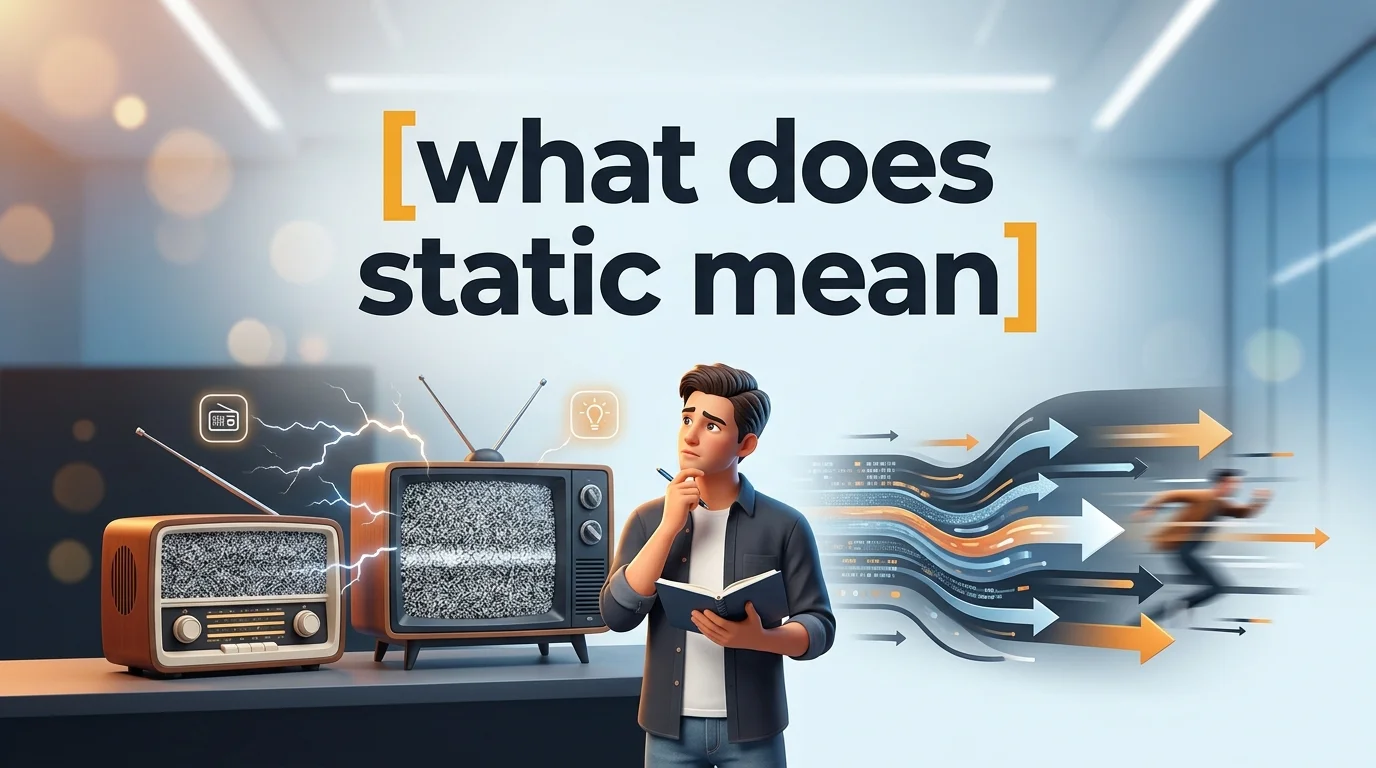
Language moves fast, but few words have jumped from physics textbooks to urban dictionaries quite like “static.” If someone recently told you they “don’t want no static,” or if you are trying to figure out why your favorite audio track suddenly sounds crackly, you are likely wondering: what does static mean in today’s world?
The truth is that this single six-letter word carries vastly different meanings depending on who is saying it, where they are saying it, and the emotional tone behind it. It can describe a physical phenomenon, a frozen situation, or a intense personal confrontation brewing in someone’s group chat.
Understanding these nuances helps you navigate modern digital conversations, avoid social awkwardness, and communicate with total confidence across different generations.
Unpacking the Word: What Does Static Mean in Daily Life?
At its most fundamental level, the word describes something that remains fixed, motionless, or characterized by lack of change. In traditional English grammar and physical science, it represents stability or resistance to movement.
However, modern slang has flipped this passive definition on its head. Today, calling something static often implies an active, crackling tension ready to burst into open conflict or drama.
Whether you are deciphering a text message, analyzing a business report, or fixing a television monitor, the core concept always revolves around energy—either energy that is trapped without movement, or invisible noise interfering with clarity.
What Does Static Mean? A Quick Reference Guide
Core Definition
The term functions as both an adjective and a noun across technical, everyday, and informal slang registers.
- As an Adjective: Lacking in movement, action, or change (e.g., “a static budget” or “static balance”).
- As a Noun (Technical): Random noise or crackling electrical interference on a display screen or audio speaker caused by atmospheric disturbance.
- As a Noun (Modern Slang): Conflict, drama, opposition, trouble, or aggressive confrontation between individuals.
“I was just trying to ask a simple question, but he came at me with pure static.”
“Our website traffic has remained completely static for the third consecutive quarter.”
“Rubbing the balloon against your wool sweater builds up static electricity.”
Origin, Background, and Social Media Evolution
Historical Etymology
The term traces back to the Ancient Greek word statikos, meaning “causing to stand” or “bringing to a halt.” It entered the English language in the late 17th century through scientific Latin, primarily to describe forces that balance each other without producing motion.
During the 20th century, the expansion of radio and television broadcasting introduced the term to everyday households. People began associating it with the annoying buzz and white noise that obscured clear signals.
Ancient Greek (Statikos: "to stand fixed")
  └──> 17th Century Science (Physics of balanced forces)
        └──> 20th Century Technology (Radio/TV signal noise)
              └──> Hip-Hop Culture (Verbal friction & confrontation)
                    └──> Global Social Media (Viral slang & meme culture)
Cultural Influence and Hip-Hop Roots
The transition from audio interference to interpersonal drama began within African American Vernacular English (AAVE) and hip-hop culture during the late 1980s and 1990s. Artists used “static” metaphorically to describe the crackling, tense environment before a street disagreement or verbal battle.
Just as static on a radio disrupts a smooth song, interpersonal static disrupts peace between people.
Social Media Amplification
Platforms like TikTok, X (formerly Twitter), and Instagram sped up the adoption of this slang globally. Short-form video captions frequently feature phrases like “zero static,” while comment section arguments are regularly labeled as “unnecessary static.”
Real-Life Conversations: How It Sounds in Texts and DMs
Scenario 1: WhatsApp Group Chat
Person A: Yo, is Marcus coming to the kickoff dinner tonight?
Person B: Nah, he said he’s skipping it. He heard Dave might be there and he doesn’t want any static.
Person A: Smart move honestly. Keep the night peaceful.
Scenario 2: Instagram Direct Message
Person A: Why did you leave that shady comment under her recent post? 😂
Person B: I wasn’t even trying to start static! I was genuinely asking a question, but everyone took it wrong.
Scenario 3: TikTok Comment Section
Person A: Imagine posting this opinion and expecting no static in the comments 💀
Person B: Right? The comment section is literally exploding right now.
Scenario 4: Casual Text Message
Person A: How is your new job going? Is management better than your last place?
Person B: It’s so calm here. Zero drama, zero static, just everyone doing their work and going home.
Emotional and Psychological Meaning
Expressing Friction and Hidden Tension
When someone uses the term in a social context, they are tapping into a deeply intuitive feeling. Static isn’t usually a full-blown physical fight; it is the uncomfortable, crackling energy in the room before or during an argument.
Psychologically, using this word allows people to label hostility without escalating it into formal accusations. It identifies bad vibes, passive-aggressive remarks, or underlying jealousy instantly.
Experience-Based Insight: The Energy of a Room
During my years working in fast-paced media environments, I remember walking into a team meeting after two senior managers had a disagreement over project ownership. No one was shouting, but you could feel a literal weight in the air—a heavy, buzzing awkwardness that made everyone hesitate before speaking.
That uncomfortable energy is what people mean when they talk about emotional static. It creates hesitation, drains productivity, and forces everyone involved to walk on eggshells.
Usage Across Different Contexts
                      ┌──> Social Media (Drama, shade, comment wars)
                      │
                      ├──> Relationships (Passive aggression, tension)
USAGE CONTEXTS ───────┤
                      ├──> Business/Tech (Fixed rates, signal noise)
                      │
                      └──> Casual Speech (Low-stakes banter, vibes)
Social Media
On platforms where visual context is everything, the word describes public drama, call-out posts, and heated debate strings.
Personal Relationships
In romantic or friendly spaces, it refers to unresolved friction, passive-aggressive comments, or lingering resentment that ruins an otherwise fun gathering.
Professional and Corporate Environments
In office settings, stick to the literal or technical meanings. A “static strategy” means a plan that hasn’t adapted to market shifts, while “static metrics” means data points that aren’t growing.
Casual vs. Serious Tone
- Casual: “I’m just staying home tonight, trying to avoid any outside static.”
- Serious: “If you keep coming at my family like that, we’re going to have real static.”
When NOT to Use It
High-Stakes Professional Settings
Avoid using the slang variation during formal job interviews, performance reviews, or board presentations. Telling your manager that a client gave you “static” sounds unprofessional; opt for “pushback” or “constructive criticism” instead.
Cross-Cultural or Multilingual Environments
Individuals learning English as a second language may only know the dictionary definition related to physics or radio signals. Using the slang form might lead to total confusion.
Formal Written Correspondence
Keep this slang out of formal emails, legal letters, or academic essays unless you are explicitly analyzing modern slang patterns or cultural linguistics.
Common Misunderstandings
Confusing Static with Dynamic
A frequent mistake occurs when people mix up static with its opposite, dynamic. Dynamic implies active movement, adaptation, and high energy, whereas static implies remaining in one fixed state.
Overestimating the Severity
Hearing that two people have “static” doesn’t always mean they are sworn enemies. Often, it refers to minor annoyance or temporary awkwardness rather than permanent hatred.
Literal Interference vs. Metaphorical Drama
When older generations hear the word, they usually picture television static or clothes sticking together after coming out of the dryer. Younger generations almost instantly interpret it through the lens of interpersonal conflict.
Comparing Static to Related Slang and Expressions
| Term | Context / Nuance | Intensity Level | Primary Usage |
| Static | Underlying friction, drama, or active confrontation | Medium to High | Social media, street slang, casual talk |
| Beef | Deep-seated, long-term hatred or rivalry | High | Hip-hop, personal feuds, serious drama |
| Shade | Subtle, indirect insults or disrespect | Low to Medium | Pop culture, casual conversations |
| Smoke | Direct, intense conflict or physical fighting | Very High | Street culture, competitive gaming |
| Stagnant | Unhealthy lack of progress or movement | Low (Non-slang) | Business, personal growth, health |
Key Insight
While terms like “beef” or “smoke” describe severe, explicit rivalries, static uniquely captures the atmospheric tension and subtle annoyance that precedes or surrounds a conflict.
Variations and Expressions You Should Know
1. “Don’t Want No Static”
Meaning: Clearly stating a preference to stay away from drama, fights, or unnecessary trouble.
2. “Static Electricity”
Meaning: The literal buildup of electric charge on a surface, often causing sparks or clingy fabrics.
3. “Static IP Address”
Meaning: A permanent IP address assigned to a network device that never changes automatically.
4. “Static Noise / White Noise”
Meaning: Unbroken background sound produced by audio equipment or radio signals.
5. “Static Character”
Meaning: A fictional character in literature who undergoes zero internal growth or change throughout a story.
6. “Bringing the Static”
Meaning: Actively provoking someone or deliberately starting an argument in a social setting.
7. “Static Budget”
Meaning: A fixed financial plan that remains unchanged regardless of sales volume or revenue shifts.
8. “Catching Static”
Meaning: Receiving unexpected criticism, grief, or hostility from someone else.
9. “Static Friction”
Meaning: The resistive force that prevents two solid objects from sliding past each other while at rest.
10. “Zero Static”
Meaning: A completely peaceful state or relationship featuring zero drama, friction, or disagreement.
How to Respond When Someone Uses It
Casual Responses
- “You know me, I keep things zero static all day.”
- “Not worth your energy, honestly. Let them deal with their own noise.”
Funny Responses
- “My life is already too chaotic for extra static—my battery is at 1%!”
- “Unless it’s static on my laundry, I don’t want to hear about it.”
Mature Responses
- “Let’s talk things out directly so we don’t end up with lingering tension.”
- “I prefer to keep communication clear and transparent to avoid misinterpretation.”
Respectful Responses
- “I appreciate you letting me know. I definitely want to resolve this smoothly.”
- “Let’s focus on finding a solution rather than getting bogged down in frustration.”
Regional and Cultural Usage Differences
┌─────────────────────────────────────────────────────────┐
│                    GLOBAL USAGE MAP                     │
├───────────────────┬─────────────────────────────────────┤
│ Western Culture   │ Heavy slang use for social drama    │
│ Asian Culture     │ Strictly technical / educational    │
│ Middle Eastern    │ Mostly scientific / formal business │
│ Digital / Gen Z   │ Universal online term for friction  │
└───────────────────┴─────────────────────────────────────┘
Western Culture
In North America, the UK, and Australia, the slang form is widely understood within youth culture, urban centers, and online spaces, existing alongside traditional technical definitions.
Asian Culture
In Asian educational and professional systems, English instruction emphasizes literal, technical, and academic definitions. The slang usage is rarely taught, though it gains traction via international media.
Middle Eastern Culture
Across English-speaking professional hubs in the Middle East, the term remains predominantly tied to technology, engineering, and business metrics rather than casual social friction.
Generational Divide: Gen Z vs. Millennials
While Millennials grew up using the word primarily to describe broken TV screens or static cling in laundry, Gen Z popularized it as an everyday social descriptor for online shading and group chat friction.
Is It Safe for Kids?
Yes, the term is entirely safe for children, teenagers, and school settings. It contains no explicit language, vulgarity, or offensive historical roots.
Parents and educators can view it simply as modern slang that helps young people describe interpersonal conflict and emotional boundaries.
Frequently Asked Questions
Is “static” a bad word?
No, it is not a curse word or vulgar expression. It is a completely safe term used in scientific, business, and casual conversational settings.
What is the opposite of static in slang?
In slang contexts, terms like “smooth,” “peaceful,” or “zero drama” serve as natural opposites, while “dynamic” serves as the literal scientific opposite.
What does “catching static” mean?
“Catching static” means receiving criticism, attitude, or hostility from someone, often without provoking them directly.
What does static mean in literature?
In literature, a static character is one who remains emotionally and mentally unchanged from the beginning to the end of a narrative.
Why do people say “I don’t want no static”?
It is a double-negative phrase used informally to strongly emphasize a desire to avoid drama, fights, or arguments.
Can static mean a lack of progress?
Yes, in business, personal fitness, and economics, describing a situation as static means it has hit a plateau without forward movement.
Navigating Modern Language with Confidence
Language evolves to help us express complex social dynamics in concise, expressive ways. The word “static” has traveled from scientific labs to radio waves, eventually landing right in our daily text messages and social feeds.
Whether you are using it to describe an unchanging project timeline or steering clear of unnecessary drama with friends, understanding its full range helps you stay connected and communicate clearly.