If you have spent any time scrolling through TikTok, reading group chats, or watching livestreams, you have likely seen people typing a single word over and over: “Cap.”
You might see someone call out a friend’s wild weekend story with a quick “that is cap,” or you might see a comment section flooded with tiny blue baseball cap emojis 🧢.
Understanding modern slang can feel like learning a completely new language every few months. Language evolves faster today than at any point in human history, driven by digital culture and instant global communication.
If you are wondering what “cap” actually means, where it originated, and how to use it without sounding out of touch, you are in the right place. Let us break down this ubiquitous phrase with real-world context, psychological depth, and clear cultural insights.
What Does Cap Mean in Slang?
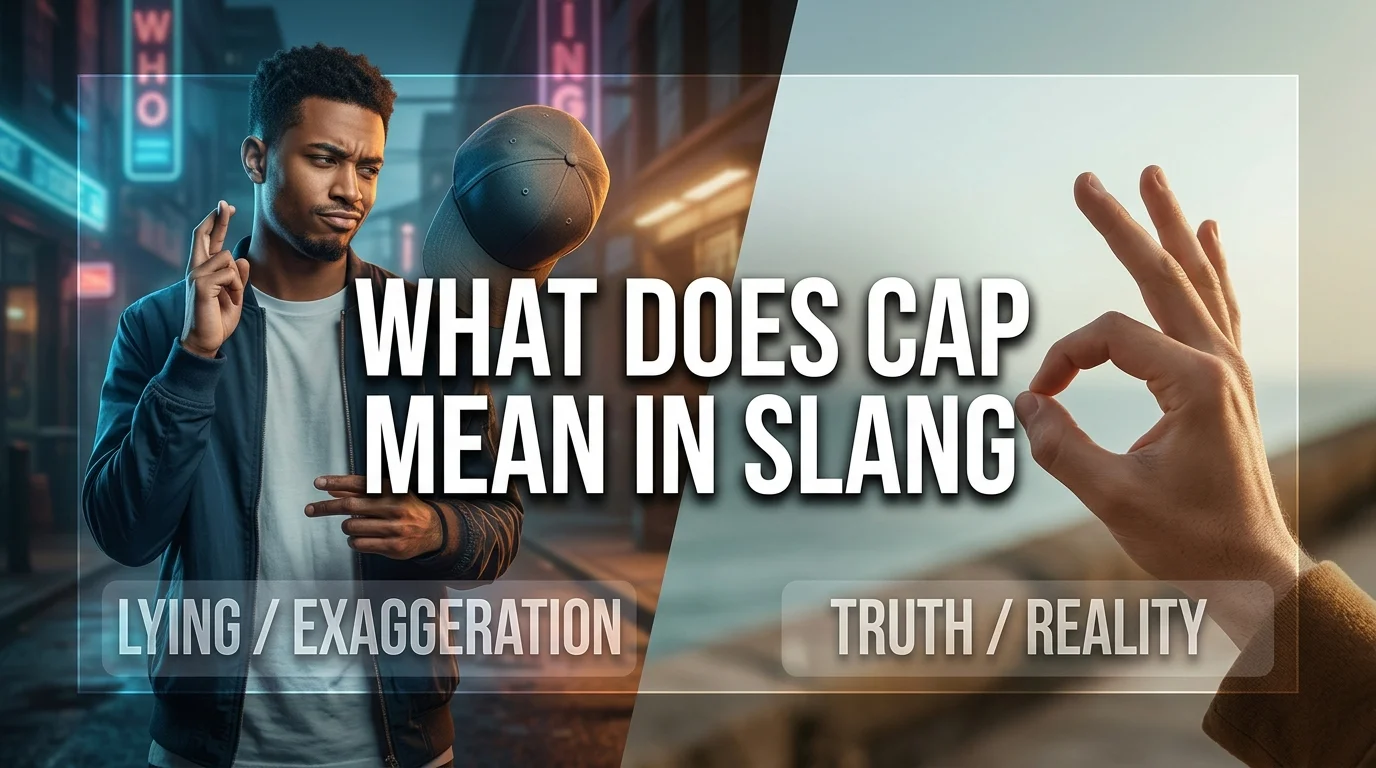
At its most fundamental level, “cap” means a lie, a exaggeration, or untruthful claim.
When someone says “that is cap,” they are calling out dishonesty or expressing deep skepticism. Conversely, when someone says “no cap,” they are emphasizing that they are telling the absolute truth.
People search for this term because digital communication strips away tone of voice, body language, and facial expressions. When a teenager texts their parent or a colleague sees the term in a casual Slack channel, it is easy to feel confused by the literal translation versus the slang intent.
Decoding this term resolves instant social friction. It allows you to track modern conversations, catch subtle humor, and recognize when someone is calling out hype versus reality.
Cap – Quick Meaning
To keep things straightforward, think of “cap” as a modern digital replacement for words like “fake,” “bs,” or “fib.”
Key Definitions to Remember
- Cap (Noun/Verb): A lie, or the act of lying.
- Capping (Action): The act of exaggerating, fabricating, or telling an outright lie.
- Capper (Noun): A person who habitually lies or exaggerates their achievements.
- No Cap (Phrase): “No lie,” “for real,” or “I am being completely serious.”
Here is how it looks in everyday phrasing:
“He said he bought a brand-new sports car yesterday, but that is total cap.”
“I just finished this entire project in twenty minutes, no cap.”
“Stop capping on the internet just to get views and followers.”
Origin & Background
While “cap” exploded into mainstream global consciousness through social media around 2018, its roots extend much deeper into African American Vernacular English (AAVE).
Black Culture & Hip-Hop Roots
The phrase traces back several decades in Hip-Hop culture and Black southern communities. In early AAVE usage, “high capping” referred to bragging, boasting, or acting superior to others without the credentials to back it up.
Over time, urban communities streamlined “high capping” down to simply “capping.” The meaning shifted slightly from general boasting to specifically calling out false claims, inflated ego, and outright lies.
Atlanta Rap Scene Expansion
During the mid-2010s, Atlanta hip-hop artists brought the phrase to the forefront of youth culture. Rappers like Young Thug, Future, and Lil Uzi Vert frequently featured the term in their tracks.
When the hip-hop track “No Cap” by Future and Young Thug dropped in 2017, it codified the expression into mainstream music lexicon. It quickly moved from songs into everyday slang across American cities.
The Social Media Explosion
Once the phrase hit TikTok, Twitch, and X (formerly Twitter), it became global overnight. Gamers began using it during livestreams to call out exaggerated skill claims.
TikTok creators turned “capping” into a central theme for call-out videos, reaction clips, and comedy skits. The blue baseball cap emoji 🧢 quickly became the universal shorthand symbol for calling out untruthfulness online.
Real-Life Conversations
Seeing slang inside isolated definitions never tells the whole story. Real human dynamics show how tone, emotional pacing, and context shape the word.
Scenario 1: WhatsApp Group Chat
Alex: I spoke to the manager today and he said we are all getting a fifty percent bonus next month.
Jordan: Bro, stop capping. We missed our quarterly targets by a mile. 🧢
Alex: I am serious! Well… okay, maybe he said five percent, but still!
Jordan: See? I knew that was heavy cap from the start.
Scenario 2: Instagram DMs
Maya: Did you actually finish reading that entire 500-page textbook in one night?
Liam: Yeah, read every single page from 10 PM to 2 AM, no cap.
Maya: No cap? Because last time you said that, you just skimmed the summary chapter!
Liam: I swear on everything, no cap this time! I have test notes to prove it.
Scenario 3: TikTok Comment Section
User_1: I bench press 350 pounds easily and I only started lifting two weeks ago.
User_2: Biggest cap of 2026 right here. 🧢🧢🧢
User_3: Man is capping for free clout on a Tuesday morning.
Scenario 4: Text Messages Between Siblings
Sam: Mom said it is your turn to clean the garage today.
Chris: Cap. I cleaned it last weekend while you were sleeping in.
Sam: Check the family group chat, she literally posted it ten minutes ago!
Chris: Oh wow, okay my bad. Thought you were capping to get out of chores.
Emotional & Psychological Meaning
Slang rarely exists just to replace standard vocabulary. It satisfies a psychological need in contemporary human connection.
The Social Protective Barrier
Calling someone a “liar” sounds hostile, accusatory, and aggressively confrontation-heavy. It risks ruining friendships, starting heated arguments, or shutting down casual social dialogue completely.
Using “cap” softens the edge of confrontation. It introduces a layer of playfulness, casual humor, and emotional distance.
Calling a statement “cap” lets you challenge someone’s accuracy while keeping the interaction lighthearted and friendly.
Vulnerability and “No Cap”
Conversely, adding “no cap” to a statement signals raw emotional sincerity. In an era dominated by online skepticism, deepfakes, clout-chasing, and staged social media videos, authenticity is rare.
When you attach “no cap” to a sentence, you are stripping away performative irony. You tell the listener: “I am dropping my guard right now, and what I am saying is authentic.”
Personal Experience Insight: Working in youth communications for years, I once watched two high school friends resolve a deep disagreement purely through this linguistic framing. One accused the other of spreading rumors. Instead of getting defensive, the second friend replied, “I never said those things about you, no cap on my family’s life.” The entire tension in the room dissipated instantly. The phrase acted as an absolute contract of trust that formal language simply could not achieve in that moment.
Usage in Different Contexts
Context determines whether using slang makes you sound natural, humorous, or completely inappropriate.
Social Media & Digital Spaces
This is where the term lives and thrives natively. You can drop “cap” or the 🧢 emoji freely in video comments, gaming lobbies, live chat streams, and casual social posts without hesitation.
Friends & Casual Relationships
Among peers, close colleagues, and family members of similar ages, “cap” is perfectly acceptable. It works best when teasing someone about an obvious exaggeration or verifying an unbelievable personal story.
Work & Professional Settings
Generally, avoid using “cap” in formal workplace environments. Telling your manager “that report is cap” during a quarterly presentation sounds unprofessional and overly informal.
However, if you work in a highly casual startup, media agency, or youth-focused industry, you might hear it used playfully in internal team chats like Slack or Teams.
Casual vs. Serious Tone Matrix
| Environment | Appropriateness | Recommended Alternative |
|---|---|---|
| TikTok / Gaming | 100% Appropriate | “Cap” / 🧢 Emoji |
| Casual Friend Group | 100% Appropriate | “You’re lying” / “No way” |
| Casual Slack Channel | 50% Use Caution | “I don’t think that’s right” |
| Formal Business Meeting | 0% Avoid Completely | “That information seems inaccurate” |
| Academic Writing | 0% Avoid Completely | “Incorrect” / “False statement” |
When NOT to Use It
Knowing when to stay quiet with slang is just as crucial as knowing what it means.
Inappropriate Contexts
- Legal or Formal Matters: Never use “cap” when discussing serious agreements, contracts, or legal truths.
- Grief and Serious News: If someone shares sad news, replying with “cap?” comes across as insensitive, dismissive, and rude.
- Severe Professional Reviews: Avoid using it during performance reviews, client pitches, or salary negotiations.
Cultural Sensitivity & Authenticity
Because “cap” originated within AAVE, using it excessively when it does not match your natural speech pattern can feel forced or performative.
Language borrowing is a natural part of living in a connected world. However, forcing slang into every sentence to appear “cool” usually backfires and creates social awkwardness.
Common Misunderstandings
Because “cap” is an everyday English word with multiple literal definitions, newcomers frequently confuse its traditional meanings with its modern slang usage.
Literal vs. Figurative Meaning
The word “cap” traditionally refers to a head covering, a bottle top, a financial limit (like a salary cap), or a protective lid.
Modern slang has zero logical connection to physical headwear or financial limits. It functions entirely as a metaphorical call-out for dishonesty.
       ┌─────────────────────────────────────────┐
       │             THE WORD "CAP"              │
       └────────────────────┬────────────────────┘
                            │
            ┌───────────────┴───────────────┐
            ▼                               ▼
  ┌──────────────────┐            ┌──────────────────┐
  │ TRADITIONAL USAGE│            │   MODERN SLANG   │
  ├──────────────────┤            ├──────────────────┤
  │ • Baseball hat   │            │ • Untruth / Lie  │
  │ • Bottle cover   │            │ • Exaggeration   │
  │ • Financial limit│            │ • False claim    │
  └──────────────────┘            └──────────────────┘
Tone Confusion
Older generations often mistake “that’s cap” as a harsh accusation of malicious deceit. In reality, modern speakers often use it lightheartedly to mean “you are exaggerating for effect” rather than “you are a bad person lying to harm me.”
Comparison Table
Understanding how “cap” compares to other slang terms helps you build a precise digital vocabulary.
| Slang Term | Core Meaning | Tone / Nuance | Example |
|---|---|---|---|
| Cap | A lie or exaggeration | Playful to skeptical | “That story sounds like total cap.” |
| No Cap | Truth / For real | Sincere, serious | “I actually won the match, no cap.” |
| Bet | Agreement / “You got it” | Confident, affirmative | “Meeting at 5 PM?” — “Bet.” |
| Cap-Free | Entirely truthful | Honest, straightforward | “Keeping it completely cap-free with you.” |
| Flex | Showing off | Boastful | “Buying that watch was a major flex.” |
| Factoid / Facts | Absolute truth | Affirmative statement | “That movie was terrible.” — “Facts!” |
Key Insight
While older expressions like “bs” or “calling wolf” carry aggressive, confrontational undertones, modern slang like “cap” acts as a flexible social tool. It allows younger generations to moderate trust, check honesty, and keep conversations moving without breaking social harmony.
Variations & Types of “Cap” Slang
Slang evolves by morphing into sub-variations. Here are the most common variations of the word you will encounter online today:
1. No Cap
- Meaning: Telling the complete truth; no lie.
- Explanation: Used to emphasize that an unbelievable statement is actually 100% genuine.
2. Capping
- Meaning: Actively lying or exaggerating right now.
- Explanation: Refers to the ongoing action of fabricating a story in real-time.
3. Big Cap / Heavy Cap
- Meaning: A massive, extreme lie.
- Explanation: Used when a story is so absurdly false that it requires extra emphasis.
4. Capper
- Meaning: A habitual liar or exaggerator.
- Explanation: Describes a person known for constantly making up wild claims.
5. Cappin’ for Clout
- Meaning: Lying specifically to get attention or followers on social media.
- Explanation: Highlights performative dishonesty aimed at building internet fame.
6. Cap Detector
- Meaning: The ability or instinct to spot a lie instantly.
- Explanation: Often used when someone immediately calls out a questionable story.
7. Cap-Free Zone
- Meaning: A safe space where only total honesty is expected.
- Explanation: Used in serious conversations among friends to request complete transparency.
8. The Cap Emoji (🧢)
- Meaning: Digital shorthand for “that is a lie.”
- Explanation: Dropped in comment sections as a visual callout when someone posts a fake video or claim.
9. Micro-Cap
- Meaning: A small, harmless white lie.
- Explanation: Describes minor exaggerations that do not hurt anyone but are still technically inaccurate.
How to Respond When Someone Uses It
When someone uses this term in conversation with you, knowing how to reply keeps the dialogue smooth and natural.
Casual Replies
- “I swear it’s not cap, I have receipts!”
- “Alright, you caught me, maybe I exaggerated a little bit.”
- “No cap at all, ask anyone who was there.”
Funny & Playful Replies
- “My cap detector is going off at maximum volume right now.” 🚨
- “Here, you dropped this: 🧢”
- “I don’t cap, I just tell stories with cinematic flair.”
Mature & Grounded Replies
- “I understand why that sounds unbelievable, but it really happened.”
- “No reason to lie about this—let me show you the actual numbers.”
- “I am being completely honest with you here.”
Respectful Replies
- “I appreciate you keeping it cap-free with me.”
- “Thanks for being real with me, no cap.”
Regional & Cultural Usage
Language takes on distinct regional colors depending on geographic and cultural demographics.
Western Culture (North America, UK, Australia)
In North America, the term is part of everyday youth speech across all major demographics. In the UK, it smoothly integrated alongside native slang like “bare,” “blag,” and “cap.” Australian youth adopt it primarily through global social media channels and gaming platforms.
Asian & Middle Eastern Global Internet Culture
In non-Western regions with large English-speaking online populations—such as the Philippines, India, the UAE, and Singapore—the term is widely understood among youth. It travels via TikTok trends, Twitch streams, and global hip-hop music culture.
Generational Differences
┌─────────────────────────────────────────────────────────────────┐
│                    GENERATIONAL PERSPECTIVES                    │
├─────────────────┬───────────────────────────────────────────────┤
│ Gen Z (1997-2012)│ Primary vocabulary; used effortlessly in daily │
│                 │ speech and digital communications.             │
├─────────────────┼───────────────────────────────────────────────┤
│ Millennials     │ Fully understand the term; use it casually or │
│ (1981-1996)     │ ironicaly in text communications.             │
├─────────────────┼───────────────────────────────────────────────┤
│ Gen X & Boomers │ Often take the term literally (hats/limits);  │
│ (Pre-1981)      │ may find the slang usage confusing at first.  │
└─────────────────┴───────────────────────────────────────────────┘
Is It Safe for Kids?
Parents often worry when their children adopt new slang words, fearing hidden, inappropriate, or harmful meanings.
Yes, “cap” is completely safe for children and teenagers.
It carries no vulgar, sexual, or inherently violent connotations. It is simply modern youth vocabulary used to discuss honesty, storytelling, and social trust.
When your child says “that’s cap,” they are simply saying “that’s false.” Encouraging children to communicate transparently—even using their own modern terms—builds open, honest family dialogue.
Frequently Asked Questions
What does “cap” mean in simple words?
In simple words, “cap” means a lie or an exaggeration. Saying “that is cap” means “that is not true.”
What does “no cap” mean in text messages?
“No cap” means “no lie” or “I am telling the truth.” It emphasizes that a statement is completely genuine and authentic.
What does the blue hat emoji (🧢) mean in comments?
The blue hat emoji represents the word “cap.” Dropping it in a comment section indicates that you think the video, image, or statement is fake or exaggerated.
Is “cap” an insult?
It depends on the tone. Usually, it is a playful way to call out an exaggeration among friends. However, calling someone’s serious claim “cap” can imply they are untruthful.
Where did the slang word “cap” originally come from?
The term originated in African American Vernacular English (AAVE) and hip-hop culture, evolving from older terms like “high capping” (meaning boasting or bragging) before going viral globally on social media.
Can I use “cap” in professional emails?
It is best to avoid using “cap” in professional emails. Stick to clear, professional language like “inaccurate,” “incorrect,” or “misleading” when communicating in formal work environments.
Conclusion
Language is a living, breathing reflection of human culture. Slang terms like “cap” and “no cap” are far more than temporary internet buzzwords—they represent how modern society navigates trust, authenticity, and connection in an increasingly digital world.
Understanding these subtle linguistic shifts helps bridge generational gaps, improves digital literacy, and enriches everyday communication.
So the next time you spot that little blue baseball cap emoji 🧢 popping up in your feed or group chat, you can read right through the code with complete confidence—no cap!