Language moves fast online. You are scrolling through TikTok, reading a movie review on X, or checking a group chat, and you spot a simple three-letter word used as a sharp insult: “mid.”
Someone calls a blockbuster movie “mid.” Another person says a popular restaurant’s food is “mid.” A friend texts you that an overhyped album is “mid at best.”
If you grew up learning standard English, you might think “mid” is just short for middle, medium, or midpoint. While that is where the root comes from, the modern slang meaning carries a completely different emotional weight.
Understanding slang like “mid” helps you bridge the gap between generational communication styles, decode subtle social feedback, and navigate modern internet culture without feeling out of the loop.
Understanding Slang: Why “Mid” Dominates Modern Conversations
Online communication thrives on efficiency and emotional edge. Words that deliver maximum impact with minimal letters always win the attention economy.
People search for the meaning of “mid” because its usage often feels dismissive, passive-aggressive, or surprisingly critical. It fills a very specific void in the English language that formal vocabulary misses.
Before this term blew up, you might have called something mediocre, average, uninspiring, or run-of-the-mill. But those words feel clinical. Saying something is “mid” hits differently because it directly targets hype.
It resolves the confusion between something being outright terrible and something being genuinely good. It defines the frustrating space right in the center.
What Does Mid Mean in Slang? A Quick Definition
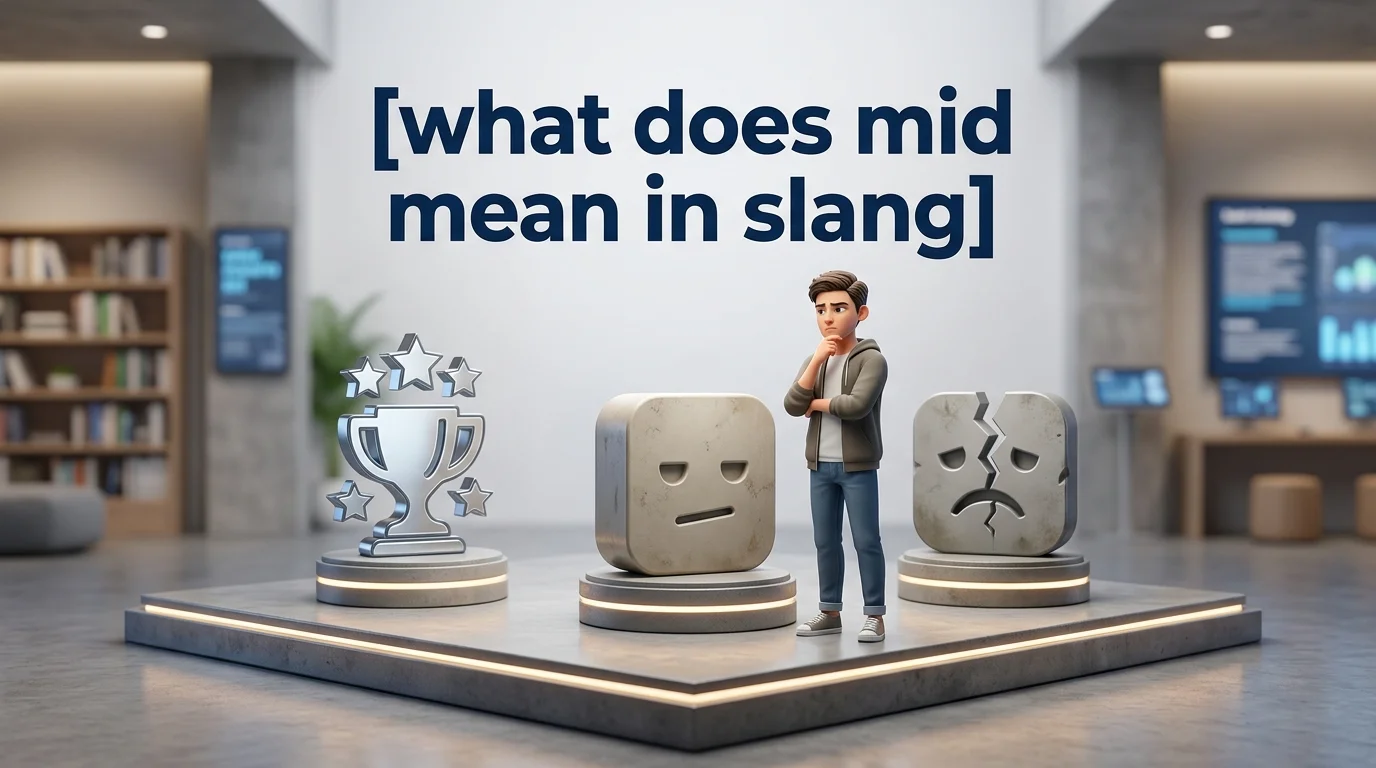
In modern slang, mid means mediocre, unimpressive, average, or overhyped. It describes something that fails to live up to expectations, yet is not quite bad enough to be called total trash.
Calling something mid implies that it is boringly average. It suggests that despite all the attention, praise, or money surrounding a topic, the actual quality is thoroughly unremarkable.
Core Definitions at a Glance
- Primary meaning: Unimpressive, mediocre, or average.
- Secondary nuance: Disappointing relative to the amount of hype it received.
- Tone: Dismissive, indifferent, slightly sarcastic, or critical.
Real-World Examples in Action
“I waited two hours in line for those viral tacos, but honestly? They were mid.”
“Don’t get me wrong, the special effects were cool, but the actual storyline was super mid.”
“Everyone is hyping up that new fashion brand, but the material feels really mid in person.”
Origin and Background: How “Mid” Evolved into Global Slang
To understand where “mid” comes from, you have to look at how cannabis culture crossed paths with mainstream internet memes.
From Cannabis Subculture to Mainstream Vocabulary
Decades before Gen Z brought the term into everyday conversation, “mid” (or “mids”) was used in cannabis culture. It referred to middle-grade marijuana—weed that was not low-quality “dirt,” but certainly not high-tier “top shelf” either.
It represented the middle tier. It got the job done, but nobody was boasting about buying it.
The Social Media Blowup
The term made a massive leap into mainstream pop culture around late 2021. A viral video featuring professional wrestler MJF (Maxwell Jacob Friedman) during an AEW promo showed him insulting the entire state of the Midwest by repeatedly calling their sports teams and culture “mid.”
TikTok creators instantly grabbed the audio clip. Within weeks, millions of videos used the sound bite to roast everything from fast food items to celebrity fashion choices.
Cannabis Subculture ("Mids")
       │
       ▼
Pro Wrestling Viral Audio (2021)
       │
       ▼
TikTok Sound Trends & Memes
       │
       ▼
Global Everyday Slang (Gen Z & Beyond)
How the Meaning Shifted Over Time
As the phrase expanded across social platforms, it lost its direct connection to its original roots. It transformed into a universal adjective for anything that disappoints.
Today, it is a core piece of digital literacy alongside terms like “cap,” “rizz,” and “no loss.”
Real-Life Conversations: How People Use “Mid” Everyday
Seeing slang used in realistic context helps you grasp the subtle tone shifts that dictionaries cannot capture.
Scenario 1: WhatsApp Group Chat
Alex: Guys, did you watch the season finale last night? Absolute masterpiece!
Jordan: Eh, I don’t know man. The first half was okay, but that ending felt super mid.
Alex: You are crazy, that plot twist was insane!
Jordan: It was predictable! Total 5/10 energy.
Scenario 2: Instagram DMs
Sam: Hey, are you buying those new sneakers dropping tomorrow?
Taylor: I was going to, but I saw the close-up photos today.
Sam: And?
Taylor: Design is mid. Not worth $200 for basic canvas.
Scenario 3: TikTok Comment Section
User_99: Why is everyone obsessing over this cafe? I went yesterday and the coffee tasted like warm milk.
BeachGuy22: Real. Extremely mid hype.
CoffeeLover_99: Y’all just love hating on popular things 🙄
Scenario 4: Late-Night Text Exchange
Maya: How was your date with Chris?
Priya: He was nice! But conversationally? Pretty mid.
Maya: Ouch. No second date then?
Priya: Probably not. I need someone who gives more than dry small talk.
Emotional and Psychological Meaning Behind the Word
Slang survives because it fulfills a clear psychological need. “Mid” is powerful because it expresses an emotion that traditional adjectives struggle to capture efficiently: indifference mixed with slight disappointment.
The War on Hype Culture
We live in an era dominated by influencer marketing, viral trends, and algorithmic hype. Every new movie is marketed as an event. Every new restaurant is labeled “life-changing.”
Calling something mid is a quiet rebellion against fake enthusiasm. It allows the speaker to declare that they refuse to fall for marketing spin.
The Power of Being Indifferent
In internet culture, showing strong negative emotions can sometimes make you look like a “hater.” If you scream about how much you hate something popular, people accuse you of being bitter.
However, labeling it “mid” keeps you in a position of calm superiority. It signals that the subject was not even worth your energy to hate. It was simply uninspiring.
A Personal Observation on Modern Communication
During a recent trip to a highly rated bakery in the city, I waited nearly forty minutes for a pastry that had millions of views online. When I finally bit into it, my immediate thought was not that it was disgusting. It was simply fine.
A teenager behind me summarized the experience perfectly to her friend: “Yeah, total mid.”
In three words, she captured the deflation of inflated expectations better than a full review ever could.
Usage in Different Contexts
Context determines whether using “mid” makes you sound plugged-in or socially awkward.
Social Media & Digital Spaces
This is the natural home for the term. On platforms like X, TikTok, Twitch, and Instagram, using the word is entirely normal. You can drop it into comments, video captions, or live streams without second thought.
Among Friends & Dating Life
In casual social settings, using the word adds humor and casual realism to your opinions. When describing a movie, an outfit, or even a boring date, it conveys your exact feelings instantly.
Work & Professional Settings
Avoid using this term in formal business communication. Telling your manager that a client presentation was “mid” sounds unprofessional, dismissive, and overly informal.
What to say instead at work:
- “The proposal meets basic requirements, but it lacks creative depth.”
- “The results were adequate, though there is room for improvement.”
- “The strategy feels somewhat standard given our targets.”
INFORMAL (Text, TikTok, Casual Chat)
├── "That meal was mid."
├── "Mid album, honestly."
└── "Felt super mid."

FORMAL (Work Email, Presentations, Professional Feedback)
├── "The outcome was satisfactory, yet unremarkable."
├── "It met baseline expectations."
└── "The performance was average."
When NOT to Use “Mid”
Because the term carries a dismissive edge, using it inappropriately can damage personal relationships or make you seem insensitive.
1. When Someone Has Put Heart and Soul Into Something
If a friend cooks you a meal from scratch, paints a canvas, or shares a project they worked on for months, calling it “mid” feels far meaner than calling it bad. It diminishes their hard work as forgettable.
2. In Serious or Emotional Moments
Never use internet slang when someone is being vulnerable or discussing personal struggles.
3. Professional Performance Reviews
Critiquing colleagues using internet slang signals a lack of emotional maturity and respect.
Common Misunderstandings About the Term
Despite its widespread popularity, people frequently misinterpret how “mid” operates in real-life conversations.
Misconception 1: “Mid Means Terrible”
Many older speakers assume calling something mid means you despise it. That is inaccurate. If something is awful, the internet uses terms like “trash,” “L,” or “garbage.” Mid specifically means middle-tier.
Misconception 2: “Mid Means Cheap”
Price does not dictate whether something is mid. An expensive luxury handbag can be mid if its quality fails to match its price tag.
Misconception 3: “It’s Just Short for Middle”
While etymologically related, saying “I will meet you at the mid point” is standard English, whereas saying “That meeting was mid” is slang.
Slang Comparison: How “Mid” Measures Up
To understand where “mid” sits in the wider ecosystem of modern slang, compare it against related terms:
| Slang Term | Emotional Tone | Meaning | Example |
| Mid | Indifferent / Critical | Mediocre, overhyped, average | “The food was mid.” |
| Trash / Garb | Angry / Harsh | Very bad, zero quality | “That ref was total trash.” |
| Peak | Enthusiastic | The absolute best, highest quality | “That finale was peak television.” |
| Basic | Slightly Judgmental | Unoriginal, mainstream, dull | “She has such a basic style.” |
| Cheeks | Casual / Humor | Poor quality, bad performance | “My gameplay was cheeks today.” |
| Fire / Gas | High Energy | Incredible, amazing, top tier | “That new track is pure gas.” |
Key Insight
The word “mid” is uniquely devastating because it denies the subject any emotional impact. Being hated still implies you made a strong impression, but being called “mid” means you were entirely forgettable.
10 Variations and Related Slang Expressions
Internet culture constantly mutates words to create fresh linguistic flavors. Here are the most common variations you will encounter:
1. Mid at Best
Meaning: Highly critical baseline assessment.
Explanation: Used when someone tries to defend a product, suggesting that even under the best conditions, it only reaches mediocrity.
2. Mid Tier
Meaning: Standard, run-of-the-mill classification.
Explanation: Borrowed directly from gaming ranking systems to describe middle-of-the-road quality.
3. Absolute Mid
Meaning: Emphasized mediocrity.
Explanation: Adds emphasis to highlight that something has zero redeeming high-tier qualities.
4. Mid Hype
Meaning: Disappointment caused by marketing.
Explanation: Describes something that would be fine on its own, but feels disappointing because of excessive social media hype.
5. Midwit
Meaning: Intellectual mediocrity.
Explanation: A blend of “middle” and “nitwit,” used online to describe someone of average intelligence who pretends to be an expert.
6. Mid-Off
Meaning: A competition between two boring options.
Explanation: Used when two unimpressive sports teams, artists, or public figures clash.
7. Super Mid
Meaning: Strikingly average.
Explanation: A slightly contradictory pairing used for extra conversational emphasis.
8. High-Key Mid
Meaning: Unapologetically average.
Explanation: Used when pointing out that something’s lack of quality is obvious to everyone watching.
9. Mid Energy
Meaning: Uninspiring vibe or performance.
Explanation: Describes a person, party, or effort that lacks enthusiasm or excitement.
How to Respond When Someone Calls Your Taste “Mid”
When someone hits your favorite movie, outfit, or music taste with a casual “mid,” you have several ways to respond depending on your desired vibe.
Casual Responses
- “Fair enough, it’s definitely not for everyone.”
- “To each their own, I personally loved it.”
- “Maybe, but it hits the spot for me.”
Funny & Witty Responses
- “Your taste buds must be on vacation today.”
- “Calling this mid is a wild take, but okay!”
- “Who hurt you?”
Mature & Grounded Responses
- “I can see why you feel that way, what didn’t you like about it?”
- “It definitely has its flaws, but I appreciate what they were trying to do.”
- “I guess my expectations were different going into it.”
Regional, Cultural, and Generational Usage
Slang does not exist in a vacuum. It shifts based on who is speaking and where they are located.
Western Culture (US, UK, Canada, Australia)
In Western digital spaces, “mid” is a permanent staple of everyday vocabulary. Youth culture in these regions uses it across text, gaming voice chats, and casual conversations.
Global Internet Usage
Because TikTok and YouTube share content globally, non-native English speakers across Asia, Europe, and Latin America have adopted “mid” into their local digital lexicons. It is frequently used in multilingual group chats.
Generational Differences: Gen Z vs. Millennials vs. Gen Alpha
- Gen Z: Uses the term naturally as an emotional shorthand without second thought.
- Millennials: Understand the term well, though some prefer older alternatives like “meh” or “average.”
- Gen Alpha: Uses the word heavily, often combining it with newer layers of absurd brainrot slang like “skibidi mid.”
Gen Alpha ──► Heavy usage + combined with absurd memes ("Skibidi mid")
Gen Z     ──► Primary drivers of natural usage in everyday speech
Millennials─► Understand & use selectively ("Meh" alternative)
Gen X/Boomers► Use formal terms ("Mediocre", "Average", "So-so")
Is “Mid” Safe for Kids and Everyday Family Settings?
Yes, “mid” is entirely safe for children, teens, and general family conversations.
Unlike many slang terms born on the internet, “mid” contains no profanity, sexual references, or inherently crude language. It is simply a modern synonym for mediocre.
Parents need not worry when hearing their kids use it. The only real concern is ensuring children learn not to use it in rude ways that hurt their peers’ feelings when sharing personal projects or creative talents.
Frequently Asked Questions
What does mid mean in texting?
In texting, mid means mediocre, boring, unimpressive, or average. People use it to describe anything that fails to live up to expectations or hype.
Is calling someone mid an insult?
Yes, calling a person “mid” is a mild insult. It implies they are uninteresting, attractive in an average way, or lack distinct personality traits.
Is mid short for middle or mediocre?
Etymologically, it comes from “middle,” but its slang meaning aligns more closely with “mediocre.”
What is the opposite of mid in slang?
The opposite of mid is peak, fire, gas, or top tier, which all describe high quality or excellence.
Can mid be used as a compliment?
Generally no. However, if expectations were extremely low, saying “Well, at least it was mid” can function as a lukewarm compliment meaning it was not a complete disaster.
Mastering the Language of the Modern Web
Slang is a living, breathing reflection of cultural priorities. The word “mid” reveals how much modern society values authenticity over commercial hype.
Instead of sitting back and accepting overhyped products, media, and trends, online culture created a sharp, efficient word to keep expectations grounded.
Understanding these nuances helps you stay connected to modern conversations. Use the term when it fits naturally, save it for casual settings, and navigate the ever-evolving world of English with confidence.