You are scrolling through TikTok, reading a heated X thread, or looking at a group text, and you see someone drop a single word: “Cap.”
Or maybe someone commented with a little blue baseball cap emoji 🧢 under a post.
If you felt a sudden wave of confusion, you are not alone. Modern digital communication moves at lightning speed, constantly spawning new terms that leave people wondering what is actually being said.
Understanding this single three-letter word has become essential for anyone trying to navigate modern social interactions, online culture, or conversations with Gen Z.
Let’s demystify what “cap” really means, where it came from, and how you can use it confidently without sounding out of place.
Understanding the True Meaning of Cap Slang
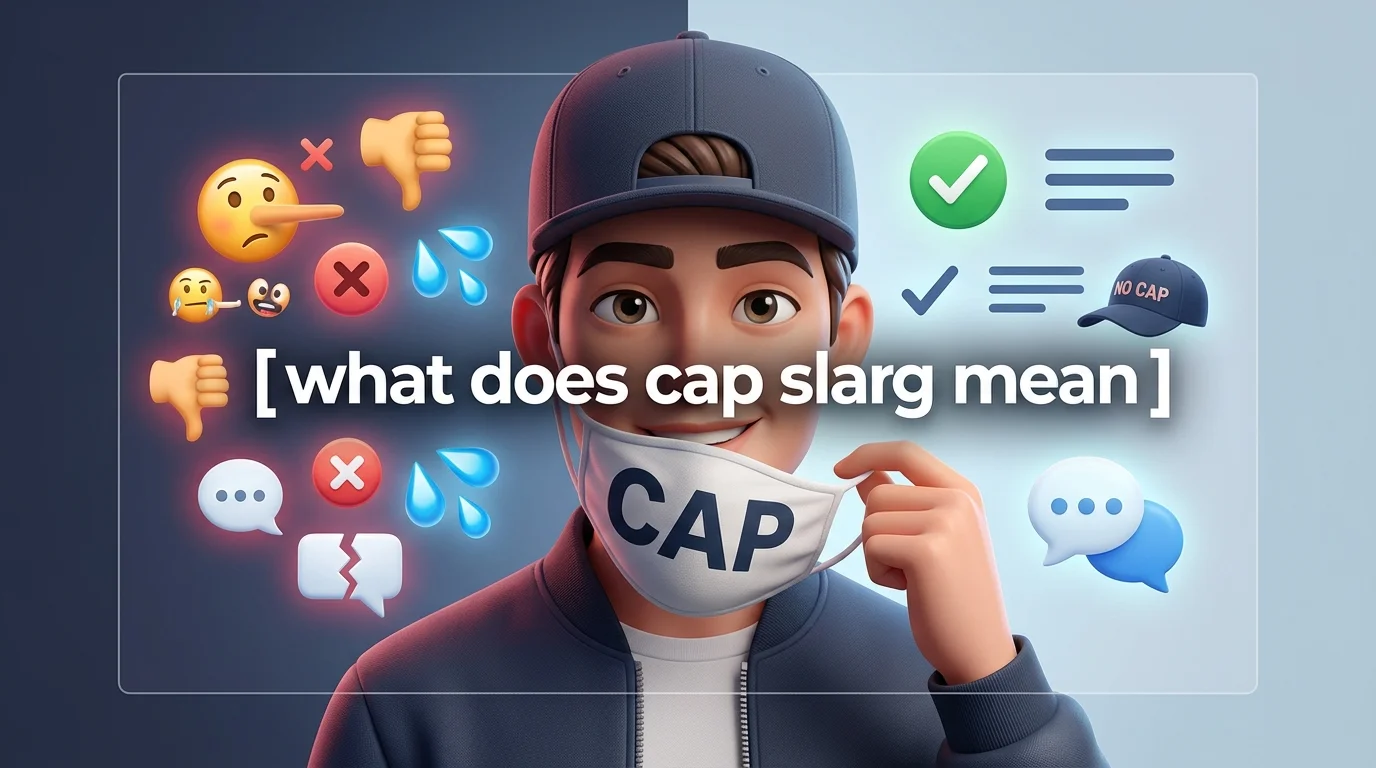
At its core, “cap” is modern internet slang that simply means a lie, a lie in itself, or something that is completely untrue.
When someone says “that’s cap,” they are calling out a claim as false, exaggerated, or outright fake.
Conversely, you will often hear its direct counterpart: “no cap.” Saying “no cap” means “no lie,” “for real,” or “I am being completely honest.”
The term functions both as a noun and a verb in everyday conversation. You can call something “a cap,” or you can tell someone to “stop capping.”
The Core Definitions Breakdown
Cap (Noun / Adjective)
- Meaning: A lie, untruth, or exaggeration.
- Example: “He said he bought a Ferrari, but that is total cap.”
Capping (Verb)
- Meaning: The act of lying, exaggerating, or faking something.
- Example: “Stop capping, you know you didn’t go to that party.”
Capper (Noun)
- Meaning: A person who frequently lies or exaggerates.
- Example: “Don’t listen to him, he’s a massive capper.”
No Cap (Phrase)
- Meaning: Truly, seriously, or without any exaggeration.
- Example: “That was the best meal I’ve ever had, no cap.”
Origin & Cultural Background of Cap
While “cap” exploded globally through TikTok and Instagram around 2019, its roots run much deeper into American linguistic history.
The phrase did not originate on the internet. It has deep origins in Black culture and Hip-Hop history.
From AAVE to Mainstream Internet Culture
Linguists trace the term back to African American Vernacular English (AAVE) in the early-to-mid 20th century.
Specifically, “to cap” originally meant to brag, exaggerate, or shoot insults at someone in games like “the dozens.” Over decades, the slang evolved within Black communities to specifically mean lying or embellishing the truth to look better.
Hip-Hop artists played a monumental role in preserving and popularizing the term.
Rap lyrics from Atlanta artists in the late 2010s brought the word into heavy rotation. Tracks by Young Thug, Future, and Metro Boomin repeatedly featured lines about “capping” and “no cap.”
The Social Media Explosion
Once Hip-Hop introduced the term to broader youth culture, social media did the rest.
TikTok creators began using the blue cap emoji 🧢 as a visual shorthand for calling out fake content.
Streamers on Twitch and YouTubers adopted the phrase during live broadcasts. Within months, a piece of regional AAVE transformed into global internet vernacular.
Real-Life Conversations Using Cap Slang
Seeing slang used in natural dialogue is the best way to understand its tone and rhythm.
Here are four realistic conversations showing how “cap” functions across different messaging platforms.
Scenario 1: WhatsApp Group Chat
Alex: I just got a call from a recruiter offering me $200k for an entry-level remote job! Jordan: Cap 🧢 Alex: Bro I’m serious! They reached out on LinkedIn! Jordan: Show the screenshot or it’s cap.
Scenario 2: Instagram DMs
Maya: Did you see Sarah’s story? She said she met Drake in LA yesterday. Chloe: That is such a major cap. Chloe: She was literally at home watching Netflix all night, I was on FaceTime with her.
Scenario 3: TikTok Comment Section
User_99: I can do 100 pushups in one minute without stopping. GymBro_Official: That’s cap, post the video or it didn’t happen 🧢 User_99: Check my latest upload then! No cap here!
Scenario 4: Text Message Between Friends
Liam: I swear I finished the entire project in twenty minutes. Noah: Stop capping man, that assignment took me three hours. Liam: No cap! I just used a really good outline and blasted through it.
Emotional & Psychological Meaning Behind Cap
Slang exists because standard vocabulary often lacks the emotional punch needed for modern social interaction.
“Cap” is not just a replacement for the word “lie.” It carries specific psychological weight and emotional nuance that traditional language misses.
The Social Psychology of Capping
Calling someone a “liar” feels heavy, accusatory, and confrontational. It sounds like a formal attack on a person’s moral character.
Using “cap” softens the blow while keeping the call-out clear.
It adds a layer of casual playfulness. It signals suspicion without immediately escalating a conversation into an intense argument.
People often “cap” online due to the pressure of digital performance. Social media encourages people to exaggerate their wealth, happiness, or achievements.
Calling “cap” serves as a community check against clout-chasing and artificial living.
A Personal Observation on Modern Authenticity
In my years observing communication shifts, I have seen language adapt quickly to cultural needs.
A friend of mine once spent an entire evening boasting about how he never gets nervous before public speaking. Another friend simply smiled and dropped a single line: “That sounds like a little bit of cap, bro.”
The entire room laughed, including the speaker. The tension vanished instantly.
That is the power of the word. It exposes vulnerability and demands honesty without destroying the social atmosphere of the room.
Usage of Cap in Different Contexts
Context determines whether using slang makes you sound trendy, relatable, or wildly unprofessional.
       INFORMAL                        FORMAL
[ TikTok / Group Chats ] --------> [ Office / Work ]
      Appropriate                     Inappropriate
Social Media & Digital Spaces
This is where “cap” naturally lives. Feel free to use it in comments, direct messages, captions, and casual gaming chats.
It fits perfectly in fast-paced environments where brevity rules.
Friends & Romantic Relationships
Among friends, calling “cap” is usually lighthearted teasing.
In dating, telling a partner “that’s cap” when they make a promise can either be a playful joke or a subtle sign of distrust. Pay close attention to your tone.
Work & Professional Settings
Avoid using “cap” in professional emails, board meetings, or client presentations.
Telling a manager or client “that report is cap” will likely come across as unprofessional, flippant, or disrespectful. Stick to terms like “inaccurate” or “misleading” at work.
When NOT to Use Cap Slang
Knowing when to stay silent is just as important as knowing the definition. Misusing slang can cause genuine social friction.
- In Serious or Emotional Arguments: If a partner or friend is sharing deep personal feelings, calling their words “cap” trivializes their emotions.
- In High-Stakes Professional Environments: Using internet slang around executive leadership can damage your credibility.
- When You Don’t Understand the Vibe: If you force slang into a conversation where it doesn’t fit naturally, it can sound performative or out-of-touch.
- In Formal Writing: Never use “cap” in academic essays, legal documents, or formal correspondence.
Common Misunderstandings About Cap
Because slang evolves rapidly, people frequently misinterpret its usage, tone, and visual symbols.
Literal vs. Figurative Meaning
The most common mistake is confusing the slang term with physical headwear.
When someone posts a cap emoji 🧢 in a comment section, they are rarely talking about a hat. They are accusing the poster of lying or exaggerating.
Tone Confusion
Older generations often view the word as harsh criticism.
However, Gen Z uses it flexibly. It can mean anything from “I know you are exaggerating a little bit for a good story” to “You are blatantly fabricating the truth.”
Comparing Cap With Other Popular Expressions
Understanding how “cap” relates to other common internet expressions helps contextualize its exact meaning in everyday dialogue.
| Slang / Phrase | Category | Core Meaning | Tone |
|---|---|---|---|
| Cap | Synonymous | A lie or exaggeration | Casual, calling out |
| No Cap | Opposite | For real; complete truth | Honest, emphatic |
| Cap 🧢 | Emoji Version | Visual call-out for a lie | Playful, critical |
| Cap-Free | Variation | Truthful, verified | Assuring |
| Fake News | Related | False information | Political, dramatic |
| Flexing | Related | Showing off (often leads to cap) | Boastful |
| On Stack | Synonymous | Swearing on truth | Serious, emphatic |
| Period | Related | Finality, truth spoken | Firm, decisive |
Key Insight
While terms like “fake news” deal with broader information media, “cap” is distinctly interpersonal. It focuses on personal credibility, self-presentation, and social honesty.
10 Popular Variations of Cap Slang
Internet culture loves spinning single words into entire sub-vocabularies. Here are the most frequent variations you will encounter online.
1. No Cap
- Meaning: Absolutely no lie; telling the complete truth.
- Explanation: Used to emphasize that a claim, no matter how wild, is genuine.
2. Stop Capping
- Meaning: Quit lying or exaggerating right now.
- Explanation: Direct command aimed at someone actively telling a tall tale.
3. Major Cap / Big Cap
- Meaning: A massive, obvious, or extreme lie.
- Explanation: Used when an exaggeration is too ridiculous to ignore.
4. High Cap
- Meaning: An expression used when a statement feels unbelievable.
- Explanation: Indicates a very high probability of deceit or fabrication.
5. Capper
- Meaning: A person who lies regularly.
- Explanation: A label given to someone known for making things up.
6. Cap Detector
- Meaning: The ability or instinct to spot a lie.
- Explanation: Used when someone immediately senses a fake story.
7. Cappin’
- Meaning: Present participle of cap; the act of telling a lie.
- Explanation: Frequently heard in rap lyrics and casual vocal conversations.
8. Cap-Free Zone
- Meaning: A safe space or conversation where only truth is shared.
- Explanation: Used to set expectations for complete honesty among friends.
9. Cap Alert
- Meaning: A warning that false information is incoming.
- Explanation: Often posted as a comment when a video seems scripted or fake.
10. Ultimate Cap
- Meaning: The absolute peak of falsehood.
- Explanation: Reserved for stories so absurd they border on complete fiction.
How to Respond When Someone Uses Cap Slang
When someone throws “cap” your way, your response depends entirely on whether you are being accused of lying or simply validating a story.
Casual & Friendly Responses
- “I’m being serious, no cap!”
- “Why would I lie about that?”
- “Hand to heart, it really happened!”
Funny & Witty Responses
- “My cap is put away today, only facts here.”
- “🧢? Nah, you’re wearing the hat, not me.”
- “I don’t even own a hat, bro.”
Mature & Direct Responses
- “I understand why that sounds hard to believe, but it is accurate.”
- “I can show you the proof if you don’t believe me.”
- “Let’s check the details together so you know I’m being real.”
Respectful Responses
- “Fair enough, I know it sounds wild.”
- “I respect your skepticism, but I’m being honest.”
Regional, Cultural, and Generational Usage
Slang does not exist in a vacuum. It shifts based on who is speaking, where they live, and what generation they belong to.
Western Culture
In North America and Europe, “cap” has achieved near-universal recognition among youth. It flows seamlessly through high school hallways, college campuses, and gaming lobbies.
Asian & Middle Eastern Digital Spaces
Global social media platforms have exported the term worldwide.
English-speaking youth in urban hubs across Asia and the Middle East regularly use “cap” in online comments, though it remains predominantly an internet-only term rather than spoken local slang.
Generational Divide: Gen Z vs. Millennials vs. Gen X
[ Gen Z / Gen Alpha ] -------------> Frequent everyday spoken usage
[ Millennials ] --------------------> Understand it, use it mainly online
[ Gen X / Boomers ] ----------------> Generally unfamiliar or use literally
Gen Z natively uses the term in daily conversation without thinking twice.
Millennials generally understand the phrase through social media exposure, using it primarily online or in text messages.
Gen X and older generations rarely use the word, often confusing it with standard vocabulary.
Is Cap Slang Safe for Kids and Teens?
Parents often worry about the hidden meanings behind modern youth language.
The good news is that “cap” is entirely clean, safe, and free from inappropriate double meanings.
It contains no sexual, violent, or explicit connotations. It is simply modern youth slang for dishonesty or exaggeration.
While it can occasionally be used during light teasing or cyberbullying, the word itself is completely benign.
Frequently Asked Questions
What does “cap” mean in text?
In text messages, “cap” means a lie or exaggeration. Saying “that’s cap” means you think the sender is not telling the truth.
What does “no cap” mean?
“No cap” means “no lie” or “for real.” It is used to emphasize that you are telling the absolute truth.
Why do people use the blue hat emoji 🧢?
The blue hat emoji represents the word “cap.” Posting it in comments or texts is visual shorthand for calling out a lie or fake story.
Is “capping” a bad word?
No, “capping” is not a curse word or profanity. It is a completely mild slang term used casually by people of all ages.
Where did the slang “cap” come from?
The term originated in African American Vernacular English (AAVE) in the 20th century before being popularized globally through Hip-Hop music and social media platforms like TikTok.
What is the opposite of cap?
The direct opposite of “cap” is “no cap,” “facts,” or “real.”
Navigating Modern Slang with Confidence
Language is dynamic, growing, and constantly changing to reflect cultural shifts.
Slang terms like “cap” are not merely temporary trends; they represent the evolving ways human beings connect, tease each other, and demand authenticity in an increasingly digital world.
Understanding these terms keeps you connected to modern culture, improves your digital communication, and ensures you never feel left out of the conversation.
The next time you hear someone share an unbelievable story, you will know exactly what it means when someone drops a blue hat emoji in response—no cap!