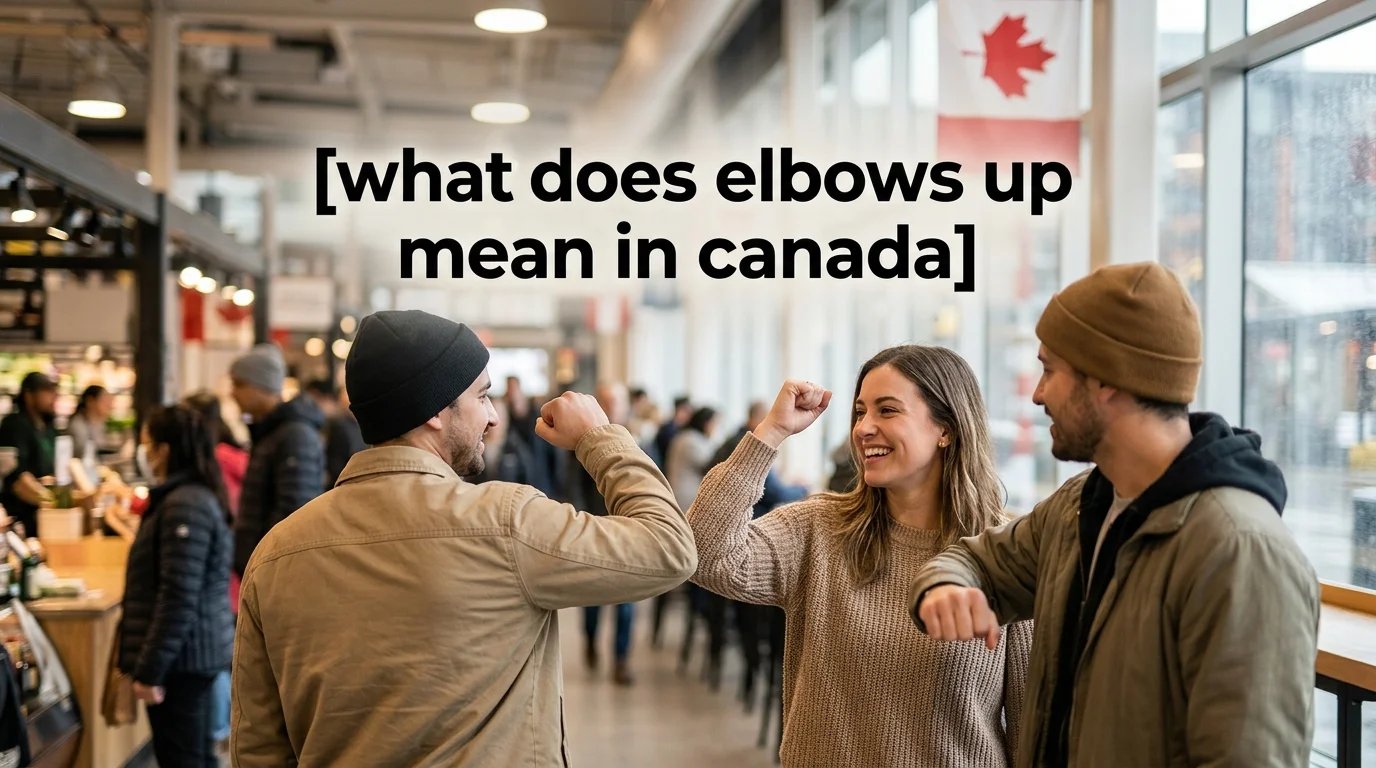
If you have stumbled across the phrase “elbows up” while scrolling through Canadian social media, watching political debates, or listening to sports commentary, you are not alone in wondering what it actually signifies.
At first glance, it sounds like physical advice you would get in a crowded subway or during a high-stakes basketball game.
In Canada, however, the phrase carries a much deeper cultural weight. It bridges the gap between legendary ice hockey strategy and modern political grit, transforming from a physical sports posture into a widespread mindset of defensive resilience.
Understanding this expression helps clear up a lot of confusion, especially for newcomers, international readers, or anyone trying to decode the uniquely competitive yet polite nature of Canadian culture.
What Does “Elbows Up” Mean in Canada?
To understand “elbows up” in a Canadian context, you have to look beyond the literal physical movement.
It is an idiomatic expression that means adopting an aggressive, defensive, or uncompromising stance to protect your position, fight for your rights, or push back against opposition.
While Canadians have an international reputation for being overwhelmingly polite, “elbows up” serves as a reminder that underneath that soft-spoken exterior lies a fierce competitive spirit.
When someone tells you to keep your “elbows up,” they are telling you to prepare for a fight, stand your ground, and refuse to let others intimidate or push you around.
What Does “Elbows Up” Mean in Canada? – Quick Meaning
In everyday Canadian English, the phrase operates as both a warning and a battle cry.
It signifies an attitude of active self-defense, readiness for hard work, and an unwillingness to back down under pressure.
The Core Definition
- Standing your ground: Refusing to yield space, authority, or progress to an opponent.
- A defensive posture: Anticipating tough competition and preparing to absorb or deliver hard hits.
- Assertive self-preservation: Protecting your interests in high-stakes environments like politics, business, or sports.
Quick Examples in Conversation
“The contract negotiations are going to be tough tomorrow, so make sure you go in there with your elbows up.”
“Canadian exporters had to play with their elbows up during those international trade talks.”
“If you want to win the puck in the corner, you’ve got to keep your elbows up and drive through.”
Origin & Background of the Phrase
The phrase traces its roots directly to Canada’s national winter sport: ice hockey.
Understanding how it moved from the icy rinks of the Great White North into the halls of parliament offers a fascinating look at Canadian cultural evolution.
The Hockey Rink Origins
In ice hockey, “elbows up” describes a physical technique used when going into the corners of the rink to battle for the puck.
Players raise their elbows slightly to protect themselves from incoming hits, create physical separation from opponents, and establish spatial dominance.
Famous Canadian hockey legends, most notably Gordie Howe—who was notorious for his physical, high-elbow style of play—helped cement the phrase into the Canadian athletic lexicon.
Transition into Political and Cultural Life
Over the decades, Canadian journalists, commentators, and politicians began borrowing hockey terminology to describe intense political battles.
Former Canadian Prime Minister Lester B. Pearson, a passionate hockey fan and diplomat, famously used hockey metaphors to describe international negotiations.
More recently, Canadian political figures and commentators use “elbows up” to describe how Canada must handle foreign relations or economic trade wars, especially when dealing with larger global superpowers.
Social Media and Modern Resurgence
In the digital age, social media has breathed new life into the phrase.
TikTok creators, political commentators on X (formerly Twitter), and sports podcasters regularly use “elbows up” to describe everything from fierce job market competition to standing up for personal boundaries.
Real-Life Conversations
Seeing how native speakers use a phrase in everyday text messages reveals its true conversational tone and emotional nuance.
Conversation 1: WhatsApp (Friends discussing work)
Person A: How is the new project lead treating you? I heard he takes credit for everything.
Person B: Honestly, it’s brutal. I had to go into the team meeting with my elbows up today just to make sure my name stayed on the presentation.
Conversation 2: Instagram DMs (Sports commentary)
Person A: Did you see the Maple Leafs game last night?
Person B: Yeah, they played way too soft in the second period. They need to put their elbows up if they want to survive the playoffs this year!
Conversation 3: TikTok Comments (Debating local politics)
Person A: Why are city officials being so aggressive about these new zoning laws?
Person B: Because neighboring districts tried to dump all the traffic on us! Our mayor had to throw her elbows up to protect the neighborhood.
Conversation 4: Text Message (Personal advice)
Person A: I’m nervous about negotiating my salary tomorrow. What if they get offended?
Person B: Don’t be scared! You’ve worked hard for this. Keep your elbows up and know your worth!
Emotional & Psychological Meaning
At its psychological core, “elbows up” speaks directly to the human balance between social harmony and self-preservation.
The phrase carries a distinct emotional charge. It represents the psychological shift from passive agreement to active self-defense. It validates the instinct to protect oneself in hostile environments without necessarily becoming the villain.
When a Canadian uses this phrase, they are acknowledging that while peace is preferred, conflict is sometimes unavoidable.
What It Reveals About Canadian Identity
Canadian culture heavily emphasizes politeness, community, and social order. However, “elbows up” acts as an emotional safety valve for that politeness.
It reveals a psychological boundary: We are friendly, but we are not weak.
A Real-Life Experience Perspective
A few years ago while covering a major trade conference in Toronto, I watched a veteran Canadian negotiator address a young team before a high-stakes meeting with international investors.
The atmosphere in the room was tense, and the young team looked intimidated by the sheer size of the opposing delegation.
The senior negotiator smiled, leaned in, and simply said, “Look, we’ve done our homework. We are nice people, but today we play with our elbows up.”
Instantly, the energy in the room shifted from anxiety to focused determination. That short sentence gave everyone permission to be firm, assertive, and unyielding without feeling rude.
Usage in Different Contexts
The meaning of “elbows up” subtly shifts depending on where and how it is used.
Social Media and Online Forums
On platforms like X, Reddit, or LinkedIn, users post “elbows up” as a hashtag or short comment to signal solidarity during group challenges, sports rivalries, or political movements.
Friends and Relationships
Among close friends, it is usually used as motivational encouragement. If a friend is dealing with a tough landlord or a difficult ex-partner, telling them “keep your elbows up” means “stay strong and don’t let them push you around.”
Work and Professional Settings
In office environments, the phrase is common during high-stakes negotiations, competitive pitch meetings, or corporate restructuring.
It serves as business jargon for standing firm on prices, deadlines, or strategic priorities.
Casual vs. Serious Tone
- Casual: “I had to keep my elbows up just to get a good spot at the concert bar!”
- Serious: “The province is going into budget talks with their elbows up to secure healthcare funding.”
When NOT to Use It
While versatile, using “elbows up” in the wrong setting can lead to awkward misinterpretations or unintended tension.
Inappropriate Contexts
- Grief or Loss: Never use it when discussing personal tragedies or sensitive emotional loss.
- Formal Customer Care: Avoid using it with clients who have legitimate complaints, as it makes you sound unnecessarily combative.
- Customer Service Roles: A employee telling a customer they are keeping their “elbows up” comes across as rude rather than professional.
Situations Where It May Cause Misunderstanding
Non-native English speakers or people unfamiliar with Canadian culture might take the phrase literally.
If used in a physical space like an airport or crowded bus, someone might assume you are threatening to physically strike them with your elbows.
Common Misunderstandings
Because the phrase has sports origins, people frequently misinterpret its intentionality and tone.
Literal vs. Figurative Meaning
The most common mistake is assuming the phrase always refers to physical violence or literal physical contact. In 95% of modern usage, it is entirely figurative and relates strictly to mental toughness, strategic positioning, and verbal assertiveness.
Tone Confusion
Outside of Canada, people often mistake “elbows up” for an expression of pure aggression or bullying.
In Canadian usage, however, it is almost always framed as a defensive reaction to outside pressure rather than an unprovoked attack.
Comparison Table: “Elbows Up” vs. Similar Expressions
| Expression | Meaning | Tone | Origin |
| Elbows Up | Stand firm, act assertively, defend your position | Competitive, resilient | Canadian Ice Hockey |
| Digging Your Heels In | Refusing to change your mind or budge | Stubborn, resistant | Traditional English |
| Throwing Hands | Engaging in a physical fight or intense argument | Hostile, aggressive | Urban Slang |
| Batten Down the Hatches | Preparing for impending trouble or crisis | Protective, cautious | Maritime / Nautical |
| Taking the Gloves Off | Removing restraints to attack relentlessly | Combative, direct | Combat Sports |
Key Insight
While phrases like “digging your heels in” suggest passive refusal to move, “elbows up” implies active engagement. It is not about standing still; it is about moving forward through resistance while protecting yourself.
Variations and Types of “Elbows Up” Usage
Over time, spoken English creates mini-variations of popular idioms. Here are the most common forms you will encounter:
1. “Play with your elbows up”
Meaning: Approach a task or game with physical or strategic aggressiveness.
Explanation: Directly references sports strategy applied to real life.
2. “Keep your elbows up”
Meaning: Stay vigilant, defensive, and ready for trouble.
Explanation: Used as protective advice before someone enters a tough situation.
3. “Elbows-up politics”
Meaning: A aggressive, confrontational style of political maneuvering.
Explanation: Frequently used by Canadian political journalists.
4. “Throwing elbows”
Meaning: Actively pushing others out of the way to get ahead.
Explanation: Describes someone being openly competitive or ruthless.
5. “Elbows-up management”
Meaning: A leadership style that fiercely defends its team or resources.
Explanation: Used in corporate environments to describe protective bosses.
6. “An elbows-up attitude”
Meaning: Possessing a naturally gritty, persistent personality.
Explanation: Describes a person who never gives up without a fight.
7. “Get those elbows up”
Meaning: A direct command telling someone to stop being passive.
Explanation: Used by coaches, mentors, or supportive friends.
8. “Elbows down” (Opposite)
Meaning: Relaxing, backing off, or taking a peaceful approach.
Explanation: Used when a conflict has ended and it is safe to drop your guard.
How to Respond When Someone Uses It
When a friend, colleague, or manager tells you to keep your “elbows up,” responding correctly depends on the situation.
Casual Replies
- “You know it! Not backing down today.”
- “Ready for whatever comes my way!”
- “Always! Got my game face on.”
Funny Replies
- “Elbows up, head down, coffee in hand!”
- “Don’t worry, I brought my hockey pads too.”
- “If my elbows get any higher, I’ll start flying!”
Mature / Professional Replies
- “Agreed. We will maintain a firm stance during the negotiation.”
- “I understand the challenges ahead and I’m ready to defend our strategy.”
- “We will advocate strongly for our position.”
Respectful Replies
- “Thank you for the guidance; I’ll stand my ground.”
- “I appreciate the warning. I’ll make sure our team is prepared.”
Regional & Cultural Usage
The interpretation of “elbows up” varies depending on geography, cultural background, and generation.
Western Culture vs. International Perspectives
In North America—particularly Canada—sports metaphors are deeply integrated into daily speech. People quickly understand that “elbows up” means strategic assertiveness.
In contrast, speakers of British or Australian English might understand the general concept but usually prefer local sports terms like “stiff upper lip” or “getting stuck in.”
Asian and Middle Eastern Cultural Nuances
In cultures where indirect communication, harmony, and saving face are highly valued, the concept of “elbows up” can initially sound overly aggressive or disruptive.
When communicating across these cultures, it is often helpful to frame “elbows up” as quiet determination rather than overt confrontation.
Generational Differences: Gen Z vs. Millennials
- Millennials & Older Generations: Tend to use the phrase in its classic sports context or when discussing politics, careers, and financial struggles.
- Gen Z: Uses the term more ironically or casually in digital spaces, pairing it with memes about surviving hustle culture, university exams, or social drama.
Is It Safe for Kids?
Yes, the phrase “elbows up” is entirely safe for children. It contains no profanity, vulgarity, or harmful social connotations.
Parents, teachers, and youth coaches in Canada frequently use it as a constructive, motivational phrase.
It teaches children about resilience, healthy competition, self-protection, and standing up to bullies on the playground or in sports.
Frequently Asked Questions
Is “elbows up” a bad word or offensive slang in Canada?
No, it is not offensive at all. It is a clean, widely accepted idiomatic expression used in sports, news broadcasts, politics, and casual everyday conversations.
Is “elbows up” exclusive to Canada?
While used in American sports contexts, its deep cultural integration into everyday speech and politics is uniquely Canadian due to the country’s profound relationship with ice hockey.
Can I use “elbows up” in a business email?
Yes, but keep it internal or informal. It works great when encouraging your internal team before a competitive pitch, but avoid using it in formal client-facing contracts.
What is the origin of the phrase “elbows up”?
It originates from ice hockey, where players physically raise their elbows to defend themselves and establish dominance in tight spaces along the rink boards.
What is the opposite of “elbows up”?
The opposite concept would be “throwing in the towel,” “backing down,” or adopting a passive, overly accommodating posture.
Conclusion
Language is a living mirror of culture, and few expressions reflect the Canadian spirit quite like “elbows up.”
It captures that unique blend of politeness and grit—a reminder that being friendly does not mean letting the world walk all over you.
Whether you are navigating a tough career transition, standing up for your personal boundaries, or simply watching a hockey game on a Saturday night, keeping your elbows up is all about facing life’s challenges with confidence, resilience, and strength.
So the next time life gets a little crowded or competitive, drop your shoulders, keep your elbows up, and hold your ground with pride.