Understanding the True Meaning of Eukaryotic
Have you ever wondered what actually makes a human being different from a simple bacterium on a microscopic level?
The answer boils down to a single, powerful scientific term that reshaped our entire understanding of life on Earth.
When people search for what eukaryotic means, they are usually trying to slice through dense textbook jargon to grasp a fundamental concept: how complex life is structured, organized, and sustained.
What Does Eukaryotic Mean? A Quick Breakdown
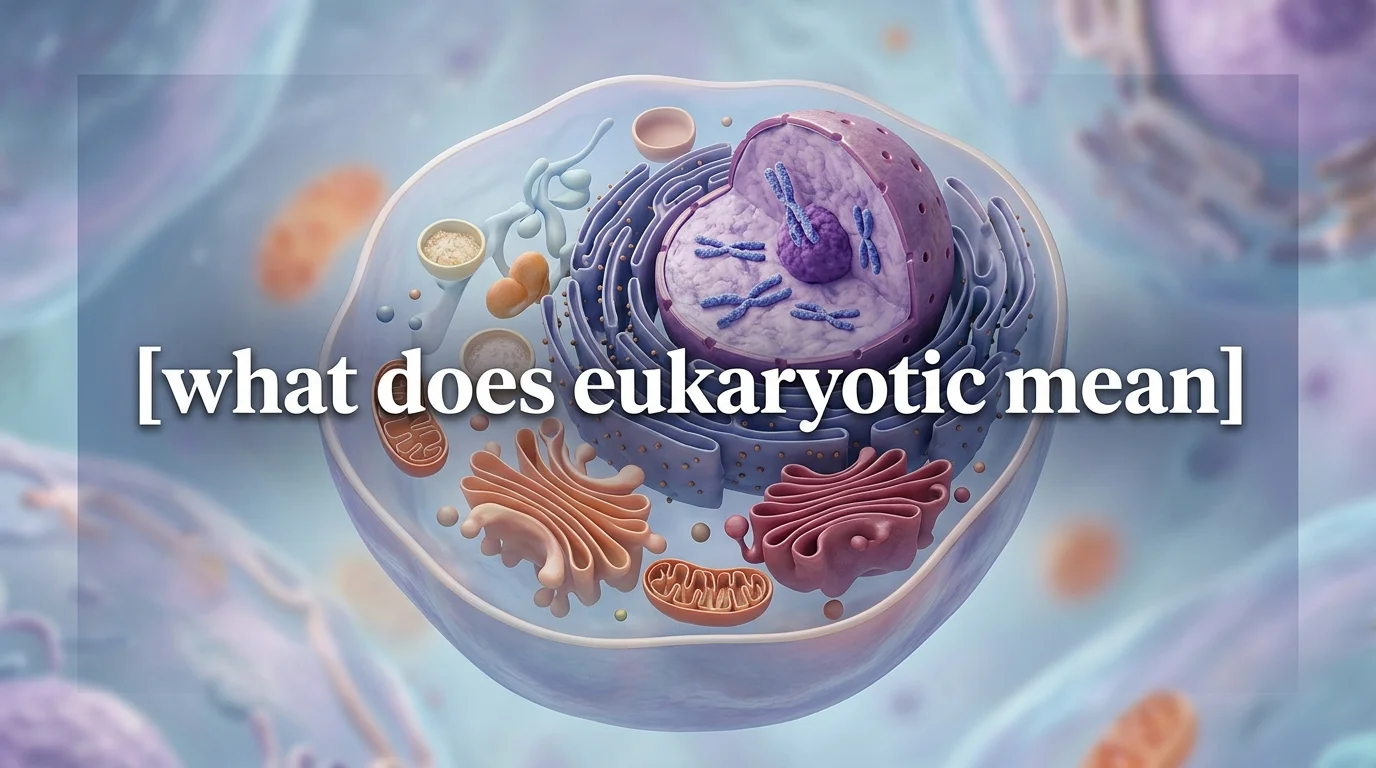
At its most direct scientific core, eukaryotic describes any organism whose cells contain a clearly defined, membrane-bound nucleus along with specialized internal structures called organelles.
       [ Eukaryotic Cell Structure ]
+------------------------------------------+
|  +------------------------------------+  |
|  |       Membrane-Bound Nucleus       |  |
|  |  +------------------------------+  |  |
|  |  |        Linear DNA /          |  |  |
|  |  |     Genetic Material         |  |  |
|  |  +------------------------------+  |  |
|  +------------------------------------+  |
|                                          |
|  [Mitochondria]    [Endoplasmic Reticulum]  |
|  [Golgi Body]      [Membrane Organelles] |
+------------------------------------------+
Core Characteristics of Eukaryotic Cells
- Enclosed Genetic Material: The primary DNA resides safely inside a double-layered nuclear membrane.
- Specialized Internal Organelles: Structures like mitochondria and endoplasmic reticulum perform isolated, highly specific tasks.
- Complex Cellular Architecture: Eukaryotic cells are typically much larger—often 10 to 100 times larger—than their prokaryotic counterparts.
“A eukaryotic organism is essentially a bustling metropolis where every organelle acts as a specialized district running dedicated operations.”
“If prokaryotic cells are open-concept studio apartments, eukaryotic cells are multi-room mansions with dedicated spaces for cooking, sleeping, and storage.”
Origin and Scientific Background
The word itself carries a deep linguistic history that tells you precisely what to look for under a microscope.
Etymological Roots
It stems directly from two classical Greek roots: eu, meaning “good,” “true,” or “well,” and karyon, which translates to “nut” or “kernel.”
In biological terminology, that “kernel” refers explicitly to the cell nucleus.
Evolution of the Concept
Scientist Édouard Chatton first coined the distinction between eukaryotic and prokaryotic organisms in the early 20th century to categorize the fundamental divergence in cellular architecture.
Over decades of evolutionary biology, scientists realized that eukaryotes evolved through endosymbiosis—a process where primitive host cells engulfed smaller beneficial microbes, eventually evolving into permanent powerhouses like mitochondria.
Real-Life Conversations Around Cell Biology
To see how people discuss this concept outside of formal lectures, examine these realistic exchanges across different digital spaces.
WhatsApp Study Group
Person A: Wait, are human skin cells prokaryotic or eukaryotic? I always mix up the two on practice exams.
Person B: We are definitely eukaryotic! Remember: “Eu” = “You”. Humans, animals, and plants all have complex cells with a real nucleus.
Instagram Comment Thread
Person A: Studying for AP Bio at 2 AM and my brain is totally fried 😭 Why are cell types so confusing?
Person B: Think of it this way: Prokaryotes have NO nucleus (Pro = No). Eukaryotes DO have a nucleus (Eu = Do)! You got this!
TikTok Educational Comment
Person A: So does this mean fungi are actually closer to us than to bacteria?
Person B: Exactly! Mushrooms are eukaryotic organisms just like animals. Bacteria belong to a completely different, simpler domain of life.
The Structural and Functional Significance
Understanding eukaryotic design unlocks a deeper appreciation for how complex life functions without collapsing into metabolic chaos.
Metabolic Efficiency Through Compartmentalization
By partitioning different chemical processes inside distinct membranes, eukaryotic cells prevent interfering reactions from destroying essential cellular machinery.
Mitochondria can churn out cellular energy (ATP) in a highly acidic internal space without damaging the rest of the cellular fluid.
Personal Insight from Educational Experience
During years of mentoring biology students, I have noticed that cell biology suddenly clicks the moment learners stop memorizing terms and start viewing organelles as functional organ systems operating inside a microscopic body.
Usage Across Different Contexts
While primarily a biological term, eukaryotic appears in distinct settings with varied expectations for precision.
Academic and Research Environments
In formal papers, medical research, and classrooms, the term demands exact scientific precision regarding domain taxonomy (Eukaryota).
Science Communication and Popular Media
In documentaries, science podcasts, and pop-culture explanations, communicators use the term metaphorically to describe the historical leap toward complex life forms.
Informal and Everyday Casual Contexts
Outside academic preparation or science enthusiast groups, using the term casually can sound overly technical unless applied humorously to describe highly organized personal setups.
When NOT to Use the Term
Knowing when to avoid technical jargon is just as important as knowing its definition.
Inappropriate Contexts
- Casual Everyday Conversations: Referencing cell domain structures during informal social chatter can disrupt normal conversation flow.
- Non-Biological Classifications: Avoid using the term metaphorically in professional corporate settings where standard business language is expected.
Misunderstandings to Avoid
Calling single-celled organisms “prokaryotic by default” is a common error. Amoebas and paramecia are single-celled yet fully eukaryotic because they contain true nuclei.
Common Misunderstandings and Pitfalls
Confusion Between Microscopic Complexity and Organism Size
Many people incorrectly assume that all eukaryotic organisms are large, visible creatures like trees or mammals.
In reality, an incredible diversity of microscopic protists consists of just a single eukaryotic cell equipped with complex internal structures.
Conflating Eukaryotes with Multicellularity
Multicellularity is a trait found across animals, plants, and fungi, but being eukaryotic merely requires having cellular compartmentalization—not multiple cells working together.
Comparative Analysis of Cell Types
| Feature | Eukaryotic Cells | Prokaryotic Cells | Viral Particles |
|---|---|---|---|
| True Nucleus | Present (membrane-bound) | Absent (nucleoid region) | None |
| Membrane-Bound Organelles | Present | Absent | None |
| DNA Structure | Multiple linear chromosomes | Single circular chromosome | DNA or RNA strand |
| Average Size | 10–100 micrometers | 0.1–5 micrometers | 0.02–0.3 micrometers |
| Primary Examples | Animals, Plants, Fungi, Protists | Bacteria, Archaea | Bacteriophages, Influenza |
Key Insight
The evolution of the eukaryotic cell structure was the primary evolutionary event that made complex, multicellular life on Earth possible.
Key Categories Within the Eukaryotic Domain
1. Animal Cells
- Meaning: Eukaryotic cells lacking rigid outer cell walls.
- Details: Highly flexible units featuring specialized organelles like centrioles for cellular division.
2. Plant Cells
- Meaning: Photosynthetic eukaryotic cells equipped with rigid cell walls.
- Details: Contain cellulose walls, large central vacuoles, and chloroplasts for energy production.
3. Fungal Cells
- Meaning: Non-photosynthetic eukaryotic structures featuring chitin walls.
- Details: Absorb nutrients externally and share structural similarities with animal cells.
4. Protist Cells
- Meaning: Diverse single-celled or simple multicellular eukaryotic organisms.
- Details: Include amoebas and algae that do not fit neatly into animal, plant, or fungal kingdoms.
5. Human Somatic Cells
- Meaning: Specialized non-reproductive eukaryotic cells forming human tissue.
- Details: Contain 46 linear chromosomes housed inside a protective nuclear envelope.
6. Single-Celled Eukaryotes
- Meaning: Independent organisms functioning entirely within one complex cell.
- Details: Organisms like Paramecium use specialized cilia to hunt and digest food.
7. Filamentous Eukaryotes
- Meaning: Multicellular network structures common to molds and fungi.
- Details: Form long cellular strands called hyphae to transport nutrients over distances.
8. Algal Eukaryotes
- Meaning: Plant-like aquatic eukaryotic organisms.
- Details: Ranging from microscopic phytoplankton to giant kelp, these utilize chloroplasts for photosynthesis.
How to Respond When the Topic Comes Up
Casual Responses
- “Ah, the classic ‘Eu means You’ rule never fails!”
- “Basically, if it has a cellular nucleus, it’s in the club.”
Knowledgeable & Academic Responses
- “The key distinction comes down to membrane-bound organelles and linear DNA structure.”
- “It’s amazing to think endosymbiosis made all modern complex life possible.”
Lighthearted Responses
- “Just glad my eukaryotic cells decided to pull it together and wake up today!”
- “Prokaryotes kept it simple, but eukaryotes opted for the deluxe cellular suite.”
Global and Educational Perspectives
Understanding of this foundational biological concept varies across educational systems worldwide.
Academic Curriculum Integration
In North American and European curricula, cell biology introduces the eukaryote-prokaryote distinction early in secondary education.
Asian educational systems often emphasize the biochemical pathways and evolutionary mechanisms of organelles alongside basic taxonomy.
Generational Awareness
Gen Z and younger learners frequently use mnemonic devices and short-form video content to master these biological concepts, making the terminology far more accessible outside traditional textbooks.
Educational Safety for Young Learners
Is learning about cellular biology safe and appropriate for young minds?
Age Appropriateness
Conceptually, cell structure is a standard, completely safe topic taught to children as young as middle school.
It provides a fascinating, constructive way for young learners to appreciate nature, human physiology, and the interconnectedness of biological life without controversial topics.
Frequently Asked Questions
What are three main examples of eukaryotic organisms?
Animals, plants, and fungi are the three most prominent examples of eukaryotic organisms.
Do human beings have eukaryotic cells?
Yes, every human cell—from heart muscle to skin tissue—is classified as eukaryotic because it contains a membrane-bound nucleus.
Are bacteria eukaryotic or prokaryotic?
Bacteria are prokaryotic because they lack an enclosed nucleus and membrane-bound organelles.
What is the main structural difference between eukaryotic and prokaryotic cells?
The main difference is that eukaryotic cells have a defined, membrane-bound nucleus holding their DNA, whereas prokaryotic cells do not.
Can a eukaryotic organism be single-celled?
Yes, many protists and yeasts are single-celled eukaryotic organisms that possess fully developed nuclei and internal organelles.
Why are eukaryotic cells generally larger than prokaryotic cells?
Their internal compartmentalization allows them to efficiently manage chemical reactions across larger physical volumes.
Conclusion
Understanding what eukaryotic means opens the door to appreciating how complex life operates at its fundamental level.
From giant redwoods to human beings, eukaryotic architecture provides the structural framework necessary for specialized biological functions.
Embrace these concepts with confidence, knowing that every complex living creature around you shares this extraordinary cellular foundation.