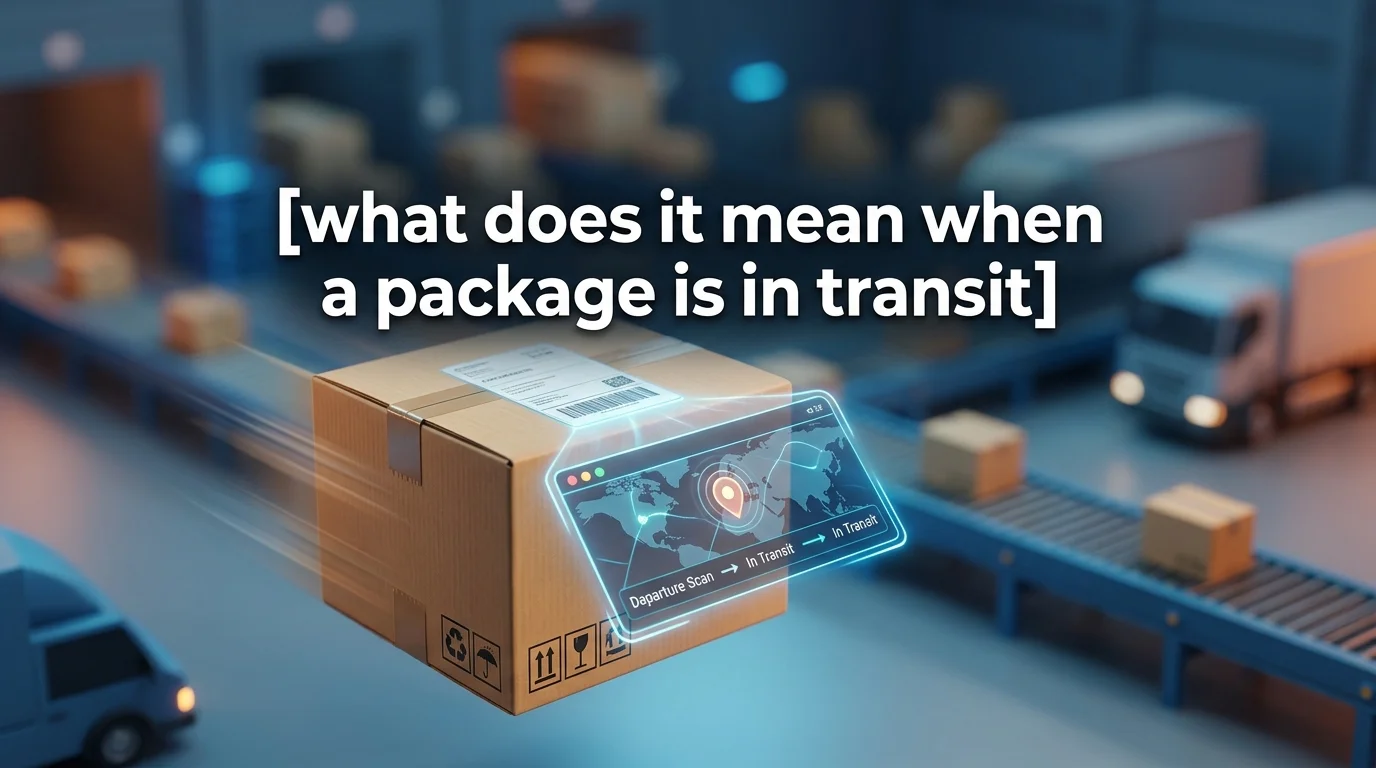
You order something online, check the tracking page every three hours, and suddenly see it: “In Transit.”
It sounds promising, but what does it actually mean? Is your package on a delivery truck right down your street, sitting in an airport cargo bay, or floating somewhere across the ocean?
Tracking updates can feel confusing, opaque, and occasionally nerve-wracking. When you are eagerly awaiting a package, a vague status update leaves you guessing.
This guide breaks down exactly what “in transit” means across major shipping carriers, why tracking statuses sometimes stop updating, and how to know precisely when your delivery will hit your doorstep.
What Does It Mean When a Package Is In Transit?
At its core, “in transit” means your package is on its way to its final destination. It has left the sender or the initial processing facility and is moving through the carrier’s logistics network.
However, “in transit” does not mean your package is currently riding on the local delivery truck to your house.
Instead, it means your shipment is moving between major sorting hubs, facilities, airports, or regional distribution centers.
“In transit indicates movement within the logistics pipeline, while ‘Out for Delivery’ means the package is on the local vehicle making its final drop-offs.”
What Does It Mean When a Package Is In Transit? – Quick Meaning
To simplify things, think of your package’s journey as a relay race.
When the status reads “in transit,” the runner holding your package is actively moving toward the next handoff point.
Core Definition
- Active Logistics Movement: Your item has been scanned out of a facility and is travelling via truck, plane, train, or cargo ship.
- Network Processing: It is progressing through intermediate sorting hubs before reaching your local post office or courier center.
- Not Yet Localized: It has generally not arrived at the final distribution hub responsible for your specific neighborhood.
Real-World Status Examples
“In Transit to Next Facility” — Common USPS update showing automatic movement between major mail hubs.
“In Transit – On Time” — Standard UPS notification indicating the shipment is following its expected route schedule.
“In Transit – Departed FedEx Location” — Shows your package just left a regional sorting hub en route to another hub or final destination.
Origin & Background of the Term
The phrase “in transit” long predates e-commerce and modern digital tracking systems.
Historical Roots
Originating from Latin transire (meaning “to go across”), the term was historically used in maritime trade and rail transport during the 19th and 20th centuries. Shipping manifests labeled goods “in transit” to mark cargo that was moving through foreign ports without being taxed or legally imported there.
The Digital Era & E-Commerce
With the rise of online shopping in the late 1990s and early 2000s, logistics giants like FedEx, UPS, and DHL digitized their logistics logs.
They introduced public-facing tracking portals so consumers could trace their purchases step-by-step.
Social Media & Modern Meme Culture
Today, “in transit” has escaped pure logistical jargon and entered everyday slang.
On platforms like TikTok, X, and Instagram, the phrase is frequently used metaphorically to describe life phases, delayed personal goals, or emotional progress.
"My physical body is at work, but my brain is permanently in transit."
Real-Life Conversations
Here is how “in transit” pops up across modern text conversations, both literally and figuratively.
WhatsApp: Package Anxiety
Person A: Did your dress for the wedding arrive yet?
Person B: No, I’ve been refreshing the tracker all morning! It still says “in transit” at the regional distribution center.
Person A: Fingers crossed it hits “out for delivery” tomorrow morning!
Instagram DMs: Online Shopping Humor
Person A: You ordered those sneakers five minutes ago why are you checking the door? 😂
Person B: Listen, the confirmation email said “in transit” and I take that personally!
TikTok Comments: Relatable Life Slang
Person A: Anyone else feel like they should have their career totally figured out by 25?
Person B: Honestly, my whole life plan is currently “in transit to next facility.” No estimated delivery date yet 💀
Text Messages: Everyday Coordination
Person A: Hey, is the birthday gift for Mom at the house?
Person B: Not yet. Tracking says it’s in transit from Chicago. Should be here Thursday.
Emotional & Psychological Meaning
Why do tracking updates trigger such strong emotional reactions?
When we buy something online, our brains experience a spike in dopamine during checkout. The waiting period that follows creates a psychological state known as anticipatory anxiety.
What the Status Triggers
- Hope: Seeing “in transit” reassures us that our order wasn’t canceled or lost at the origin.
- Impatience: Extended periods without a tracking refresh breed frustration and uncertainty.
- Control: Tracking pages give consumers a psychological sense of control over a process that is entirely out of their hands.
Personal Real-World Scenario
A few months ago, I ordered a rare replacement part for a vintage coffee grinder. For four straight days, the status remained stuck on “In Transit, Arriving Late.”
My immediate reaction was panic—I assumed it had tumbled off a conveyor belt into oblivion.
On the fifth day, without any intermediate scans, it suddenly flipped to “Out for Delivery.” The package had been moving safely the entire time; intermediate optical scanners simply missed a line-code scan along the highway route.
Usage in Different Contexts
The term changes slightly depending on where and how it is used.
Social Media & Pop Culture
On social platforms, users employ “in transit” figuratively to mean working on something behind the scenes, being between life stages, or traveling.
Friends & Casual Relationships
In casual text exchanges, you might tell a friend “I’m in transit” to communicate that you are currently driving, riding the subway, or heading toward your meetup spot.
Professional & Business Logistics
In business, “goods in transit” refers to inventory that has left the seller’s warehouse but hasn’t reached the buyer yet. It carries financial and legal implications regarding liability, risk, and insurance ownership (FOB shipping point vs. FOB destination).
When NOT to Use It
Using the phrase incorrectly can lead to confusion in both logistics and casual conversation.
Professional Misunderstandings
Do not tell a customer their order is “in transit” if you have only created a shipping label.
Creating a label generates a tracking number, but until the carrier physically scans the box into their truck, the package is not in transit.
Personal Miscommunications
Telling a friend you are “in transit” when you haven’t left your house yet can cause frustration. In modern communication, it explicitly implies you are actively moving toward the destination.
Common Misunderstandings
Clear up these frequent misconceptions about tracking statuses.
“In Transit” Means It Arrives Today
False. A package can remain “in transit” for days or even weeks during international shipping or long-distance ground transit.
Only “Out for Delivery” indicates scheduled arrival on the current day.
The Scanner Must Update Every Hour
False. Trucks travel across country lines for 10 to 18 hours without intermediate scans.
Your tracking status will not update until the vehicle reaches the next major sorting hub.
“In Transit” vs. “Out for Delivery”
- In Transit: Moving between long-distance points, hubs, or transportation modes.
- Out for Delivery: Loaded onto the local courier van for final home or business drop-off.
Comparison Table
| Term | Stage of Journey | Location | Next Expected Step |
| Label Created | Pre-Transit | Seller Warehouse | Physical Carrier Hand-off |
| In Transit | Mid-Journey | Sorting Hubs / Transport | Local Distribution Hub |
| Out for Delivery | Final Mile | Local Courier Van | Front Door Drop-off |
| Delivered | Complete | Destination Address | Package Received |
| Exception | Delayed | Held at Hub / Customs | Resumed Transit |
Key Insight
Understanding where your shipment stands in this timeline prevents unnecessary calls to customer support and sets realistic delivery expectations.
Variations & Types of “In Transit” Messages
Carriers use various terms to describe movement through their logistics networks.
1. In Transit to Next Facility
- Meaning: The package left one distribution center and is travelling to the next regional hub.
2. In Transit, Arriving Late
- Meaning: The package is moving, but unforeseen delays (weather, traffic, volume surges) pushed back the estimated arrival date.
3. In Transit – On Time
- Meaning: The shipment is following its predicted delivery schedule without delays.
4. In Transit – Out for Delivery
- Meaning: Rare combined status indicating the package transitioned from the regional hub directly to the local delivery truck.
5. In Transit – Cleared Customs
- Meaning: An international shipment successfully passed customs inspection and resumed internal movement.
6. In Transit – Held at Customs
- Meaning: The package is paused at an international border awaiting documentation, tax payments, or inspection.
7. In Transit – Tendered to Local Carrier
- Meaning: A major courier (like FedEx or UPS) handed the parcel to a local postal service (like USPS) for final delivery.
8. In Transit – Exception
- Meaning: An unexpected event (damaged barcode, incorrect address, severe weather) temporarily halted movement.
How to Respond When Someone Uses It
Depending on context, here is how you can reply when someone mentions something is “in transit.”
Casual Replies
- “Awesome, let me know when it arrives!”
- “Fingers crossed it gets here before the weekend.”
Funny Replies
- “In transit? So it’s taking the scenic route across the country again!”
- “Tell the delivery driver I’ll leave out cookies if they hurry up.”
Mature / Practical Replies
- “Thanks for the update. Send me the tracking link so I can keep an eye on it.”
- “Appreciate it. I’ll make sure someone is home to sign for it.”
Respectful / Business Replies
- “Thank you for providing the shipping update. We will monitor the delivery status on our end.”
Regional & Cultural Differences
Shipping terminology and expectations vary around the globe.
Western Culture (US, UK, Canada)
Consumers expect granular, real-time GPS tracking and frequent automated updates. Delays beyond two or three days often trigger inquiries with customer support.
Asian Culture
E-commerce networks in countries like China, South Korea, and Japan operate with hyper-dense logistics. “In transit” periods are typically short, with same-day or next-day delivery standard in major metropolitan areas.
Generational Differences
- Gen Z: Frequently uses “in transit” metaphorically in text communications, memes, and videos to represent personal growth or transitional phases.
- Millennials & Older Generations: Treat the phrase strictly as a transactional status for tracking physical goods and purchases.
Is It Safe for Kids?
Yes, the phrase “in transit” is completely safe, neutral, and educational.
It contains no offensive connotations and serves as a helpful real-world example of modern logistics, commerce, and vocabulary for young readers.
Frequently Asked Questions
How long can a package stay in transit?
For domestic ground shipping, packages typically remain in transit for 1 to 5 business days. International shipments can stay in transit for 1 to 3 weeks depending on customs processing and distance.
Why is my package stuck in transit for days without updates?
Packages traveling long distances by truck or train do not get scanned while moving on highways. Scans only occur when the item enters or leaves a physical sorting center.
Does “in transit” mean my package is lost?
No. A package is rarely lost simply because it reads “in transit.” Scanners sometimes miss barcodes, or weather delays slow down transport between hubs.
What should I do if my package is in transit past the estimated delivery date?
Wait 24 to 48 hours, as logistics networks often resolve brief delays. If the status remains unchanged after two business days, contact the carrier or seller with your tracking number.
Can I pick up my package while it is in transit?
No. Packages in transit are sealed inside large transport containers, semi-trucks, or cargo planes. You can only request a pickup once it reaches your local distribution facility.
Conclusion
Seeing “in transit” on your tracking screen means your order is actively making its journey across the logistics network.
While it doesn’t mean the delivery truck is turning onto your street just yet, it guarantees that your item is moving toward you.
Understanding these updates removes the mystery from online shopping, giving you clarity and peace of mind while you await your package.