Understanding the Rise of “W” in Modern Slang
Slang evolves faster than traditional language rules can keep up. If you have spent time scrolling through TikTok, reading group chats, or scanning YouTube comments, you have likely seen a single letter dropping everywhere: W.
Seeing a lone letter standing in for an entire phrase can leave you feeling out of the loop. People search for this term because internet shorthand often lacks context, leaving readers wondering whether it represents an abbreviation, a typo, or a new cultural code.
Understanding this term bridges the gap between modern digital culture and clear everyday communication. It strips away the confusion of social media lingo and helps you instantly grasp the emotional tone behind short online messages.
What Does W Mean in Slang? – Quick Meaning
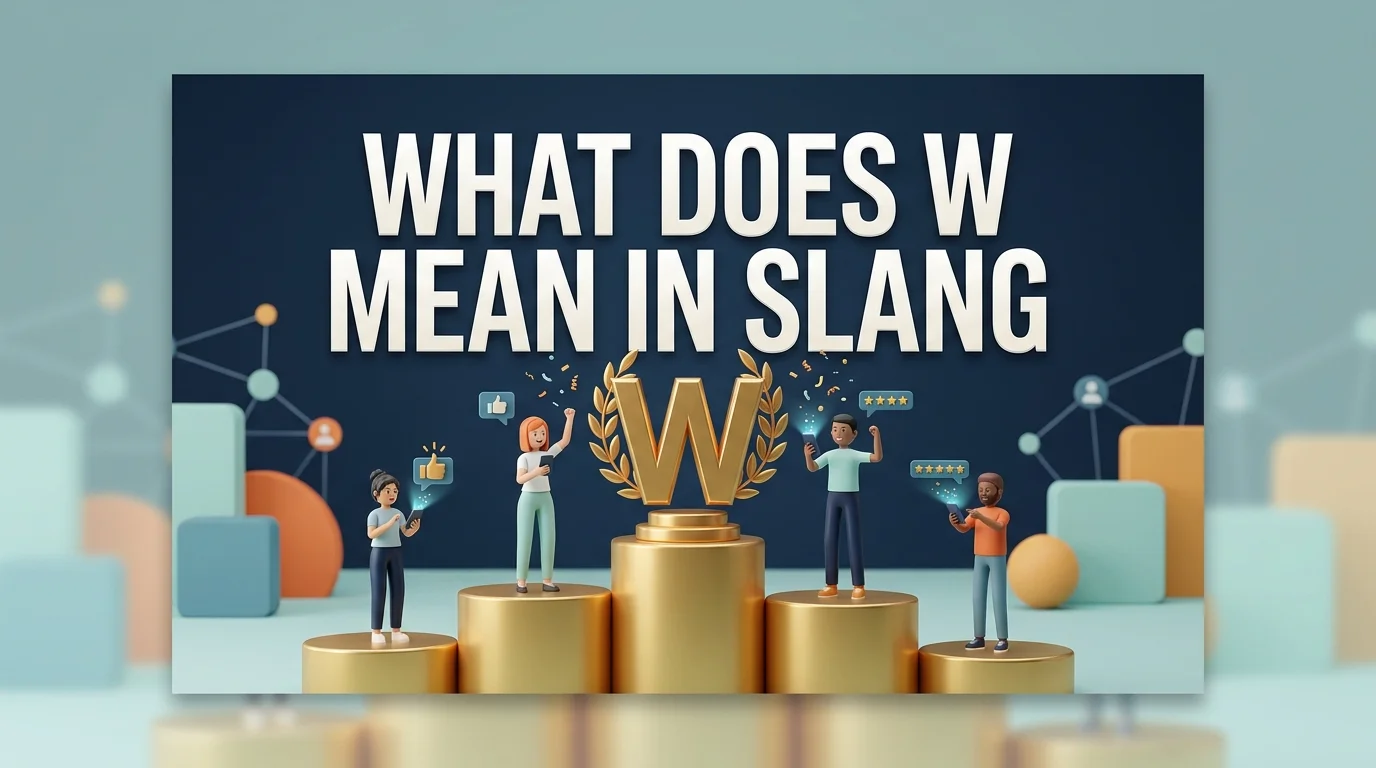
At its core, W stands for “Win” or “Winner.”
It is used to celebrate a success, express approval, show support, or acknowledge something positive happening to someone. When someone types a single letter, they are effectively declaring that a situation, person, or decision is a total victory.
- “You got the job promotion? Massive W!”
- “Taking a mental health day when you feel burned out is a huge W.”
- “Found five dollars in my winter jacket pocket today. Small Ws count.”
Core Definitions
- A Victory: Used as a noun to represent a successful outcome.
- An Act of Approval: Used as an interjection to praise someone’s actions or choices.
- A Compliment: Describing a person as a “W friend” means they are supportive, reliable, and overall great.
Origin & Background of the Slang Term
Sports Roots and Gaming Culture
The letter originates directly from traditional sports statistics, where standings are recorded using “W” for wins and “L” for losses. Scoreboards and team records have long relied on this clean abbreviation to show success at a glance.
Online gaming communities, particularly competitive streamers on platforms like Twitch, adopted the letter to quickly call out great plays in live chats. Typing a quick letter allowed viewers to react instantaneously without missing fast-paced gaming action.
The Social Media Explosion
Hip-hop culture and sports commentary online accelerated its adoption, turning a simple statistical shorthand into everyday slang. Platforms like Twitter, TikTok, and Instagram amplified it globally, making it a staple of digital communication for Gen Z and younger Millennials.
Over time, the meaning broadened from literal athletic wins to covering virtually any positive moment in daily life, big or small.
Real-Life Conversations
WhatsApp Chat
Person A: I finally asked my boss for that pay raise today.
Person B: Tell me you got it!
Person A: Full 15% increase starting next month!
Person B: Huge W! So proud of you!
Instagram DMs
Person A: Sent you that coffee you liked via delivery app, hope it brightens your study session.
Person B: You are literally a W friend, thank you so much!
TikTok Comments
Person A: I decided to drop out of a toxic friendship circle and focus on my own goals this year.
Person B: Absolute W response. Self-care always comes first!
Text Message
Person A: Traffic was clear, hit every green light, and made it to the train with two minutes to spare.
Person B: Common W morning for you!
Emotional & Psychological Meaning Behind “W”
Expressing Shared Joy and Validation
Using this shorthand is an effortless way to extend validation. It functions as digital applause, instantly communicating that you are cheering for someone else’s success without requiring a lengthy response.
Psychologically, receiving this brief compliment satisfies our innate desire for social recognition. It turns everyday micro-accomplishments into shared moments of celebration among friends.
A Modern Take on Connection
In a fast-paced digital environment where attention spans are limited, single-character affirmations offer immediate positive reinforcement. The brevity adds enthusiasm rather than reducing emotional weight.
I remember watching a quiet colleague present a project pitch that they had rehearsed endlessly. When a teammate casually posted a simple praise in the group chat right after, the immediate visible relief and smile on their face showed how powerful a tiny gesture of encouragement can be.
Usage in Different Contexts
Social Media Platforms
On TikTok, Instagram, and X (formerly Twitter), you will find it flooding comment sections under videos showing acts of kindness, clever comebacks, or personal triumphs. It acts as an instant upvote for real-life moments.
Friends and Casual Relationships
Among friends, the term serves as warm praise for good taste, smart decisions, or helpful acts. It creates an informal, relaxed atmosphere where successes are celebrated casually and frequently.
Work and Professional Settings
Professional environments generally call for traditional language. Using internet slang in formal emails or presentations can appear unprofessional, though casual team chats on Slack might tolerate it if the office culture is exceptionally relaxed.
Tone Dynamics: Casual vs. Serious
The phrase carries a lighthearted, upbeat tone. Avoid using it during serious, somber, or sensitive conversations, as short slang can easily be interpreted as dismissive or insensitive when someone is sharing heavy emotional news.
When NOT to Use Modern Slang
Formal Communication
Skip internet shorthand in cover letters, academic writing, client emails, and formal interviews. Stick to professional vocabulary to maintain credibility and respect.
Serious or Grief-Filled Moments
If a friend is sharing tragic news or discussing a difficult life event, slang is completely out of place. Objective sympathy requires thoughtful, full sentences rather than short internet expressions.
High-Stakes Workplace Interactions
Avoid using slang with senior executives or external clients unless an exceptionally casual relationship has already been established over time. Misunderstandings can affect professional perception.
Common Misunderstandings
Literal vs. Figurative Meaning
Newcomers often assume the letter represents an abbreviation for “What,” “With,” or “Why.” Confusing these leads to dynamic misunderstandings in basic text exchanges.
Misinterpreting Tone
Because the term consists of a single letter, older generations sometimes mistake it for laziness or dismissiveness. In reality, the sender is usually offering enthusiastic support.
Overusing the Term
Dropping slang into every sentence dilutes its impact. Using it naturally requires matching the energy of the conversation rather than forcing it into every interaction.
Comparison Table: Slang Terms Demystified
| Term | Meaning | Tone / Vibe | Example Usage |
|---|---|---|---|
| W | Win / Success | Enthusiastic, Supportive | “Got the ticket! Big W!” |
| L | Loss / Failure | Disappointed, Sympathetic | “Dropped my ice cream. Major L.” |
| Flex | Showing off | Confident, Flashy | “That new car is a subtle flex.” |
| Goat | Greatest of All Time | High Respect | “He helped me move, absolute GOAT.” |
| Cap | Lie / Untruth | Skeptical, Casual | “No cap, that was the best meal ever.” |
Key Insight
While slang terminology shifts constantly across online platforms, most terms balance neatly along binary lines of praise and criticism, success and failure.
Variations and Related Types
- Big W: A major life achievement or significant victory.
- Small W: A minor daily success that brightens your mood.
- Common W: A consistent, predictable act of greatness from someone who regularly does well.
- Massive W: An overwhelming, extraordinary accomplishment deserving extra praise.
- Dub: A phonetically spelled phonetic alternative meaning victory (derived from “double-u”).
- W Mans: A reliable, respectful male friend who looks out for others.
- W Rizz: Exceptional charm, charisma, or romantic appeal.
- Taking the W: Accepting a victory with pride and gratitude.
- W Parent: A mother or father showing wonderful support for their child.
- W Take: An opinion or statement that is completely accurate and well-reasoned.
How to Respond When Someone Uses It
Casual Replies
- “Appreciate you! Couldn’t have done it without the team.”
- “Felt good to finally get that right!”
- “We take those victories all day long!”
Funny Replies
- “Adding this victory to my official highlight reel.”
- “Framing this comment on my wall tonight.”
- “Even a broken clock gets a victory twice a day!”
Mature Replies
- “Thank you, I really put a lot of hard work into this.”
- “I appreciate the encouragement, it means a lot.”
- “Thanks! Glad the effort paid off in the end.”
Respectful Replies
- “Thank you so much for the kind words!”
- “That is very generous of you to say, thanks.”
- “I appreciate your ongoing support!”
Regional and Cultural Usage Differences
Western Internet Culture
In North America, Europe, and Australia, the slang is ubiquitous across streaming culture, sports commentary, and youth text messaging. It moves seamlessly across digital platforms without geographic barriers.
Asian Internet Communities
While traditional idioms dominate local social media networks in East Asia, global gaming communities in countries like South Korea and the Philippines frequently use the English letter in esports discussions.
Middle Eastern Digital Spaces
Bilingual youth across the Middle East frequently mix English internet slang like this into Arabic script text messages, adapting western digital shorthands for local gaming and lifestyle chats.
Generational Divide: Gen Z vs. Millennials
Gen Z uses the shorthand effortlessly as a standard part of their daily lexicon. Older Millennials often understand it through social media exposure, whereas Gen X and Baby Boomers may find single-letter slang confusing without clear context.
Is It Safe for Kids?
Yes, the term is entirely safe for children and teenagers. It carries no inappropriate, explicit, or harmful double meanings.
The slang represents positive affirmation and peer celebration. Parents can feel completely comfortable seeing their children use or receive this shorthand in online gaming lobbies, group texts, and social media platforms.
Frequently Asked Questions
What does W mean in text messaging?
In text messages, it stands for “Win.” It is used to celebrate good news, show agreement, or compliment someone on a positive outcome.
What is the opposite of a W in slang?
The direct opposite is “L,” which stands for “Loss.” It denotes a failure, embarrassment, or unfavorable situation.
Is W short for Dub?
Yes, “Dub” comes from the pronunciation of the letter “W” (double-u). Both terms mean victory and are used interchangeably.
Can W be used as an adjective?
Yes, people often say things like “that was a W move” or “he is a W friend” to describe high quality or positivity.
Is using W professional?
It is best suited for casual settings. Keep it out of formal work communication, business emails, and professional documentation.
Does W mean “What” or “With”?
In general text shorthand, “w/” often means “with,” but a standalone capital letter almost always means “Win” in modern slang.
Conclusion
Language evolves to reflect the speed and energy of how we connect online. A single letter like W manages to pack encouragement, celebration, and solidarity into a lightning-fast keystroke.
Understanding these modern expressions helps keep your communication fresh, relatable, and engaged with current culture. Use it confidently next time a friend shares a win, and enjoy taking part in the ever-shifting landscape of digital speech.