If you have scrolled through TikTok comments, browsed fandom posts on Tumblr, or received a strange text from a younger sibling, you have likely run into the acronym “OTP.”
You might know it as the frustrating security code sent to your phone during two-factor authentication. Yet, in online casual chat, typing that security definition will get you blank stares.
Understanding internet slang feels like learning a second language that updates its vocabulary every week. Missing the context creates awkward misunderstandings, especially when slang crosses into emotional or relational territory.
This guide breaks down everything about OTP in slang, covering its true meaning, origin, cultural impact, emotional undertones, and exact usage scenarios across platform settings.
What Does OTP Mean in Slang?
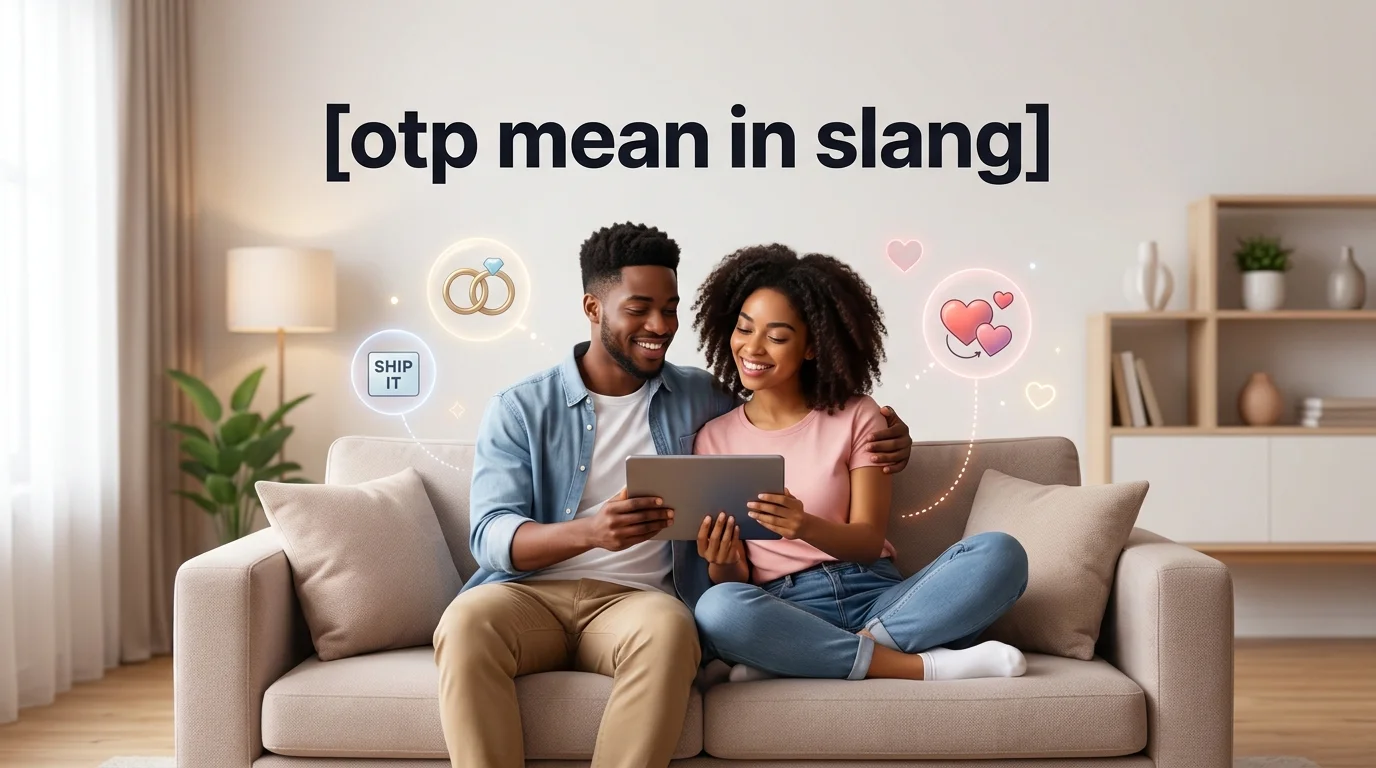
In digital culture, OTP stands for “One True Pairing.” It describes two people—either fictional characters, celebrities, or real-life friends—who you believe are ideal romantic partners.
When you refer to a couple as your OTP, you express a deep emotional investment in their relationship. You are declaring that, regardless of plot obstacles or real-world friction, these two individuals belong together.
While the term began in online fandoms to celebrate fictional romances, it now describes real-world couples, supportive friendships, and hilarious Everyday dynamic pairings like coffee and Monday mornings.
"They are my ultimate OTP; nobody else comes close."
"If those two don't end up together by the season finale, I'm quitting the show. Pure OTP energy."
"Honestly, me and my bed are the real OTP this weekend."
Origin and Background of OTP
Fandom Roots and Early Days
The term originated in the late 1990s and early 2000s inside text-based fan fiction communities on platforms like LiveJournal, Fanfiction.net, and Usenet newsgroups. Fans of popular series like Harry Potter, Buffy the Vampire Slayer, and X-Files used the acronym to organize fan fiction stories centered on specific romantic pairings.
Writing or reading about an OTP provided a way for fans to explore chemistry that original authors or TV producers overlooked.
The Social Media Explosion
When Tumblr emerged in the late 2000s, OTP transformed from a niche fan fiction tag into a widespread internet meme. Tumblr users created visual edits, fan art, and multi-gif sets celebrating their favorite couples.
The acronym moved rapidly into fandoms for shows like Supernatural, Sherlock, and anime series. As these fandoms migrated to Twitter, Instagram, and TikTok, the slang escaped fan fiction circles entirely.
The Evolution of Modern Slang
Today, OTP isn’t restricted to fictional characters. Gen Z and Millennial speakers use it casually in everyday conversation to highlight strong chemistry anywhere.
The meaning expanded to include platonic pairings, humorously paired inanimate objects, and real-life friends who match each other’s energy perfectly.
Real-Life Conversations
WhatsApp Chat: Real-Life Friends
Person A: Did you see Sarah and Mark at the dinner last night?
Person B: Yes! The way he carried her jacket the whole night was so sweet.
Person A: I know! They are literally my OTP in our friend group.
Person B: Same here. If they ever break up, I am losing faith in love.
Instagram DM: Reacting to a Celebrity
Person A: Look at this photo Zendaya just posted with Tom Holland!
Person B: Stop, my heart can’t take it! 😭
Person A: They are the absolute ultimate OTP.
Person B: No debate needed. Unmatched energy.
TikTok Comments: TV Show Discussion
Person A: If the writers don’t make them end up together in Season 3, I am rioting.
Person B: FR! They have had OTP energy since episode one.
Person A: The side-eye glances alone proved it!
Text Messages: Relatable Humor
Person A: Hey, coming out tonight?
Person B: Nah, me and my couch are currently being the healthiest OTP in town.
Person A: Fair enough, enjoy your cozy night!
Emotional & Psychological Meaning of OTP
Using OTP expresses more than a casual observation; it shows enthusiasm, emotional projection, and a desire for romantic harmony. Modern digital culture can feel disconnected, so championing an OTP allows people to celebrate genuine connection, emotional safety, and deep compatibility.
Psychologically, rooting for an OTP taps into narrative empathy. We project our own desires for loyalty, passion, and mutual understanding onto these pairings. Celebrating them brings a sense of vicarious joy.
A friend of mine spent weeks obsessing over two characters in an indie drama series. She wasn’t just interested in the plot; she was processing her own views on trust after a tough breakup.
Seeing those characters navigate conflict gave her hope about real-world relationships. When she texted me, “They are my lifetime OTP,” she was acknowledging her own emotional standard for healthy partnership.
Usage in Different Contexts
Social Media
On platforms like TikTok, X (formerly Twitter), and Instagram, OTP functions as an tag, a caption, or an exclamation. It signals high engagement and shared enthusiasm among fans or followers.
Friends & Relationships
In personal relationships, calling a friend group couple your “OTP” acts as a high compliment. It validates their bond and tells them their connection looks strong, healthy, and enviable from the outside.
Professional & Work Settings
Avoid using OTP in professional contexts. In corporate or formal environments, the acronym is almost universally recognized as “One-Time Password.”
Using it to describe coworkers can cross professional boundaries, violate workplace etiquette, or create awkward confusion regarding network security.
Casual vs. Serious Tone
The slang carries a lighthearted, expressive tone. While it signals genuine admiration, using it in an intensely serious conversation about real-life relationship problems can feel overly casual or dismissive.
When NOT to Use It
Workplace Communications
Sending an email stating “You and the project manager are my OTP” can lead to HR interventions or serious confusion about security protocols. Keep the term out of corporate channels.
Sensitive or Grieving Moments
If a real-life couple is experiencing conflict, separation, or loss, using fan-culture slang trivializes their pain. Stick to empathetic, direct language instead.
Formal Writing & Academic Papers
Unless your topic focuses specifically on digital linguistics, internet sociology, or fan culture studies, slang terms like OTP have no place in academic or formal research papers.
Common Misunderstandings
The Security Code Confusion
The biggest misunderstanding comes from mixing up the slang term with the technical term One-Time Password. Context usually solves this instantly:
- If your bank sends it, it’s a security code.
- If a friend posts it under a cute photo of a couple, it’s a romantic compliment.
Tone and Sarcasm Misreads
Sometimes people use OTP sarcastically to call out toxic relationships or chaotic pairings. Reading the speaker’s emotional tone prevents mistaking a sarcastic remark for genuine praise.
Literal vs. Figurative Meaning
You don’t need to believe two people are the only couple that should ever exist. The word “One” is hyperbole used to emphasize how great the connection looks.
Comparing OTP to Other Slang Terms
| Term | Full Meaning | Primary Focus | Best Used For |
|---|---|---|---|
| OTP | One True Pairing | Ideal romantic pairing | Celebrating a specific couple |
| Ship | Shipping / Relationship | The act of supporting a couple | Expressing a desire for a relationship |
| Canon | Canonical Fact | Official storyline truth | Confirming a couple is officially together |
| ** Endgame** | Endgame Couple | Long-term ultimate status | Predicting a couple stays together forever |
| BFF | Best Friends Forever | Purely platonic friendship | Highlighting deep non-romantic bonds |
Key Insight
While “shipping” is the action of supporting a relationship, your “OTP” is the ultimate destination—the absolute top-tier pairing you care about most.
Variations and Types of OTP
NOTP
A pairing you actively dislike, oppose, or refuse to support in a story or real-life dynamic.
BroTP
A strictly platonic “One True Pairing.” Used to celebrate powerful, inseparable friendships or brotherly bonds.
Ot3
A term used when three individuals form an ideal romantic or platonic dynamic together.
Multishipper OTPs
A term for when someone supports multiple different pairings involving the same character without exclusive loyalty.
Ghost OTP
A pairing involving a character who has died or left a story, yet fans still celebrate the romantic bond.
Crack OTP
An absurd, unlikely, or bizarre pairing created purely for comedy or chaos.
Semi-Canon OTP
A pairing where chemistry is obvious and acknowledged by creators, but never officially confirmed on screen.
AU OTP
An “Alternate Universe” pairing where fans imagine their favorite couple in a completely different setting, like a modern coffee shop.
Crossover OTP
A pairing made up of two characters from entirely different TV shows, books, or cinematic universes.
How to Respond When Someone Uses It
Casual Replies
- “100% agreed, they are perfect together!”
- “Honestly, same. I’ve been saying this forever!”
- “They really do have the best energy.”
Funny Replies
- “My only OTP right now is me and my bed.”
- “Please don’t remind me, I’m single enough already!”
- “If they break up, my therapist is going to hear about it.”
Mature Replies
- “They really do seem to bring out the best in each other.”
- “It’s nice seeing two people so well-matched.”
- “They’ve built a really healthy connection.”
Respectful Replies
- “I can definitely see why you root for them so much!”
- “Their chemistry is pretty undeniable.”
Regional and Cultural Usage
Western Culture
In North America, Europe, and Australia, OTP is widely integrated into mainstream youth language. You will hear it in podcasts, YouTube videos, and casual conversations among young adults.
Asian Internet Culture
In East Asian online communities, particularly in K-pop and anime fandoms, the concept is massive. Fans frequently group idols or fictional characters into specific pairings, though local slang terms like kombu or local character ship names are also used alongside OTP.
Middle Eastern Internet Usage
Bilingual youth across the Middle East use OTP in English-speaking or mixed-language social media groups. It retains the exact same fandom and romantic context.
Generational Differences: Gen Z vs. Millennials
Millennials created the slang term within early online fandom spaces. Gen Z inherited it, shortened its application, and brought it into mainstream daily conversation, often using it casually to compliment real-world friends.
Is It Safe for Kids?
Yes, the term OTP is completely safe for children and teenagers. It carries no inherently explicit, offensive, or inappropriate connotations.
It is simply an innocent piece of fan culture language used to express admiration for strong relationships, wholesome romances, or great friendships.
Frequently Asked Questions
What does OTP stand for in text messages?
In informal text messages, OTP stands for “One True Pairing,” referring to two people or characters who make an ideal couple. In banking or security texts, it stands for “One-Time Password.”
Is OTP positive or negative slang?
OTP is an overwhelmingly positive term. It expresses affection, excitement, support, and admiration for a relationship dynamic.
Can an OTP be platonic?
Yes, a purely platonic pairing is often called a “BroTP,” though many people use OTP casually to describe great non-romantic friendships as well.
What is the difference between shipping and OTP?
“Shipping” is the verb (the act of rooting for a relationship), while “OTP” is the noun (the specific couple you think is the absolute best).
How do you pronounce OTP in conversation?
You pronounce it by spelling out the individual letters: O-T-P. It is rarely spoken as a single blended word.
Is OTP still popular in 2026?
Yes, OTP remains a core term in internet culture, fandom spaces, and social media slang, continuing to evolve alongside modern digital communication.
Navigating Modern Slang with Confidence
Language evolves rapidly, reflecting how we form connections, share enthusiasm, and build digital communities. Understanding slang like OTP allows you to navigate online conversations, connect with younger generations, and appreciate the creative ways people express emotional support.
Whether you are talking about your favorite TV show couple, celebrating a friend’s engagement, or joking about your morning coffee routine, using OTP adds a touch of modern charm to your communication.
Embrace the shifting vocabulary of the digital age, keep context in mind, and use your new slang knowledge with confidence!