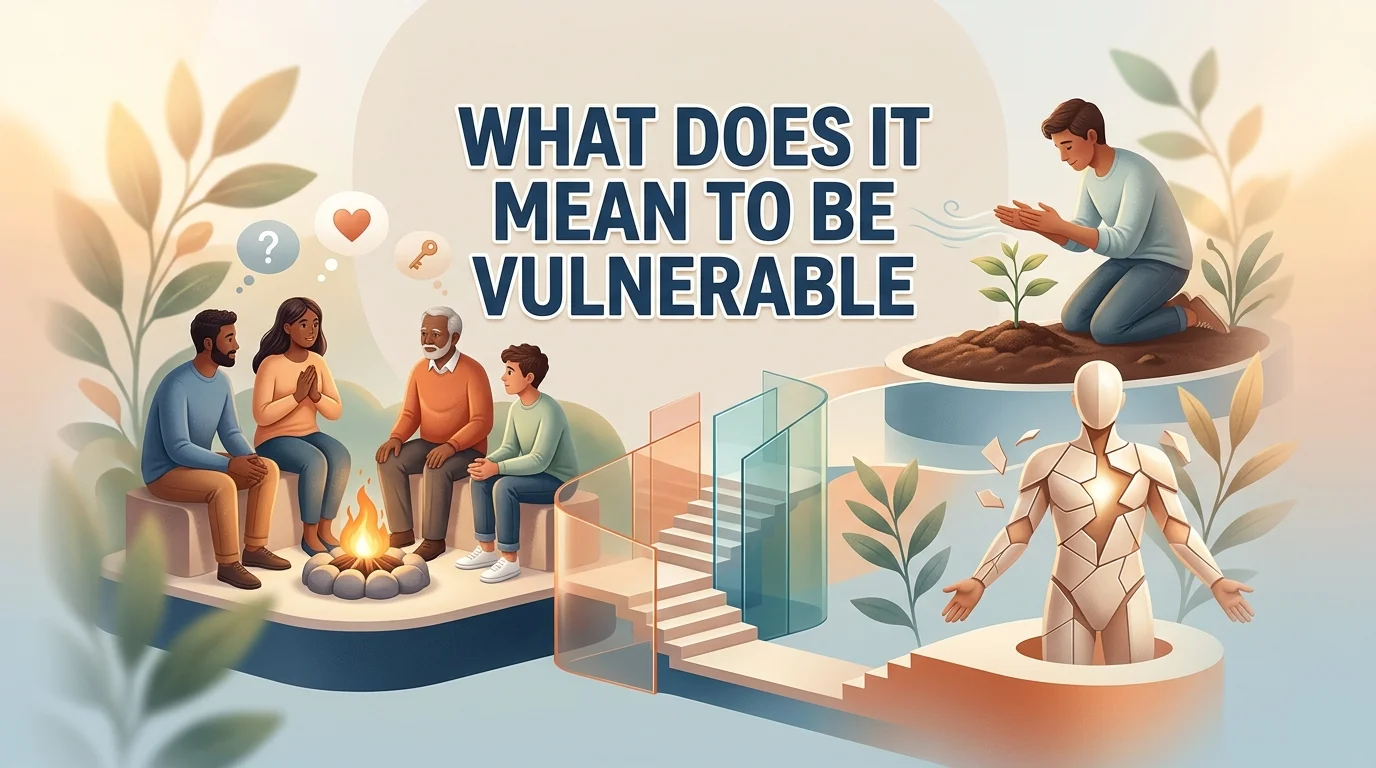
What Does It Mean to Be Vulnerable and Why Everyone Is Talking About It
We live in a culture obsessed with strength, confidence, and curated perfection. Yet, everywhere you look—from viral TED Talks to midnight text messages—people are talking about vulnerability.
You have probably searched for this term because you felt a sudden lump in your throat when someone asked you to share how you really felt. Maybe a partner asked you to open up, a manager spoke about creating psychological safety, or a social media creator praised the power of emotional honesty.
The confusion stems from a simple disconnect: traditionally, society taught us that being vulnerable meant being weak, exposed, or easily broken. Today, human psychology and modern relationship experts view it as the ultimate expression of emotional courage.
Understanding what it means to be vulnerable dissolves the fear of being seen for who you truly are. It shifts your perspective from self-protection to genuine connection.
What Does It Mean to Be Vulnerable? A Quick Meaning
At its core, being vulnerable means willingly exposing your emotional truth, risks, and uncertainties without any guarantee of a safe or favorable outcome. It is the conscious choice to strip away self-protective masks.
Core Elements of Vulnerability
- Emotional Risk: Exposing your true feelings when you might face rejection or judgment.
- Authenticity: Choosing genuine self-expression over performative perfection.
- Uncertainty: Stepping into raw conversations without controlling the final outcome.
- Courage: Facing the inherent discomfort of potential emotional pain.
“I love you, and I am terrified that you might not feel the same way.”
“I honestly have no idea what I am doing with my life right now, and I feel completely lost.”
“I made a huge mistake on that project, and I need help fixing it.”
Origin & Background: How Vulnerability Evolved
Historical Roots
The word originates from the Latin noun vulnus, meaning “wound,” and the verb vulnerare, meaning “to wound.” For centuries, the term was applied almost exclusively to physical combat and military strategy. A city wall with a breach was vulnerable; an unarmed soldier was vulnerable.
Cultural Shifts
Throughout the 20th century, Western culture reinforced the idea that emotional self-restraint equaled resilience. Stoicism was celebrated, while emotional expression was suppressed, especially in professional and traditional domestic settings.
The Modern Renovation
The social perception underwent a massive transformation in the 2010s. Researchers brought empirical data to human emotions, demonstrating that emotional exposure is not a character flaw, but the birthplace of trust, innovation, and belonging.
Social Media Impact
Platform dynamics have altered how we experience openness. While early social media prioritized glossy, perfect lives, current digital spaces favor unedited, raw reflections. This shift transformed vulnerability from a private struggle into a public cultural currency.
Real-Life Conversations
WhatsApp Texting
Alex: Hey, are you free to talk? I felt really hurt by that comment you made at dinner tonight.
Jordan: Oh, I was just joking around!
Alex: I know you didn’t mean bad, but it touched on something I am really insecure about. I wanted to tell you directly instead of keeping it in.
Instagram DMs
Maya: Your latest story hit home. How do you stay so confident while sharing your struggles online?
Sam: Honestly? I am terrified every single time I press share!
Maya: Wow, I never would have guessed. It feels so real and helpful.
TikTok Comment Section
User_123: I wish I could be as brave as you to tell my parents I want to change my major.
Creator_Jay: It took me three months of panic attacks to say a word. Being brave just means doing it while your heart is racing.
Direct SMS
Chris: I know we haven’t spoken since the argument. I am texting because I miss you, and I hate how pride got in my way.
Taylor: Thank you for saying that. I was too afraid to reach out first.
Emotional & Psychological Meaning
What Emotion It Expresses
Vulnerability is not a single emotion. It is an emotional state composed of honesty, humility, fear, and profound hope. When you allow yourself to be open, you acknowledge your human limits while reaching out for genuine connection.
Why People Practice It
- To Build Deep Trust: Intimacy cannot survive behind emotional armor.
- To Heal Internal Trauma: Unspoken pain festers, while expressed pain finds room to heal.
- To Reduce Mental Exhaustion: Maintaining a fake persona drains immense psychological energy.
- To Experience Authentic Joy: Suppressing painful emotions inadvertently numbs positive ones too.
What It Reveals About Modern Communication
Modern communication suffers from digital transactionalism. We exchange information rapidly, yet we often fail to connect. Emphasizing vulnerability reveals a collective hunger for meaningful interaction over superficial updates.
A Real-Life Experience
A few years ago, I led a high-stakes workshop with senior executives. Midway through, a participant asked a sharp, technical question that I simply could not answer. My immediate instinct was to dodge, use corporate jargon, or deflect.
Instead, I paused, took a breath, and said, “I don’t know the answer to that, but I will find out by tomorrow.” The room instantly shifted. The tension vanished, and three other attendees admitted their own uncertainties regarding the project. Admitting my limitation created immediate psychological safety for everyone else.
Usage in Different Contexts
Social Media Context
On platforms like TikTok or Instagram, openness often looks like unscripted videos, candid mental health discussions, or sharing personal failures. It builds community, though it carries the risk of oversharing for digital validation.
Friends & Relationships
In personal relationships, emotional exposure means setting boundaries, admitting mistakes, expressing affection without guarantees, and revealing past hurts. It serves as the bedrock for long-term emotional intimacy.
+-----------------------------------------------------------------------+
|                       THE VULNERABILITY SPECTRUM                      |
+-----------------------------------+-----------------------------------+
|      HEALTHY OPENNESS             |       UNHEALTHY OVERSHARING       |
+-----------------------------------+-----------------------------------+
| Shared with trusted people        | Shared with strangers for clout   |
| Respects personal boundaries      | Crosses appropriate boundaries    |
| Seeks mutual connection           | Seeks immediate validation        |
| Driven by self-awareness          | Driven by emotional overwhelm     |
+-----------------------------------+-----------------------------------+
Work and Professional Settings
In professional spaces, executive vulnerability does not mean crying in every meeting or sharing deep personal secrets. It means acknowledging project risks, admitting knowledge gaps, asking for support, and taking accountability for mistakes.
Casual vs. Serious Tones
- Casual Tone: “Not gonna lie, I am super nervous about this presentation today!”
- Serious Tone: “I am struggling with my anxiety right now, and I need to step back from extra commitments.”
When NOT to Use It
Unsafe Environments
Do not expose your deepest emotional wounds to people who have repeatedly used your secrets against you. True openness requires a foundation of basic respect and psychological safety.
Professional Boundaries
Sharing extreme personal trauma with clients or junior colleagues compromises professional boundaries. It shifts the burden of care onto people who are not equipped or obligated to carry it.
Strategic Manipulation
Beware of performative vulnerability, where individuals share calculated “flaws” to manipulate others or gain unearned trust. Real exposure is authentic, not a calculated sales tactic.
Common Misunderstandings
Myth vs. Reality
- Myth: Vulnerability is a sign of weakness and emotional instability.
- Reality: Expressing raw truth requires immense internal strength and self-possession.
- Myth: Being open means sharing every detail of your life with everyone.
- Reality: Healthy exposure requires discernment and clear personal boundaries.
- Myth: It comes naturally to emotional people and is impossible for analytical thinkers.
- Reality: Openness is a trainable skill, not an inherent personality trait.
Comparative Breakdown
| Expression / Concept | Core Meaning | Key Difference from Vulnerability |
|---|---|---|
| Vulnerability | Exposing true feelings despite emotional risk. | Rooted in courage and mutual connection. |
| Weakness | Inability to withstand pressure or lack of strength. | Weakness avoids challenge; openness faces it head-on. |
| Oversharing | Dumping private details without boundaries. | Oversharing lacks discernment and emotional regulation. |
| Stoicism | Enduring pain without showing feelings. | Stoicism conceals emotions; vulnerability expresses them carefully. |
| Performative Honesty | Curating “raw” moments for public praise. | Performative honesty seeks attention; real openness seeks truth. |
Key Insight
True emotional openness is never about spilling your guts to whoever happens to be standing nearby. It is the conscious, courageous choice to share your true self with those who have earned the right to hear it.
10 Variations and Types of Emotional Openness
1. Relational Vulnerability
Opening your heart to a romantic partner despite the risk of heartbreak.
2. Intellectual Vulnerability
Admitting when you do not understand a concept or lack critical information.
3. Professional Vulnerability
Asking for help with workload issues before hitting complete burnout.
4. Creative Vulnerability
Sharing original artistic, literary, or musical work with the world.
5. Selective Vulnerability
Carefully choosing specific, trusted individuals to share deep personal struggles with.
6. Performative Vulnerability
Displaying manufactured emotional moments online to gain engagement or sympathy.
7. Forced Vulnerability
Feeling pressured by authority figures or peer groups to disclose private details.
8. Somatic Vulnerability
Listening to and acknowledging physical signs of exhaustion or stress in your body.
9. Parental Vulnerability
Admitting to your children that you made a mistake or do not have all the answers.
10. Unconscious Vulnerability
Accidentally revealing underlying feelings through body language, tone, or slip-ups.
How to Respond When Someone Opens Up to You
+--------------------------------------------------------------------+
|               HOW TO RESPOND TO EMOTIONAL OPENNESS                 |
+------------------+-------------------------------------------------+
| Response Type    | Example Phrase                                  |
+------------------+-------------------------------------------------+
| Casual           | "I really appreciate you telling me that."      |
| Supportive       | "Thank you for trusting me with this."          |
| Mature           | "That sounds really tough. How can I help?"     |
| Validation       | "Your feelings make total sense to me."         |
+------------------+-------------------------------------------------+
Casual Responses
- “Thanks for keeping it real with me, I appreciate it.”
- “I hear you, and honestly, I feel the same way sometimes.”
Funny / Lighthearted Responses
- “Well, now that we’ve shed our emotional armor, want to get tacos?”
- “Thanks for sharing! My brain hurts from being this mature, but I love it.”
Mature Responses
- “Thank you for sharing that with me. It takes courage to say it out loud.”
- “I am listening. Take all the time you need to explain.”
Respectful & Empathetic Responses
- “I value your trust, and your secret is completely safe with me.”
- “You don’t have to fix everything right now. I am just here to support you.”
Regional & Cultural Usage
Western Perspectives
In North American and Western European cultures, personal disclosure is increasingly celebrated as a key component of leadership, therapy, and social relationships. Expressing personal struggles is often viewed as an empowering act.
Asian Cultural Contexts
In many Eastern cultures, collective harmony and indirect communication take priority. Openly discussing personal emotional struggles can sometimes be viewed as burdening the group, though younger generations are reshaping this dynamic through digital spaces.
Middle Eastern Contexts
Cultural values emphasize hospitality, family honor, and community loyalty. While emotional expression within deep family circles is strong, sharing personal vulnerabilities outside trusted family networks remains carefully guarded.
Generational Differences: Gen Z vs. Millennials
- Millennials: Pioneered the transition from corporate stoicism to personal growth culture, often discovering emotional openness through self-help and therapy in adulthood.
- Gen Z: Treats emotional transparency as a default setting, using humor, memes, and candid videos to process mental health struggles publicly.
Is It Safe for Kids and Teens to Learn?
Teaching children about emotional openness is essential for healthy psychological development. Children who learn that it is okay to feel scared, sad, or uncertain grow into emotionally resilient adults.
However, parents and educators must teach age-appropriate boundaries. Children should understand the difference between sharing feelings with trusted family members versus sharing sensitive personal information with strangers online.
Frequently Asked Questions
Is being vulnerable the same as being weak?
No, weakness is the refusal or inability to face reality, whereas emotional openness requires the strength to face uncertainty and potential pain head-on.
How do I start being more vulnerable if I am naturally closed off?
Start small by expressing simple preferences or admitting minor uncertainties to a trusted friend, then gradually build up to deeper conversations over time.
Can vulnerability hurt your career?
Only if done without professional boundaries. Sharing operational uncertainties or asking for assistance builds trust, while dumping personal trauma on colleagues can create awkwardness.
What is the difference between vulnerability and oversharing?
Vulnerability aims for connection and respects boundaries, while oversharing is often an uncontrolled emotional dump meant to grab immediate attention or validation.
Why is opening up so terrifying for most people?
It triggers our primal fear of social rejection, exposing us to potential criticism, judgment, or abandonment by our social group.
How do I know if someone is safe to open up to?
Safe individuals listen without immediate judgment, keep your confidences secret, and show consistent respect for your emotional boundaries over time.
Embracing Emotional Courage
Learning what it means to be vulnerable is not about stripping away your defenses or walking through life unprotected. It is about understanding that your flaws, fears, and uncertainties do not make you broken—they simply make you human.
When you drop the exhausting facade of having everything together, you give others implicit permission to do the same. You trade the illusion of perfection for the rich reality of genuine human connection.
Start small today. Say the honest sentence, admit the boundary you need, or ask for the help you deserve. True courage begins the moment you decide to be seen as you are.