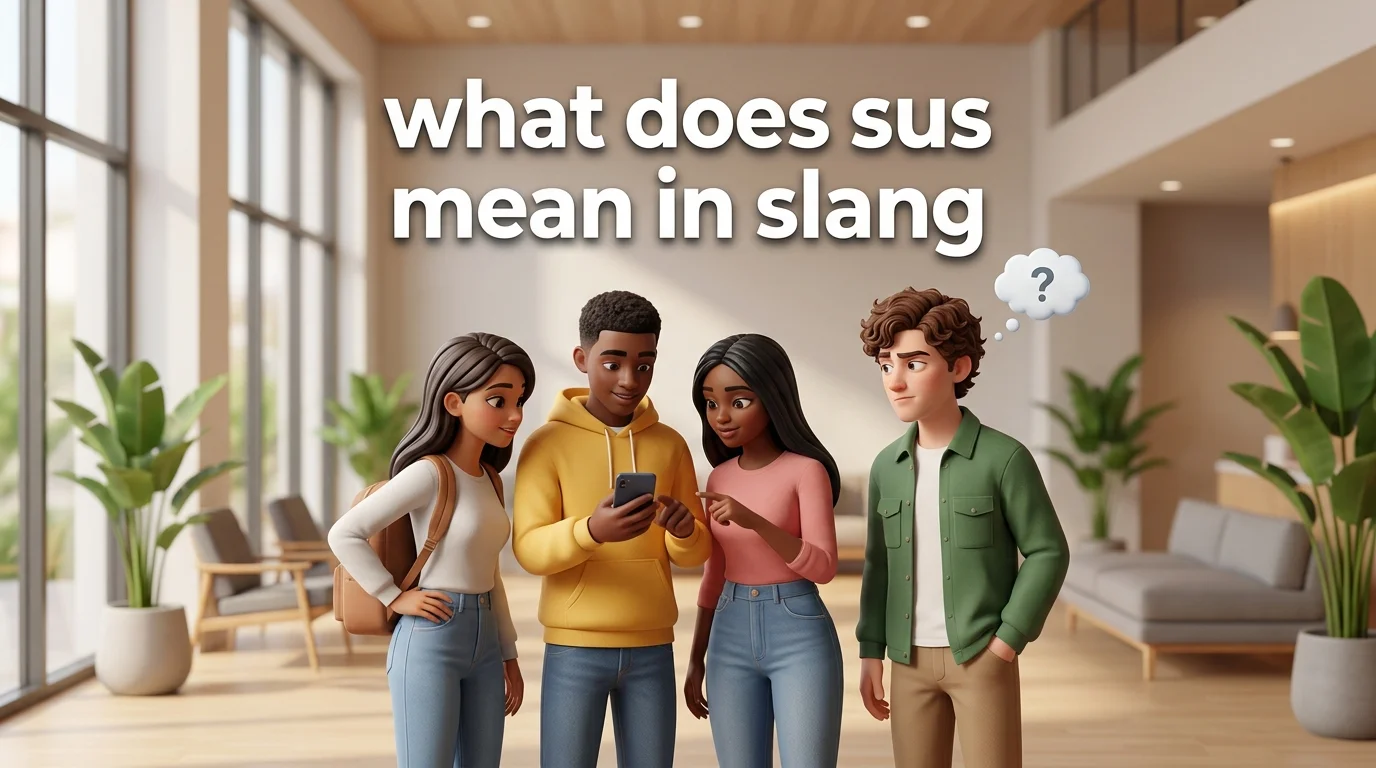
Language moves fast online. You are scrolling through TikTok, checking group chats, or reading comments on Instagram, and suddenly you see a three-letter word everywhere: sus.
If you have ever stopped scrolling and wondered what does sus mean in slang, you are certainly not alone. Millions of people search for this exact term every month to bridge the gap between traditional English and digital youth culture.
Slang acts as a cultural shorthand. Decoding it helps you stay connected, avoid awkward social blunders, and understand the subtle emotional shifts in modern conversation.
Unpacking the Hype: Why Everyone Is Searching for “Sus”
Slang used to take decades to spread across neighborhoods and regions. Today, a single viral video or online game can push a word into global usage overnight.
People search for this term because it pops up in wildly different environments. You might hear a teenager call a shady text message “sus,” or you might see a corporate coworker drop it casually in a Slack channel.
Understanding this word solves a real modern problem. It helps you decode underlying tone, detect sarcasm, and participate in online culture without feeling out of place.
What Does Sus Mean in Slang? A Quick Meaning
At its core, sus is a short, snappy abbreviation for two words: suspicious or suspect.
When someone uses this term, they are calling out something that feels off, untrustworthy, questionable, or weirdly secretive.
- Primary Definition: Feeling skeptical or doubtful about someone’s behavior, intent, or story.
- Secondary Definition: Describing a situation or physical object that appears shady or unsafe.
- Tone: Highly versatile—ranging from lighthearted joking among friends to serious accusations of dishonesty.
Examples in Everyday Language
“He said he was at the library all night, but his location was turned off. That’s super sus.”
“Don’t click that link in your email. The sender’s address looks really sus.”
“Why are you acting so sus right now? Just tell me what happened!”
Origin and Background: Where Did “Sus” Come From?
The Early Roots
Long before smartphone screens dominated our lives, the word existed in spoken dialects. Police officers and street circles in the UK, Australia, and New Zealand used “sus” as early as the mid-20th century as shorthand for a “suspect” or “suspicious activity.”
The famous British “Sus Law” in the 1970s permitted police to stop and search individuals suspected of wrongdoing. The word sat quietly in regional dialects for decades waiting for a digital rebirth.
The Social Media Shift
In the early 2010s, urban youth culture and early internet forums adopted the term. Urban Dictionary documented its rise as online users stripped away extra syllables to speed up typing on touchscreens.
Platform algorithms accelerated this transition. Twitter feeds, Reddit threads, and meme pages normalized short, impact-driven slang that fit within tight character limits.
The Among Us Explosion
No single event propelled the word into global consciousness quite like the 2020 resurgence of the multiplayer video game Among Us.
Players worked together on a virtual spaceship while hidden “impostors” sabotaged the crew. Success depended on spotting lying players during group discussions.
Typing full sentences on phone keyboards during timed voting rounds took too long. Gamers frantically typed “Red sus” or “Blue is acting sus” to cast votes.
The game became a global pandemic phenomenon. Millions of players brought the word out of gaming lobbies and straight into their daily text messages, group chats, and social media captions.
Real-Life Conversations: How “Sus” Sounds in the Wild
Scenario 1: WhatsApp Group Chat
Alex: Hey, did Jordan ever pay you back for the concert tickets last weekend?
Maya: Nope. Every time I bring it up, he conveniently remembers he has an urgent phone call to make.
Alex: Wow, that’s so sus. He’s definitely dodging you.
Scenario 2: Instagram DMs
Sam: Look at this brand offering me a free $500 gift card if I give them my bank details for “verification.”
Taylor: Do NOT click that! That account has zero posts and two followers.
Sam: Yeah, I figured. Extremely sus vibes.
Scenario 3: TikTok Comment Section
User_99: He claimed he built this entire custom car in two hours with no help at all.
GearHead_22: Bro is lying for views. The edit cuts right before the hard part.
User_99: Right? Total sus behavior, fake content for sure.
Scenario 4: Casual Texting Between Siblings
Chris: Did you take my hoodie out of my closet?
Morgan: What hoodie? I haven’t even been in your room today.
Chris: You’re wearing it right now in your latest Snapchat story…
Morgan: …Okay, you caught me.
The Emotional and Psychological Meaning Behind the Word
Expressing Intuition Without Aggression
Calling someone “suspicious” sounds heavy, formal, and accusatory. It can instantly escalate a conflict and make people defensive.
Using slang softens the blow. It allows people to express gut-level mistrust while keeping the tone conversational and low-stakes.
What It Reveals About Modern Communication
Modern communication values speed, emotional intelligence, and shared humor. Shortened terms act as emotional shorthand.
By using it, you signal that you are plugged into current cultural norms. It creates an instant micro-connection between the speaker and the listener.
A Personal Observation on Digital Trust
During a conversation with a younger colleague recently, I noticed how effortlessly they used the word to describe an unverified news article.
Instead of launching into a long debate about journal credibility, they simply said, “The sources on this look a bit sus.”
That single word communicated caution, skepticism, and analytical thinking in a split second. It shows how modern language adapts to filter out digital noise quickly.
Usage in Different Contexts
Social Media Platforms
On TikTok, Instagram, and X (formerly Twitter), the term functions as a commentary tool. Users tag videos, memes, and stories as “sus” to highlight questionable behavior or obvious cap (lies).
Friends and Relationships
Among peers, the word is often playful. Teasing a friend about a secret crush or a hidden snack involves zero actual malice.
In romantic contexts, however, it can gently raise real red flags without triggering a major confrontation right away.
Work and Professional Settings
Exercise extreme caution in professional environments.
While startup cultures and creative agencies might tolerate casual phrasing in Slack, traditional corporate offices view it as unprofessional.
Instead of telling your manager a budget proposal looks “sus,” use professional equivalents like “unverified,” “questionable,” or “requiring further review.”
When NOT to Use “Sus”
+-------------------------------------------------------------------+
|                     WHEN TO AVOID USING "SUS"                     |
+-------------------------------------------------------------------+
| 1. High-Stakes Professional Settings (Board Meetings, Interviews) |
| 2. Formal Written Correspondence (Legal Docs, Academic Papers)    |
| 3. Serious Legal or Medical Situations (Describing Suspects)      |
| 4. Cross-Cultural Talks with Non-Native English Elders            |
+-------------------------------------------------------------------+
Inappropriate Contexts
Avoid using slang during formal evaluations, legal proceedings, academic papers, or serious disciplinary meetings.
Calling an employee’s official expense report “sus” in a formal audit can sound trivial and uneducated.
Cultural and Generational Sensitivity
Older generations may misinterpret the word or find it disrespectful if used in serious discussions.
Language requires audience awareness. Tailor your vocabulary to the person receiving your message.
Common Misunderstandings and Pitfalls
Tone Confusion: Sarcasm vs. Serious Accusation
Because the term spans both comedic memes and real accusations, tone of voice and body language carry tremendous weight.
A smiling friend saying “You’re sus” is teasing you. A quiet partner saying it with a flat expression might mean a serious boundary was crossed.
Literal vs. Figurative Meaning
Not every use refers to an actual crime or malicious deceit.
Often, people use it figuratively to describe minor oddities, bizarre food combinations, or quirky personal habits.
Comparing Slang Terms
| Slang Term | Core Meaning | Intensity Level | Typical Context |
|---|---|---|---|
| Sus | Suspicious, untrustworthy, odd | Moderate | Casual text, gaming, daily social chats |
| Shady | Deceitful, unethical, dishonest | High | Serious interpersonal or financial issues |
| Fishy | Strange, causing mild doubt | Low to Moderate | Traditional spoken English, mysteries |
| Cap | A complete lie or falsehood | High | Calling out exaggerated claims online |
| Sketchy | Potentially dangerous or unsafe | High | Physical places, risky situations |
Key Insight
While terms like shady and sketchy carry heavier historical weight, sus stands out for its flexibility, allowing speakers to toggle effortlessly between playful banter and genuine caution.
10 Popular Variations and Types of “Sus”
- Sus (Classic): The standard abbreviation for suspicious or questionable behavior.
- Suss Out: A verb phrase meaning to investigate, figure out, or discover the truth about something.
- Super Sus: An intensified version used when an action raises massive red flags.
- Acting Sus: Describing someone whose current behavior departs unnaturally from their normal routine.
- Sus Vibes: Describing an uncomfortable atmosphere, venue, or general feeling rather than a person.
- Sus Link: A dangerous URL, phishing email, or malware attachment designed to steal data.
- Kinda Sus: A soft, cautious accusation used when you aren’t completely sure yet.
- Sus Account: A fake social media profile, bot account, or scammer page online.
- Sus Food: A meal that looks, smells, or tastes spoiled, unusual, or poorly prepared.
- Sus Logic: An argument or excuse that makes zero rational sense upon close inspection.
How to Respond When Someone Calls You “Sus”
Casual Replies
- “Fair enough, I can see why that looked weird!”
- “Nothing to see here, totally innocent!”
- “Haha, don’t worry, I’m clear.”
Funny Replies
- “I was in Electrical doing tasks, I swear!”
- “If I’m sus, then what does that make you?”
- “Don’t vote me out yet, give me a chance to explain!”
Mature Replies
- “If something I did bothered you, let’s talk about it directly.”
- “I realize that sounded confusing. Let me clarify what I meant.”
- “I value your trust, so tell me what’s making you uncomfortable.”
Regional, Cultural, and Generational Differences
Western Internet Culture
In North America, Europe, and Australia, the word has fully integrated into everyday informal speech across high schools, universities, and internet spaces.
Asian and Middle Eastern Digital Spaces
English-speaking youth in Asian and Middle Eastern hubs (such as Singapore, Dubai, and the Philippines) use the word extensively online, heavily influenced by global gaming streams and Western pop culture.
Generational Divide: Gen Z vs. Millennials vs. Gen X
+-------------------------------------------------------------------+
|                     GENERATIONAL USAGE BREAKDOWN                  |
+-------------------------------------------------------------------+
| Gen Z (Born 1997-2012)   | Uses it natively in speech and text.   |
| Millennials (1981-1996)  | Understands it well; uses it casually. |
| Gen X & Boomers          | Often misinterpret or rarely use it.   |
+-------------------------------------------------------------------+
Is “Sus” Safe for Kids?
Parents can breathe a sigh of relief: yes, the word is completely safe for children.
It contains no inherently vulgar, sexual, or hateful explicit content. It is simply a modern linguistic abbreviation for “suspicious.”
The only tiny caveat for parents is monitoring the context of online conversations.
If your child reports that a stranger online is acting “sus,” take that intuition seriously, as it may indicate an unsafe digital interaction or online scam.
Frequently Asked Questions
What does sus stand for in texting?
It stands directly for “suspicious” or “suspect.” It describes anyone or anything that feels untrustworthy, odd, or questionable.
Is “sus” a real word in the English dictionary?
Yes, major reference works including the Merriam-Webster and Oxford dictionaries have officially recognized “sus” as an informal slang term due to its widespread global usage.
Did the game Among Us create the word “sus”?
No, the word existed in police slang and regional dialects for decades. However, Among Us popularized the term globally in 2020.
Is calling someone “sus” offensive?
It is generally not considered offensive. It is usually treated as casual teasing or informal skepticism, though context and tone matter.
What is the difference between “sus” and “suss out”?
“Sus” is an adjective meaning suspicious. “Suss out” is a phrasal verb meaning to investigate, inspect, or discover the truth about a situation.
Can I use “sus” in business emails?
It is best to avoid it in formal business communications. Use professional alternatives like “questionable,” “unverified,” or “concerning.”
Final Thoughts on Modern Slang
Language is a living, breathing organism. It shifts, shrinks, and stretches to match the pace of human life.
Understanding terms like “sus” isn’t just about learning youth slang. It is about staying empathetic, culturally aware, and connected to the evolving ways we communicate online and offline.
The next time you spot something that raises a eyebrow, you’ll know exactly what word fits the moment. Embrace the evolution of language, use it confidently, and keep your communication clear!