Have you ever stumbled across someone dropping the phrase “Eiffel Tower” in a group chat, TikTok comment, or movie dialogue and felt a sudden wave of confusion? You are definitely not alone. While most people naturally picture the breathtaking 1,083-foot iron lattice monument illuminating the night sky in Paris, the modern internet has given this iconic term a whole secondary life.
Over the last two decades, “Eiffel Tower” has evolved from a simple geographical landmark into a widely recognized cultural symbol, a romantic metaphor, and a ubiquitous piece of urban slang. Depending on where you hear it—whether in an art history class, a pop culture comedy show, or an unfiltered group text—the meaning shifts dramatically.
Understanding these shifting contexts is key to avoiding embarrassing social missteps and decoding digital conversations. In this complete guide, we will break down every single meaning of the phrase, exploring its historic origins, modern slang definitions, emotional psychology, cultural impact, and real-world conversation examples.
What Does Eiffel Tower Mean? Understanding the Core Meanings
When someone asks what “Eiffel Tower” means, the answer depends entirely on who is speaking and where the conversation is happening. In everyday language, the phrase carries three distinct definitions spanning architecture, cultural symbolism, and explicit adult slang.
The Literal Architectural Meaning
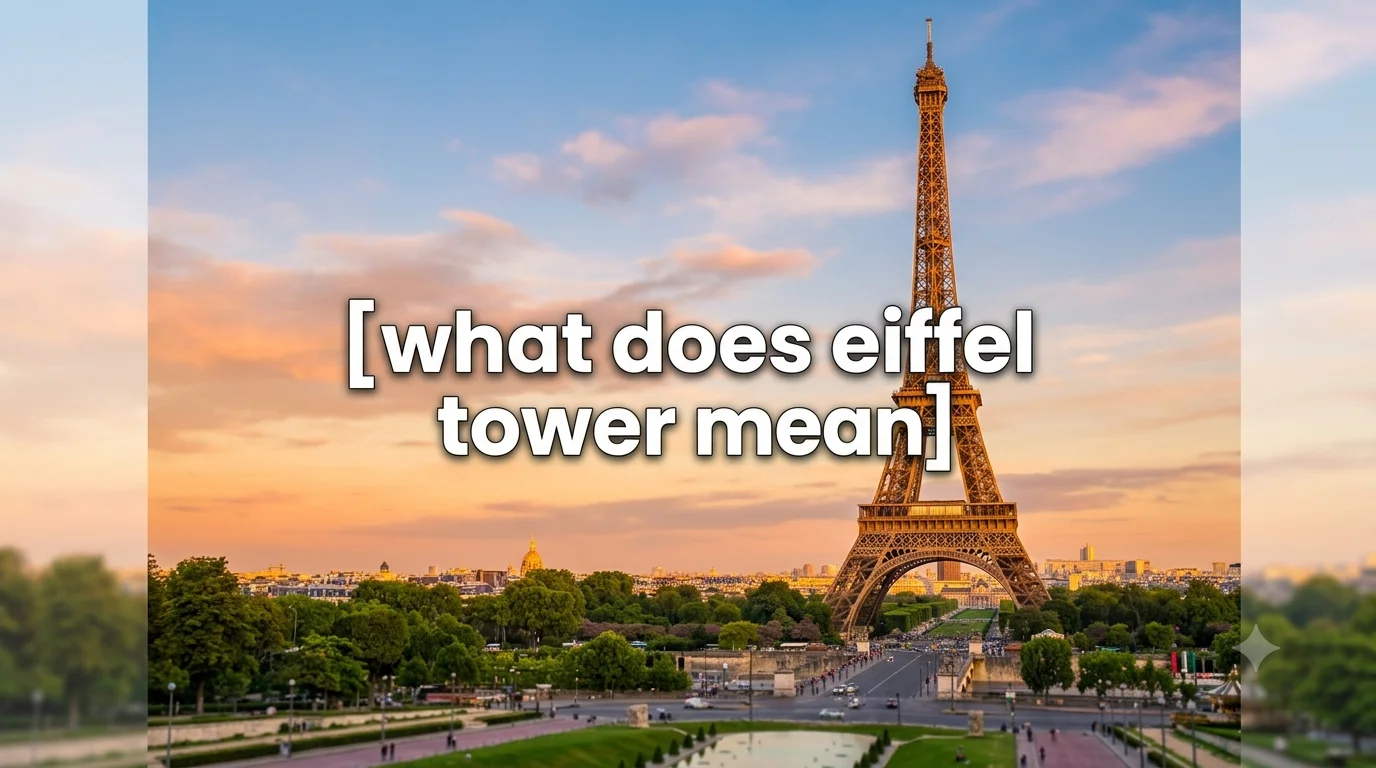
Literally speaking, the Eiffel Tower is a wrought-iron lattice tower located on the Champ de Mars in Paris, France. Named after the engineer Gustave Eiffel whose company designed and built it between 1887 and 1889, it stands as one of the most recognizable structures on Earth.
The Symbolic Meaning of Romance and Modernity
Symbolically, the phrase “Eiffel Tower” represents romance, architectural ambition, artistic elegance, and French cultural heritage. When referenced in poetry, travel blogging, or cinema, saying something is “like the Eiffel Tower” implies height, beauty, enduring strength, or romantic idealization.
The Urban Slang Definition
In adult pop culture and modern slang, “Eiffel Tower” refers to a specific sexual position or group dynamic involving three participants. In this context, two standing or kneeling partners engage in simultaneous physical acts with a middle partner while reaching over to high-five or clasp hands above. The physical shape formed by the two raised arms touching at the apex resembles the iconic triangular silhouette of the Parisian monument.
[what does eiffel tower mean] – Quick Meaning Breakdown
If you are looking for a rapid reference guide to unpack this phrase in under thirty seconds, here is how the term functions across common digital spaces:
- Literal Definition: The famous 330-meter iron monument in Paris, France.
- Symbolic Definition: A global emblem of love, passion, high art, and European travel.
- Slang Definition: A three-person sexual act (spit roast) where two partners touch hands high above the person in the middle to form an “A-frame” shape.
- Pop Culture Definition: A comedic slang phrase made famous by films, comedy podcasts, and sitcoms (such as The IT Crowd) to evoke raunchy, hyper-confident humor.
“We spent our anniversary evening right under the Eiffel Tower.”
(Context: Romantic travel reference describing the actual monument)
“Bro, did you hear what they called that wild move in the movie? An Eiffel Tower!”
(Context: Casual pop culture slang reference)
“Their relationship is like the Eiffel Tower—built on a strong framework and visible from miles away.”
(Context: Figurative relationship metaphor)
Origin & Background: How the Meaning Evolved
The Historic Parisian Origins
The story of the term begins in late 19th-century Paris. Built as the centerpiece for the 1889 World’s Fair (Exposition Universelle), the tower was originally hated by French artists and intellectuals who dubbed it a “monstrous iron giant.” However, as decades passed, the structure won over the global imagination, becoming the definitive symbol of French craftsmanship and romantic nostalgia.
The Shift into Pop Culture and Internet Slang
The transition from monument to slang began during the late 1990s and early 2000s with the rise of anonymous internet forums, college party culture, and adult humor websites like Urban Dictionary. Internet users began giving classic architectural shapes funny or provocative names based on physical geometry.
Because two people standing face-to-face with high-fiving arms create a pointed triangular arch, the visual connection to Gustave Eiffel’s tower was immediate. Hollywood comedies, stand-up routines, and viral memes accelerated this usage, cementing it into modern slang vocabulary.
Social Media Amplification
With the explosion of platforms like TikTok, Reddit, and Instagram, the phrase started circulating in jokes, reaction videos, and comment sections. Today, young adults often drop the term ironically or coyly to test whether someone else gets the crude double-entendre.
Real-Life Conversations: How It Sounds in Texting & Social Media
To truly grasp how people use this phrase today, examine these four realistic chat scenarios across different messaging platforms.
Scenario 1: Text Messages Between Friends (Misunderstanding)
- Person A: Hey, what are you and Marcus doing for your anniversary trip to Paris?
- Person B: We booked a picnic right under the Eiffel Tower at sunset!
- Person A: Omg perfect! A real dream come true haha.
Scenario 2: TikTok Comment Section (Slang Joke)
- Person A: Why are those two guys in the background high-fiving over her head like that? 😂
- Person B: Bro doesn’t know… they are literally setting up an Eiffel Tower 💀💀
- Person A: Wait what does that even mean???
- Person B: Don’t Google it at work, trust me!
Scenario 3: Instagram DMs (Flirty/Playful Tone)
- Person A: My trip to France got confirmed today!
- Person B: Jealous! Are you going to go see the Eiffel Tower or just eat croissants all day?
- Person A: Both, obviously. But mostly taking cute photos by the tower!
Scenario 4: WhatsApp Group Chat (Banter & Humor)
- Person A: Did anyone watch that crazy comedy special last night?
- Person B: Yeah! The part where he explained his college dorm stories was hilarious.
- Person A: When he shouted “Eiffel Tower!” I lost my breath laughing.
- Person B: Classic joke, but so unhinged!
Emotional & Psychological Meaning Behind the Usage
Language is inherently psychological. When someone uses the phrase “Eiffel Tower,” the underlying emotion depends on whether they are tapping into romantic idealism or cheeky, boundary-pushing humor.
The Desire for Connection and Romance
When used in romantic contexts, referencing the landmark invokes feelings of warmth, wonder, and longing. It satisfies a psychological desire for grand gestures and fairy-tale experiences. Paris has long held a psychological grip on the global imagination as the “City of Love,” making the monument a shorthand for deep affection.
The Thrill of Taboo Humor and In-Group Belonging
When used as slang, the term serves a very different psychological purpose: humor and social bonding through taboo topic references. Using slang related to adult topics allows speakers to feel edgy, mature, or part of an “in-group” that understands secret internet subculture. High-schoolers, college students, and young adults frequently use taboo slang to test boundaries and build camaraderie.
Experience Insight: A Real-World Classroom Example
During a university linguistics seminar on modern internet jargon, a student asked why people prefer visual metaphors like “Eiffel Tower” over direct physical descriptions. The room quickly realized that visual slang reduces discomfort. Using a familiar, famous landmark name turns a taboo subject into a memorable visual joke, softening the awkwardness of discussing adult topics directly.
Usage in Different Contexts
Context determines everything when it comes to ambiguous slang terms. Using this phrase without reading the room can easily lead to confusion or awkward silence.
Social Media & Online Forums
On Reddit, Twitter, or TikTok, the term is almost exclusively used in a cheeky, sarcastic, or humorous manner. Users regularly drop references to it in comment threads to elicit laugh-emoji reactions or trigger “if you know, you know” moments.
Friends & Casual Relationships
Among close friends who share similar humor, referencing the slang version is usually harmless banter. It often comes up when discussing wild party stories, watching raunchy comedy movies, or playing party games like Truth or Dare.
Professional & Work Settings
In professional, academic, or corporate environments, the phrase should only ever be used in its strict, literal geographical sense. Bringing up adult slang in workplace chats or team meetings can breach professional boundaries and cause severe HR issues.
Summary of Tone Differences
Casual / Internet:  Humorous, provocative, sarcastic, double-entendre
Travel / Lifestyle: Romantic, inspiring, picturesque, poetic
Professional:       Strictly historical, geographical, or architectural
When NOT to Use It
Because of its dual nature, there are clear boundaries around when you should withhold this phrase or use extreme care.
Inappropriate Contexts
- Formal Business Presentations: Avoid using phraseology that could accidentally sound double-sided unless discussing actual French tourism or engineering.
- Conversations with Children or Young Teens: Keep conversations clean and strictly focused on geography and history.
- Professional Emails: Stick to conventional, clear terminology.
Cultural Sensitivity and Misinterpretation
In traditional or conservative cultural settings, off-hand adult jokes can cause genuine offense. Additionally, when talking to non-native English speakers who know the tower only as a monument, using the slang meaning can create total communication confusion. Always gauge your listener’s age, background, and comfort level before using risky humor.
Common Misunderstandings
Navigating modern jargon requires separating literal facts from figurative slang. Here are the biggest misconceptions people encounter with this term.
Literal vs. Figurative Confusion
The single biggest mistake people make is assuming that every online reference to the “Eiffel Tower” is about French travel. If a meme shows two people high-fiving over someone else, it has nothing to do with Paris!
The “High-Five” Myth
Many people believe that any physical act involving three people is automatically called an “Eiffel Tower.” However, purists of urban slang point out that the high-five or hand-clasp at the top is the absolute defining feature. Without the touching hands forming the pointed arch, it is simply a standard spit-roast or threesome arrangement.
Tone Confusion
Sometimes people take slang references far too seriously. In 90% of online banter, people use the term purely as an outrageous joke or meme reference rather than an literal proposal or personal confession.
Comparison Table: “Eiffel Tower” vs. Related Expressions
To better understand where this phrase fits in the landscape of modern slang and travel metaphors, consider this comparative breakdown:
| Expression / Slang | Primary Category | Core Meaning | Tone / Vibe |
| Eiffel Tower | Landmark / Adult Slang | Famous French monument OR a 3-person position with high-fiving arms. | Playful, raunchy, or romantic. |
| Spit Roast | Adult Slang | A 3-person physical act without the high-five hand gesture. | Explicit, literal slang. |
| Devil’s Threesome | Group Dynamics Slang | A threesome involving two men and one woman. | Casual, colloquial. |
| City of Love | Travel Metaphor | A romantic nickname specifically designating Paris, France. | Romantic, elegant, inspiring. |
| High-Five Arch | General Slang | A non-sexual gesture where two people touch hands overhead to form a bridge. | Wholesome, playful, sporty. |
Key Insight
While many adult slang terms describe physical acts directly, “Eiffel Tower” stands out because it relies on architectural geometry. The comedic visual of touching hands overhead turns a complex adult scenario into a recognizable geometric silhouette.
Variations & Types of Usage
The phrase “Eiffel Tower” takes on slightly different nuances depending on the exact prefix, suffix, or modifier attached to it. Here are 9 common variations you might encounter online:
1. The Classic Eiffel Tower
The standard reference describing either the iconic Parisian landmark or the foundational adult threesome position with high-fiving hands.
2. High-Five Eiffel Tower
An explicit slang variation emphasizing the enthusiastic hand-clasp over the middle partner’s head.
3. Flipped Eiffel Tower
A variation where the partner in the center lies on their back rather than kneeling on all fours.
4. Lying Down Eiffel Tower
A modified position where all three participants lie sideways while maintaining the triangular arm structure.
5. Double-Stack Eiffel Tower
An extreme slang variation involving four participants to expand the foundational geometry of the group.
6. Eiffel Tower Emoji (🗼)
The official emoji depicting the Parisian monument, used in travel posts, romantic texts, or subtle adult double-entendres.
7. “Doing the Eiffel Tower”
A conversational verb phrase used in jokes, sitcoms, or party banter to describe executing the slang maneuver.
8. Reverse Eiffel Tower
An internet slang variation where participants face outward while maintaining the high overhead hand connection.
9. Parisian Eiffel Tower
A specific clarifying phrase used in travel blogging to emphasize that one is discussing the actual historic landmark in France rather than internet slang.
How to Respond When Someone Uses It
If someone drops this phrase in a text message, DM, or conversation, your response should match the context and your personal comfort level. Here are four ways to react:
Casual Replies (When discussing travel or memes)
- “Paris is literally at the top of my bucket list! Did you climb to the top deck?”
- “Haha I haven’t heard that joke in years, you’re wild!”
- “Classic meme, but let’s stick to normal travel talk haha.”
Funny & Witty Replies (When playing along with banter)
- “Careful, keep your hands to yourself or you’ll collapse the structure! 🗼”
- “I think I’ll stick to visiting the one in France, thanks!”
- “Sir, this is a Wendy’s.”
Mature & Direct Replies (When redirecting the conversation)
- “Haha, okay let’s pull back the adult jokes for a second.”
- “I get the joke, but let me tell you about my actual vacation plan.”
- “That’s a bit too TMI for me, let me switch topics!”
Respectful & Neutral Replies (For polite social settings)
- “Oh yes, the architectural history of Paris is truly fascinating.”
- “I am not familiar with that slang, but the monument itself is beautiful.”
Regional & Cultural Usage Differences
How this term is received varies wildly depending on geographical location, cultural values, and generational cohorts.
Western Culture (North America & Europe)
In the United States, Canada, the UK, and Western Europe, the slang definition is widely recognized among Millennials and Gen Z who grew up on internet meme culture. However, in France itself, local residents strongly view the Tour Eiffel as a monumental symbol of national pride, culture, and artistic heritage, often finding American slang derivations peculiar or crass.
Asian & Middle Eastern Cultures
In many Asian and Middle Eastern countries, English slang terms regarding adult topics are far less prevalent in mainstream communication. In these regions, “Eiffel Tower” almost exclusively signifies luxury travel, European romanticism, and iconic world architecture.
Generational Differences: Gen Z vs. Millennials
- Millennials (Born 1981–1996): Introduced to the term through 2000s comedy movies, Urban Dictionary, and early college internet humor.
- Gen Z (Born 1997–2012): Encounter the term through TikTok reaction videos, ironic memes, and secondary pop-culture references, often using it purely as absurd internet humor.
Is It Safe for Kids?
No, the slang meaning of “Eiffel Tower” is not age-appropriate for children.
While the actual Eiffel Tower is an educational, historical, and family-friendly architectural subject, parents and educators should be aware that searching the term on uncurated search engines or social media platforms can bring up explicit adult definitions.
If a child asks about the Eiffel Tower, focus the discussion entirely on geography, French culture, and engineering history. Using safe-search filters on browsers prevents accidental exposure to urban slang pages.
Frequently Asked Questions
Is the Eiffel Tower slang term offensive?
It is not inherently slurs or hate speech, but because it refers to explicit adult acts, using it in public or inappropriate settings can cause discomfort, embarrassment, or offense.
Why is it called an Eiffel Tower in slang?
The name comes directly from physical geometry. When two standing or kneeling partners reach over to high-five overhead, their bodies and touching arms form a pointed “A-frame” silhouette that resembles the Parisian landmark.
What is the difference between an Eiffel Tower and a Spit Roast?
While both involve three participants in a similar setup, an Eiffel Tower specifically requires the two outer partners to touch hands or high-five over the center partner’s head. A spit-roast does not require this hand connection.
Where did the Eiffel Tower slang phrase originate?
The slang term gained popularity in the late 1990s and early 2000s across American college campuses, online slang dictionaries like Urban Dictionary, and Hollywood comedy films.
What does the Eiffel Tower emoji (🗼) mean in text messages?
Most of the time, the emoji simply represents travel, romance, Paris, or France. However, in casual texting between young adults, it can occasionally be used as a subtle double-entendre or flirtatious joke.
Conclusion
Language is a living, evolving ecosystem. A single phrase like “Eiffel Tower” can seamlessly bridge the gap between world-class French architecture and modern internet slang. Whether you are planning a dream trip to Paris, studying engineering history, or simply trying to understand a confusing meme in your group chat, recognizing context is your greatest tool.
By understanding both the romantic grandeur of the historic monument and the raunchy humor of the urban slang term, you can navigate digital conversations with confidence, nuance, and humor. Next time the phrase pops up in your feed, you will know exactly what it means!