Have you ever opened a bag of potato chips, taken a single bite, and immediately noticed a loud, hearty crunch that felt entirely different from a standard paper-thin snack? If you checked the bag, chances are you saw the words “kettle cooked” stamped proudly across the front.
In a world filled with fast-paced manufacturing, the phrase sounds surprisingly rustic. It evokes images of cast-iron pots, slow kitchen stirring, and artisanal care. But what does kettle cooked mean when applied to modern food, and why has it become such a massive point of debate among snack lovers, foodies, and casual shoppers alike?
People search for this term because the label often commands a higher price tag, boasts a completely distinct texture, and promises a more authentic eating experience. Clearing up the confusion around kettle cooking reveals how a simple shift in culinary physics changes everything from flavor absorption to crunch longevity.
Understanding the True Meaning of Kettle Cooked
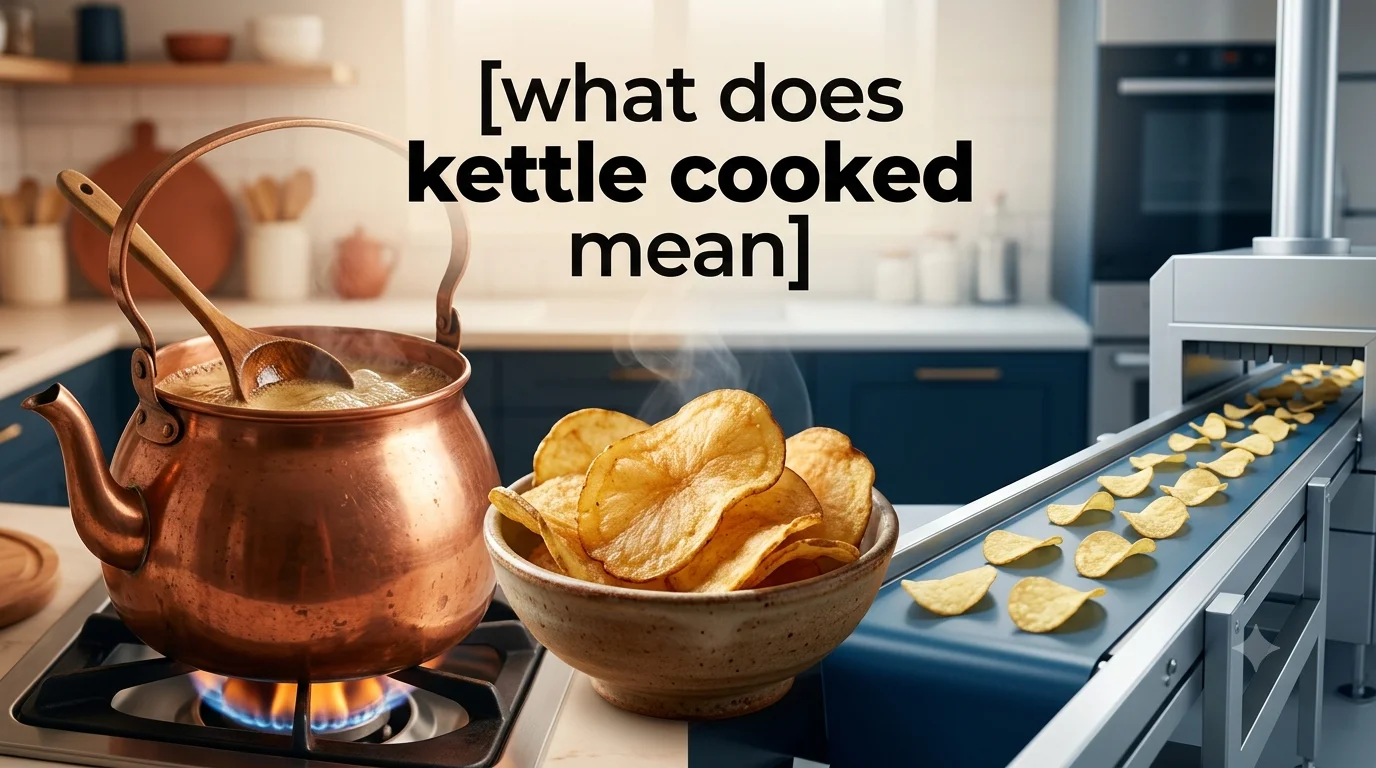
At its core, “kettle cooked” refers to a traditional batch-preparation method where raw potato slices are fried in small, individual lots inside a deep kettle rather than moving continuously through an industrial oil bath.
When you buy standard commercial chips, the production process is continuous. Potato slices travel down a conveyor belt through hot oil at a constant temperature. Kettle cooking breaks that assembly line approach completely.
- Batch Cooking: Potatoes enter the oil all at once in distinct batches.
- Temperature Fluctuation: The cold raw potatoes cause the oil temperature to drop initially, forcing the chips to cook slower.
- Thicker Slices: Potatoes used in this process are usually sliced thicker to withstand the longer fry time.
“Standard chips are built for speed; kettle-cooked chips are built for texture.”
“Kettle cooking lets the starch stay on the potato, creating an irregular, deeply golden, and satisfyingly loud bite.”
“It is the difference between mass-produced toast and a slow-baked sourdough slice.”
The Origin, Evolution, and Cultural Impact of Kettle Cooking
Before mass industrialization dominated the food industry in the mid-20th century, almost all potato chips were essentially kettle-cooked by default. Home cooks and local vendors sliced potatoes by hand and tossed them into deep pots of bubbling lard or oil.
As food technology advanced during the 1950s, continuous-fryer machines took over. These massive machines allowed factories to spit out millions of uniform, ultra-light chips per hour. While efficient, the food industry sacrificed depth of flavor and structural integrity for speed.
The Craft Revival
During the late 1970s and 1980s, smaller boutique snack brands began pushing back against uniform food processing. They brought back the old-school batch method to create a premium product.
Social media accelerated this trend over the past decade. Food creators on TikTok and Instagram frequently showcase the contrast between delicate everyday snacks and heavy-duty kettle varieties. The term evolved from a simple manufacturing description into a cultural shorthand for authenticity, artisanal quality, and premium snacking experiences.
Real-Life Conversations: How People Talk About It
Understanding language means looking at how everyday people discuss it in their digital spaces. Here are realistic exchanges showing how the term shows up across platforms.
On WhatsApp
Person A: Hey, picking up snacks for movie night! Want the regular barbecue chips or the kettle-cooked ones?
Person B: Definitely kettle-cooked! Regular ones get soggy too fast during a long movie. I need that extra crunch.
On Instagram DMs
Person A: Did you see this chef making homemade potato chips in a Dutch oven?
Person B: Yes! He kept saying “batch cooking is key.” I finally get why kettle chips taste so much punchier.
In TikTok Comments
Person A: Why are kettle chips so much harder to chew though? 😂
Person B: That’s the starch baby! They fry them slow so they fold over and get super crisp!
Via Text Message
Person A: My sandwich feels incomplete today.
Person B: Grab a bag of jalapeño kettle cooked chips. Trust me, the crunch changes the whole lunch dynamic.
The Emotional and Psychological Appeal of Kettle Snacking
Food choices carry subtle psychological weight. Choosing a kettle-cooked snack over a standard alternative touches on our desire for mindfulness, sensory gratification, and nostalgia.
The acoustic feedback of a kettle chip plays a major role in its appeal. Psychologists who study food perception note that louder sounds during mastication trick the brain into perceiving food as fresher and higher quality. That sharp, resonant snapping sound offers an immediate sensory reward that soft snacks simply cannot match.
A Quick Personal Insight
I remember sitting at a roadside diner in Maine years ago, ordering a basic turkey club sandwich. It came with a side of house-made kettle chips that were twisted, dark amber, and impossibly thick.
Taking that first bite made me realize how much flavor is lost in standard mass-production. The oil had absorbed into the thick-cut edges without making them greasy, leaving a lingering, rich potato flavor that felt honest and unhurried.
Mass Production (Continuous Fry)      vs.      Traditional Batch (Kettle Cooked)
[Constant High Heat]                           [Temperature Drops & Rises Slowly]
[Starch Washed Away]                           [Starch Retained for Extra Crunch]
[Uniform Thin Slices]                          [Thick, Folded, Irregular Slices]
How the Term is Used Across Different Contexts
While the origin belongs to culinary processing, the way we use the term extends into lifestyle, branding, and conversational metaphors.
Social Media & Food Culture
On social platforms, saying something is “kettle cooked style” often implies that a dish took extra effort, features bold textures, or skips shortcuts. It signals quality over rapid convenience.
Casual & Everyday Conversations
Friends use the term when debating snack preferences or describing a specific craving for sturdy, crunchy comfort foods that pair well with heavy dips.
Marketing and Branding
In business and professional culinary settings, the phrase serves as a certified label signifying that the product meets specific batch-processing standards rather than automated continuous frying.
When NOT to Use the Term
Language requires context, and using culinary jargon in the wrong setting can lead to minor misunderstandings or misplaced expectations.
- Soft Food Contexts: Avoid using the term to describe soft, baked goods or light puffed snacks like popcorn or cheese curls.
- Ultra-Refined Fine Dining: In high-end culinary menus, using commercial snack terminology can sound out of place unless used with intentional irony.
- Sensitive Health Discussions: Do not confuse “kettle cooked” with “healthy” or “low calorie.” While the process is traditional, it still involves deep-frying in oil.
Common Misunderstandings About Kettle Cooking
Despite its popularity, several myths surround what kettle cooking actually involves.
Myth 1: Kettle Chips Are Baked
Many consumers assume the distinct crunch means the potato was baked or air-fried. In reality, kettle chips are deep-fried in oil just like traditional chips; the thermal curve of the oil bath is simply different.
Myth 2: It Means Every Chip Was Cooked by a Person
While the batch method imitates hand-crafted cooking, large-scale modern brands still use automated machinery to load and stir the kettles. The term guarantees the method, not necessarily a human holding a wooden spoon over an open flame.
Myth 3: They Contain Less Fat
Because the oil temperature drops when raw slices enter the pot, the potatoes actually spend longer in the oil. This process creates a thicker crust, but it does not automatically make the chip lower in fat than standard varieties.
Comparing Kettle Cooked to Other Culinary Terms
| Expression | Primary Cooking Method | Resulting Texture | Primary Appeal |
| Kettle Cooked | Small batch frying, variable oil heat | Dense, hard crunch, folded shapes | Rich potato flavor, structural strength |
| Continuous Fried | High-speed conveyor belt, steady heat | Light, thin, easily shatterable | Easy snacking, consistent uniformity |
| Baked Chips | Radiant heat oven baking | Dry, crispy, flat | Lower oil content, lighter feel |
| Hand-Cut / House | Fresh potato slicing on-site | Variable crispness, deep golden hues | Freshness, rusticity |
Key Insight
Kettle cooking sacrifices absolute uniformity to gain superior structural crunch and deep potato flavor. The batch variation is not a defect; it is the entire point of the process.
10 Common Variations and Related Culinary Phrases
1. Batch Cooked
Meaning: Prepared in small, separate quantities rather than a continuous stream.
Explanation: This is the technical operational term for the kettle process.
2. Slow Fried
Meaning: Cooked over a longer duration at slightly lower initial heat.
Explanation: Describes how the oil temperature curve develops during batch entry.
3. Extra Crunch
Meaning: A texture classification for snacks requiring higher bite force.
Explanation: The direct structural result of high potato starch retention.
4. Thick Cut
Meaning: Potatoes sliced at a higher thickness setting before frying.
Explanation: Gives the slice enough integrity to survive a long kettle bath.
5. Hand Kettle
Meaning: Small-scale batch frying monitored directly by a cook.
Explanation: Common in local delis and artisanal snack boutiques.
6. Artisan Chips
Meaning: Snacks made with non-industrial methods or unique seasonings.
Explanation: A marketing term that frequently overlaps with kettle cooking.
7. Dark Roast / Deep Gold
Meaning: Chips allowed to fry slightly longer for caramelized sugar notes.
Explanation: Refers to the darker hue often seen in batch-cooked potatoes.
8. Folded Slices
Meaning: Chips that curl over on themselves during the frying process.
Explanation: A natural outcome when thick slices hit oil without conveyor constraints.
9. Kettle Style
Meaning: Products mimicking batch textures using modified continuous lines.
Explanation: Indicates a texture designed to imitate traditional kettle crunch.
10. Unwashed Starch Slices
Meaning: Potatoes fried without rinsing off surface starches first.
Explanation: The technical reason kettle chips form such a dense, hard shell.
How to Respond When Someone Mentions Kettle Chips
Whether you are discussing party groceries or texting about snacks, here is how to keep the conversation flowing naturally.
Casual Replies
- “Good choice! Those are way better for dipping anyway.”
- “Grab the sea salt flavor if they have it!”
Funny Replies
- “My teeth are ready for the battle!”
- “Are we getting chips or an acoustic sound effect show?”
Mature / Culinary Replies
- “I love how the batch frying preserves that natural potato flavor.”
- “Great pick. Regular chips turn to mush too quickly.”
Respectful Replies
- “Thanks for checking! Kettle cooked works great for me.”
- “Appreciate you asking—that crunch is hard to beat.”
Regional and Generational Variations in Usage
Western Snacking Culture
In North America and Western Europe, kettle-cooked chips are widely accessible in mainstream supermarkets. They sit alongside traditional snacks as a standard alternative for consumers seeking a heartier bite.
Asian Culinary Perspectives
In countries like Japan and South Korea, texture diversity is highly valued in snack design. The concept of “kettle cooked” is often translated as heavy-crunch or slow-fried, appealing to consumers who enjoy complex oral sensations.
Middle Eastern Contexts
Across Middle Eastern markets, batch-style chips are frequently paired with rich, thick dips like labneh or hummus, making structural integrity a top consumer priority.
Generational Divide: Gen Z vs. Millennials
- Millennials often view kettle chips through the lens of quality ingredients, nostalgia, and premium craft food culture.
- Gen Z tends to embrace the high-sensory aspect, popularizing intense crunch sounds in online food reviews and ASMR content creation.
Is the Term Safe and Appropriate for All Audiences?
Yes, the term is completely safe, family-friendly, and universally understood in food contexts. It carries no negative slang connotations or hidden double meanings.
When introducing kettle chips to very young children or elderly individuals, keep the hard, dense texture in mind. The rigid edges can be sharp or difficult to chew compared to delicate standard potato chips.
Frequently Asked Questions
What makes a chip kettle cooked?
A chip is kettle cooked when raw potato slices are fried in separate batches using a single pot or kettle. This drops the oil temperature initially, causing the potato to cook slower and absorb starch differently than standard continuous-fried chips.
Are kettle cooked chips healthier than regular chips?
Not necessarily. While they often contain simpler ingredients, kettle-cooked chips are still deep-fried in oil and contain similar levels of fat, calories, and sodium as traditional options.
Why are kettle chips so much crunchier?
The batch cooking method allows the potatoes’ natural starches to remain on the slice while cooking slower at varying temperatures, creating a dense, rigid structure rather than a light air-filled crust.
Why do kettle chips have folded shapes?
Because the potato slices are tossed into the kettle freely without conveyor belts to hold them flat, they curl and fold over each other naturally as they fry.
Do kettle chips cost more to make?
Yes, batch cooking produces fewer chips per hour compared to continuous industrial fryers, leading to slightly higher production costs that reflect in the final retail price.
Final Thoughts on the Kettle Cooked Experience
Understanding what kettle cooked means comes down to appreciating how traditional methods change everyday food experiences. It takes a simple staple—the humble potato—and transforms it through slow-batch cooking into a dense, flavor-rich snack with an iconic snap.
Next time you grab a bag, take a moment to notice those curled edges, deep golden tones, and sturdy textures. Knowing the care and mechanics behind the process makes every crunchy bite just a little more satisfying.