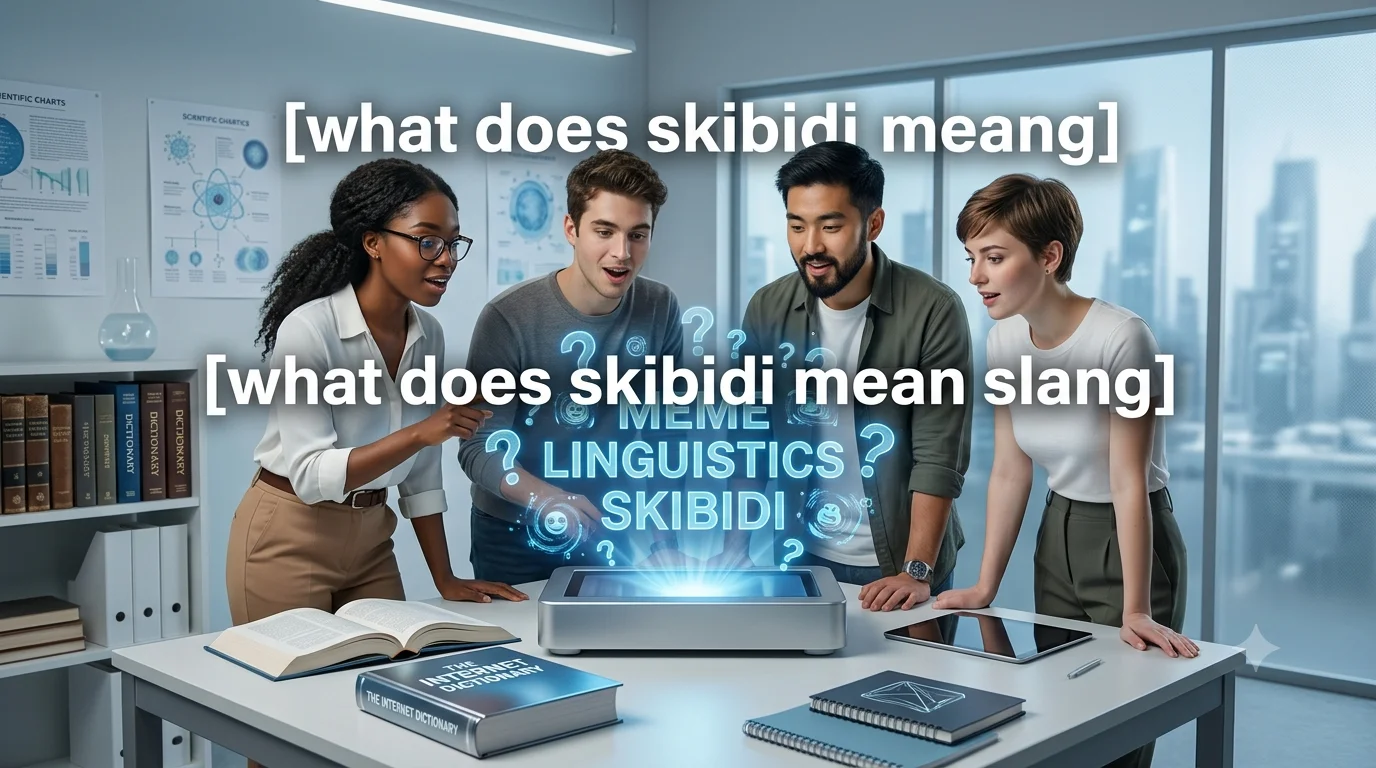
Decoding the Internet’s Most Confusing Slang Word
If you have spent five minutes on TikTok, overheard a group of middle schoolers, or tried reading your teenager’s group chat, you have likely run into one word that seems to make no sense at all: skibidi.
It shows up in conversations as an adjective, a compliment, an insult, and sometimes just a random noise. One minute someone says a pizza is “skibidi,” and the next, they are describing an awkward interaction as “un-skibidi.”
The sheer randomness leaves most adults feeling completely out of the loop. You search for its meaning because you want to bridge the communication gap, avoid looking out-of-touch, or simply understand what the younger generation is actually saying.
This guide breaks down the true origin, shifting definitions, psychological appeal, and social rules behind skibidi. By the end, you will navigate modern internet culture with confidence.
What Does Skibidi Mean in Slang?
A Word with Endless Meanings
At its core, skibidi is a flexible modifier whose meaning depends almost entirely on the tone, context, and intent of the speaker. It does not have a strict dictionary definition like traditional vocabulary words.
Instead, it acts as a cultural placeholder. Most frequently, it functions as a slang substitute for terms like “cool,” “bad,” “awesome,” or “weird.”
Quick Breakdown of Intent
- Positive usage: Signifies that something is cool, impressive, high-quality, or stylish (equivalent to “dope” or “fire”).
- Negative usage: Expresses that something is sketchy, bad, cringey, or low quality.
- Nonsense usage: Serves as a silly filler word designed to add humor, chaotic energy, or irony to a sentence.
Everyday Examples
“That new skate park is totally skibidi.” (That new skate park is really cool.)
“Why are you acting so skibidi right now?” (Why are you acting so weird or suspicious right now?)
“Bro has that skibidi rizz.” (He has undeniable charm or attraction.)
Origin & Background of the Skibidi Phenomenon
From a Catchy Song to a Viral Empire
The story of skibidi began long before it dominated middle school hallways. The phonetics trace back to musical mashups, notably featuring snippets from Little Big’s song “Skibidi” and Biser King’s track “Dom Dom Yes Yes.”
The word truly exploded into a global cultural movement in early 2023. Georgian animator Alexey Gerasimov uploaded a series of short, surreal YouTube videos featuring human heads emerging from toilet bowls, singing a chopped-up remix containing the phrase.
The Rise of “Skibidi Toilet”
This viral series, known as Skibidi Toilet, quickly became a full-blown narrative universe. Millions of kids and young teens became captivated by the absurd battle between the toilet creatures and hardware-headed rebels.
The absurd humor resonated instantly with Gen Alpha (those born roughly between 2010 and 2024). What started as an obscure animator’s project turned into billions of views across social platforms.
How the Meaning Evolved
As the videos flooded feeds globally, kids began extracting the word from the animation. It morphed from a catchy soundtrack lyric into an everyday slang term.
Over time, the explicit connection to the animated toilets faded for many users. The term transformed into a pure piece of brainrot slang—a blanket term used to express whatever mood a speaker wants to project.
Real-Life Conversations
WhatsApp Chat between School Friends
Ethan: Are you coming to the gaming session tonight?
Liam: Yeah, just finished my homework. Got that skibidi speed today.
Ethan: Nice, hop on Discord, we need one more player.
Instagram DMs
Maya: Did you see the fit Chloe wore to the party?
Sarah: Yes! Total skibidi energy, she looked amazing.
Maya: Right? I need to ask her where she bought that jacket.
TikTok Comment Section
User_99: This edit goes so hard 🔥
Creator: Appreciate it! Tried to keep it extra skibidi for you guys.
User_99: You definitely succeeded bro.
Text Message Thread
Dad: I bought those sneakers you wanted for school.
Noah: Dad, you are officially skibidi. Thank you!
Dad: I am not sure what that means, but you are welcome!
Emotional & Psychological Meaning behind the Slang
The Emotion of Absurdity and Belonging
Slang has always served a psychological purpose for youth culture: creating a private language that belongs exclusively to them. Skibidi carries a distinct emotional weight rooted in ironic humor, playfulness, and subversiveness.
Using the word allows younger speakers to express joy or silly chaos without taking themselves too seriously. It breaks the tension in social interactions through shared absurdity.
Why Young People Adopt It
Youth culture craves identity markers that set them apart from older generations. By embracing words that sound completely ridiculous to adults, kids build solidarity with their peers.
It serves as an insider passcode. If you use it naturally, you signal that you are plugged into the same digital culture, memes, and online communities.
Modern Communication Shift
The popularity of this word highlights how modern communication relies heavily on micro-cultures and fast-paced visual media. Entire language frameworks now launch from viral videos overnight.
Meaning is no longer tied to fixed definitions; it is tied to shared digital experiences and collective humor.
A Quick Real-World Scenario
Imagine walking past a basketball court where a group of 12-year-olds are playing. One kid sinks a distant three-pointer, turns to his friends, and shouts the word with a grin.
He isn’t thinking about animated toilets or linguistic structures. He is using a energetic sound bite to capture pride, hype, and humor all at once.
Usage in Different Contexts
Social Media & Digital Spaces
Online, the term is everywhere. It thrives in comment sections, livestreams, and video captions.
It is routinely paired with other trending internet terms, such as “rizz,” “sigma,” or “fanum tax,” creating complex slang stacks that confuse outsiders even further.
Friends & Casual Relationships
Among peers, the word functions as a bonding tool. Friends use it casually to compliment an outfit, joke about a bad grade, or exaggerate a story.
The tone is almost always lighthearted. It rarely carries serious hostility when spoken between friends.
Work & Professional Settings
Using this slang in a professional environment is generally a bad idea. It carries an overly juvenile connotation that can instantly undercut your credibility.
Unless you work in youth-focused media, marketing, or entertainment, keep it out of emails, client meetings, and workplace presentations.
Casual vs. Serious Tone Matrix
| Context | Tone | Acceptability Level |
|---|---|---|
| Gaming Lounge | Playful / Energetic | Extremely High |
| School Hallway | Casual / Ironic | Extremely High |
| Family Dinner | Silly / Joking | High |
| Job Interview | Formal / Professional | Zero |
When NOT to Use It
Misplaced Professionalism
Attempting to drop internet slang into formal conversations often creates cringey interactions. Saying a business proposal is “skibidi” will likely leave colleagues confused or unimpressed.
Serious or Sensitive Situations
Never use this term during emotionally heavy moments. Using slang while someone is expressing genuine grief, frustration, or pain comes across as dismissive and insensitive.
Forced Usage (The “How Do You Do, Fellow Kids?” Effect)
Overusing slang to appear trendy usually backfires. If you do not naturally speak the dialect, forcing it into every sentence feels performative and unnatural.
Respecting cultural sensitivity means recognizing that youth slang belongs to youth spaces. Adults can understand it without needing to adopt every word into their daily vocabulary.
Common Misunderstandings
Myth vs. Reality
- Myth: The word has an inherently inappropriate or dirty definition.
- Reality: The word itself is nonsensical and clean, though it originated from surreal internet humor.
- Myth: It only has one positive meaning.
- Reality: Context dictates everything; it can mean great, terrible, or weird depending on delivery.
Tone Confusion
Because the word lacks a fixed definition, tone of voice delivers the actual message. An enthusiastic tone turns it into praise, while a sarcastic tone transforms it into a subtle insult.
Misinterpreting the speaker’s vocal inflection often leads adults to believe the word is aggressive when it is simply playful.
Slang Comparison Table
| Word / Phrase | General Meaning | Similar or Opposite? | Context / Vibe |
|---|---|---|---|
| Skibidi | Cool, bad, weird, or nonsensical filler | Base Term | Chaotic internet culture |
| Rizz | Charm, charisma, seduction skill | Related Expression | Romantic or social confidence |
| Sigma | Independent, cool, lone-wolf figure | Related Expression | Ironic admiration / confidence |
| Cringe | Embarrassing, awkward, painful to watch | Opposite Meaning (usually) | Negative social reaction |
| Dope | Cool, excellent, impressive | Similar Meaning (Positive) | Classic casual praise |
| Sus | Suspicious, untrustworthy, strange | Similar Meaning (Negative) | Caution or skepticism |
Key Insight
Internet slang evolves at an unprecedented pace. Words like skibidi do not replace traditional English; they act as expressive overlays that allow subcultures to communicate emotion faster than standard vocabulary permits.
Variations and Types of Skibidi Slang
1. Skibidi Toilet
- Meaning: The original meme reference.
- Explanation: Refers directly to the surreal viral YouTube series featuring heads inside toilets.
2. Skibidi Rizz
- Meaning: Elite charm or smooth romantic attraction.
- Explanation: Combines the word with “rizz” to describe someone with effortless charisma.
3. Un-Skibidi
- Meaning: Bad, uncool, or disappointing.
- Explanation: Adding the prefix creates a quick negative modifier for bad news or bad behavior.
4. Skibidi Sigma
- Meaning: An ultimate, highly respected, cool individual.
- Explanation: Blends two dominant internet trends to create a hyper-exaggerated compliment.
5. Absolute Skibidi
- Meaning: Something truly peak, amazing, or unmatched.
- Explanation: Used to emphasize that an experience or item reached the highest quality possible.
6. Skibidi Bop
- Meaning: A rhythmic nonsense phrase or musical nod.
- Explanation: Echoes the original musical sound bites that started the trend online.
7. Low-Key Skibidi
- Meaning: Subtly cool or surprisingly good.
- Explanation: Indicates that something is surprisingly impressive without being overly flashy.
8. Mega Skibidi
- Meaning: Over-the-top, massive, or extremely intense.
- Explanation: Acts as an amplifier for dramatic stories or large events.
9. Skibidi Mode
- Meaning: Entering a state of total focus, chaos, or high energy.
- Explanation: Describes someone locking into a video game or hype moment.
How to Respond When Someone Uses It
Casual Replies
- “Fair enough, that sounds pretty wild.”
- “I guess that makes two of us then!”
- “Honestly, I can get behind that.”
Funny Replies
- “Are we talking toilet level, or just regular cool?”
- “My brainrot meter just hit maximum capacity.”
- “I am going to pretend I understood 100% of that sentence.”
Mature Replies
- “I appreciate the enthusiasm!”
- “Glad to hear things went so well for you.”
- “Let us keep the focus on the task right now.”
Respectful Replies
- “Thanks for keeping me updated on the modern vocabulary.”
- “That sounds like a great outcome, I am happy for you.”
Regional and Cultural Usage
Western Culture (US, UK, Canada, Australia)
In Western countries, the term is heavily tied to Gen Alpha gaming culture, Roblox platforms, and TikTok trends. It is used with heavy irony and self-awareness by older teens, while younger kids use it literally.
Asian Internet Culture
Across Southeast Asia and East Asia, the term entered through YouTube Shorts and gaming streams. It frequently appears in gaming chats as a general exclamation of excitement during matches.
Middle Eastern Digital Spaces
In the Middle East, youth adopt the term directly from international content creators. It functions almost exclusively as an imported English slang term within online gaming communities.
Global Internet Standard
Because the meme relies on visual humor and nonsensical lyrics, it bypassed language barriers easily. The word maintains a remarkably consistent usage across different languages worldwide.
Generational Divide: Gen Alpha vs. Gen Z vs. Millennials
[Gen Alpha]  ---> Uses it naturally, daily, and endlessly.
[Gen Z]      ---> Uses it ironically to make fun of Gen Alpha.
[Millennials]--> Searches Google to figure out what their kids are saying.
Is It Safe for Kids?
Parents can breathe a sigh of relief: the slang term itself is completely harmless. It contains no inherent profanity, explicit meaning, or hateful messaging.
It is simply the modern equivalent of legacy nonsense slang like “fo shizzle” or “groovy.”
However, parents should be aware of the original Skibidi Toilet animations on YouTube. While mostly silly, some episodes feature mildly chaotic action, loud noises, and bizarre imagery that might startle very young toddlers.
Monitoring screen time and maintaining open communication about digital trends remains the best approach.
Frequently Asked Questions
Is skibidi a real word in the English dictionary?
No, it is an informal slang word originating from viral internet culture. Standard dictionaries do not recognize it as formal English.
Is skibidi a bad word or profanity?
Not at all. The term contains no inappropriate or offensive language and is safe for general conversation among kids.
What generation uses skibidi the most?
Gen Alpha (born 2010–2024) uses it most frequently, though Gen Z often uses it ironically to joke about younger kids.
Why do kids say skibidi toilet so much?
They say it because it refers to a massively popular viral YouTube series that became a defining pop-culture phenomenon for their age group.
Can skibidi be used as a compliment?
Yes, depending on the tone of voice, saying something is “skibidi” often means it is cool, stylish, or impressive.
How do I know if someone is using it negatively?
Pay close attention to body language, facial expressions, and vocal tone. A sarcastic roll of the eyes signals a negative meaning.
Navigating Modern Slang with Confidence
Language moves fast, driven by the relentless pace of digital culture. Words like skibidi might sound absurd at first glance, but they represent a vibrant, evolving way for young people to connect, share laughs, and build community.
You do not need to start using internet slang in your everyday speech to stay connected. Simply understanding the intent behind these words bridges the gap between generations.
Next time you hear someone drop this term into a sentence, you won’t need to pull out your phone to search for an explanation. You can simply smile, read the room, and keep the conversation flowing smoothly.